
Marketplace Ministry Origins: A SOAP Study on Mark 6

If you’re a longtime follower, you know it’s been a while since my last vocational post. Thus, I figured for today we’d travel back in time to 2016 when I first started to explore Jesus’ cleansing of the temple (Luke 19:45-48). To guide our discussion, I’ll once again we taking a SOAP Bible study approach to help us synchronize revelation. 

Get ready, set…

Scripture: “When they had crossed over, they came to land at Gennesaret and moored to the shore. And when they got out of the boat, the people immediately recognized him and ran about the whole region and began to bring the sick people on their beds to wherever they heard he was. And wherever he came, in villages, cities, or countryside, they laid the sick in the marketplaces and implored him that they might touch even the fringe of his garment. And as many as touched it were made well.” 

Observations: Taking a bird’s eye view at Mark 6, we soon realize there’s much going on in this passage. While author ‘Q’ is renowned for his truncated style, this doesn’t undermine the literal and figurative ground covered in this chapter.  

After Jesus’ rejection at Nazareth, we note he is intentionally mobile starting in v. 7 where we find a Great Commission preview in the sending out of the 12 disciples. Verses later, we find a surprisingly long account of John the Baptist’s death (No offense, John, I think your 16 verses could have been cut in half and we would have been fine) followed by the feeding of the 5,000 and walking on water accounts (v. 30-52). Honestly, it’s almost like author ‘Q’ is creating this Gospel popery, an EP of Jesus’ greatest hits for future generations to share.  For most, the chapter concludes in v. 52 once Jesus has calmed the storm; however, in terms of time lapse, there’s still over half the book to go. 

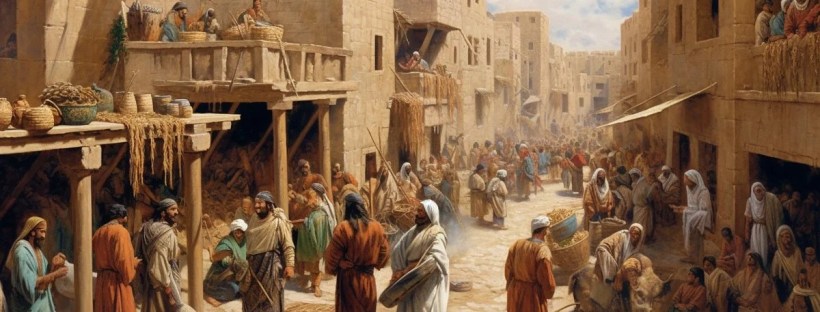
Enter v. 53, where we find Jesus passing over into Gennesaret* and setting the stage for one of the most overlooked segments in Scripture (I.e. v. 54-56). To best understand the significance of this excerpt, we must first take note of the setting. Having crossed the Sea of Galilee from Bethsaida, we find our Ocean’s 13 crew in an exhausted state, more from past pitstops than the 9.8 km sail. Upon porting, we note the crowd instantly recognized him, which may be a subtle detail to some but bears emphasis when we zoom out.

For before Jesus’ presence could be seen, it was often first felt.  

Even when oral tradition and word of mouth were the only vehicles, the awareness of Christ’s authority kept increasing. Just imagine if social media existed 2,000 years ago. Jesus would have needed 12 bodyguards in addition to the 12 disciples!  

Either way, with corporate cognizance ignited, the hustle put into rounding the sick and afflicted makes sense. After all, the Isaiah 53 prophecies were compelled to verify in light of the Messiah. No wonder there was such an initial reaction considering the anticipation was manifesting off the heels of past divinations.

Contrasting the comps of this passage, I can appreciate the conclusion in Matthew’s account: 

…and implored him that they might only touch the fringe of his garment. And as many as touched it were made well.” (v. 36

A safe and sound finale, it’s no surprise author ‘Q’ takes a similar approach lacing the climax and resolution with one swoop; however, while he maintains the same canon, we’re gifted a slight wrinkle in v. 56. See if you can find it…

“...And wherever he came, in villages, cities, or countryside, they laid the sick in the marketplaces and implored him that they might touch even the fringe of his garment. And as many as touched it were made well.” 

Pause. Did you catch that? Where did they lay the sick again? The marketplace, you say?

Indeed, from city to country, the social fulcrum was corporate Israel! 

Ya’ll, that is crazy and completely mind-boggling. Just think if that were to happen today, how much culture shock this would cause on social and vocational levels. As much as the church would be expected to help in these situations, would it yield some responsibilities to non-religious epicenters?

While the answer there is a blog for another day, when we consider the ending of Mark 6, we must understand the temple and outer peripheries where marketplace extended were social hotspots. In fact, if you analyze the places Jesus roamed during His ministry, the temple/marketplace tandem topped the chart! As we transition into potential applications, one must wonder what today’s “marketplace” looks like…

Application: Outside the sanctuary, where would Jesus be hanging out if he came back today? Bars, clubs, cafes, and transport hubs come to mind. Per your comment adds below, I’m sure there are many others. Regardless, I can’t help but marvel knowing the workplace was at one point in history the nerve center for where Jesus did ‘business’. Put another way…

The brunt of Jesus’ labor occurred not in the synagogue, but in the highest concentrations of people and their transactions.  

This speaks to me on several fronts. For starters, the modern tendency is to endure work, be it a basic necessity or worse, a necessary evil, on route to finding Jesus anywhere else. We may reference Christ a few times throughout the day, mostly internal. But for the most part, we’re pressing through the office part of our day to get to the good stuff.

However, in Jesus’ time, the black and white lines of today didn’t apply as He constantly referenced the Father within His itinerary. In past posts, I’ve talked about the intentionality of Christ and how it manifests administratively, to planning, leadership development, and time management among other criteria. Interestingly, when you layer Mark 6 with Matthew 14 and Luke 9, we find the Spirit-yielding logistics of Jesus’ mission as the backbone of His greatest works. As much as we tout the miraculously, we must also acknowledge the leadership of His lordship from delegation to per diem.

Secondly, Jesus never advised His disciples outside of what He’d already established as best practice. Whatever He asked the disciples to do, He had already done and was doing alongside them. Could one argue Jesus was the great middle-manager in history? Absolutely. However, unlike some we may know in real life, Jesus did not direct apart from His directive. To that which Jesus was on mission, so were His disciples on co-mission. And the encouragement for us is two-fold:  

  1. Just as Jesus established the marketplace as a place of freedom where teachings and miracles occurred, so, too, did He empower His disciples to do the same in rural areas. 
  2. Just as Jesus intended the marketplace to serve as an apostolic arm, so, too, must we embrace this corporate call in current times.  

Granted, I understand how thousands of years have made certain external factors a case of apples and oranges. Still, I can only imagine what could happen if more marketplace ministers today served as compassionate conduits of Christ’s desire to heal, as ambassadors reconciling others through the ministry of prayer and availability! Whatever changes in our midst starts from within and I implore you, my friends, to not segregate the sacred from secular at work but live your faith transparently. Do not literally hide God’s Word in your heart in so masking the evidence of sanctification. Rather, love on purpose so others may find your company as an extension of safety to where requests are exchanged and prayer has more runway.

I’m telling you, even a few mindful tweaks can have deep, far-reaching impact. Follow the Gospel model set forth by Jesus and His Spirit will awaken you as you yield and abide. 

Prayer:

Footnotes

*The name Gennesaret is associated with the area mentioned in two NT references (Matthew 14:22; Mark 6:45). After feeding the 5,000, Jesus’ disciples crossed over the Sea of Galilee to Bethsaida (6:45), then crossed back again (6:53) and came to land at Gennesaret. Sometimes, however, the name is not restricted to the district, for Luke speaks of the lake of Gennesaret (Luke 5:1), referring to the Sea of Galilee 

Graphic creds: Tenor

Sovereignty in Suffering: Why God Heals and Sometimes Doesn’t

Why does God heal some people and not others?

I’m combing through the archives, realizing I haven’t touched this question yet, at least head on. And I suppose part of my hesitancy is due to many answers rightfully citing God’s sovereignty, but in a borderline cringe-worthy way, if that makes sense, when you know the answer is correct but by incomplete, even insensitive means.

To those who have lost loved ones, the world not only needs to know the answer but how you specifically arrived there. As a former math undergrad, I can’t help but want to show my work. Even if I’m slightly off, a transparent step-by-step can be revealing for the better.

Without further ado, let’s dive in…

As teased above, the general issue I have in tackling this topic is the popular phrasing of the question, ‘Why God allows suffering…or bad things to happen’. A simple Google search is testament to many people not wanting the accountability that comes with free will as those loved by God yet born into sin. Before we can break down God’s sovereignty into what God allows versus doesn’t allow, one must know who God is.

For the purposes of this post, we’re going to establish God as more than enough, as the Rock whose work is perfect and ways are just – a “God of faithfulness and without iniquity” (Deuteronomy 32:4) whose steadfast love and faithfulness goes before Him (Psalm 89:14).

As such, if we want to believe in God, then we must accept absolute good as only possible through perfect love (I.e. The Trinity) which God not only possesses but fully embodies. Conversely, we must accept this reality isn’t possible within our self-centered bias and without a reliance on a higher authority. In essence, if we want to broach this question, we must assess our relationship to the supreme governance we’re taking into question. Remember relativism in a vacuum isn’t the problem; it’s the fact many have inverted relativism and absolutism with self being the standard setter, in turn, replacing faith with entitlement. Give me someone who doesn’t under the existence of suffering and I’ll show you one who doesn’t understand faith, hope, the divine and our relationship to it, etc.

But enough of the theological and philosophical mumbo-jumbo. I know most of you reading this understand all this. I’m just sayin’ if we want to address this inquiry, we must start with who God is…every time. Even if our inventory is nothing more than a refresher, the infinite layers of God’s greatness are worth pondering.

Back to the initial question: Why does God show His hand and seems to withhold it in some situations?

While there is truly an element of mystery within our quest to understand, the short and skinny is in Scripture. If we fuse a string from Paul’s letters, we find the God who works all things AND holds them together, intends all things for our good. Why should a man not complain about the consequences of sin? Why does God not always intervene to quench chaos, crisis, and calamity? That answer is in one word…His Word!

The way I think of it: The Creator of all things is always creating ways for people to find Him which includes the testimony of those who cling to Jesus. As for walking on the paths God sets, this requires responsibility and full reliance. Without them, one cannot find God within the grand scheme unfolding, let alone how He can redeem the effects of fallenness for His glory.

For Lys and I, while we’re decent people whose hearts are often in the right place, at the end of the day, we aren’t detached from the ultimate consequence of sin, which is death. Still…

  • By way of the Cross, we know our eternal home, security, and perspective regarding our freedom.
  • By way of restoration, we know healing and recovery.
  • By way of sanctification, we know suffering has a place as we discover God and mature into His likeness.

Accordingly, we believe the same God who gave us free will to choose Him is the same God who elects to choose how His power will manifest, even if the display isn’t synonymous with our initial expectation. Now, I know this statement can be frustrating for some. It’s certainly not my heart to dilute this discussion into a binary equation.

That said, the truth always bears repeating:

Just as God is infinite, so are the ways His power and grace can evince within His sovereignty.

Since God is perpetual love which covers everything from His omniscience to our purpose, we have every reason to trust that His perfect will…will…be done, not only when we’re tested, but especially so.

Put another way, God being mighty to save does not imply He will always save in accordance with our immediate best interest. Rather, the attribute speaks to God’s relentless pursuit of our hearts as One who saved and still saves today. At any given point, God is sowing within the tapestry of where our responsibility (to pray, abide, trust, etc.) and His sovereignty collide. And while it’s human to crave the majestic aspect here wonder working power is imminent, the origin is first and foremost internal. In this way, whether God allows an external match or withholds it, the result can go beyond us into tomorrow, the next and next door, and so forth.

In closing, I lift a victorious fist. Glory to God the road isn’t smooth sailing and compels us to come together amidst our discomfort. Glory to God the Scriptures can come alive as we depend on the Father the same Jesus modeled for us. And glory to God hope and compassion can spring to the forefront as we demonstrate truth to a decaying world.

Remember the earth is God’s footstool and it comes with daily prompts to look up and know He’s in control even our lives seem out of it.

‘Tis why we often say you got this and keep going. Even when the days are dark, He’ll keep the light on one way or another.

#Selah #noregrets …

Graphic creds: Desiring God

Like David: Receiving Your ‘After God’s Heart’ Identity (Intro)

This won’t be a long post today. Just a little preview of a new series to come. At the very least, some foundation laying…

In recent years, I’ve referenced our ‘loved by God’ identity as the base of knowing who we are; however, as recent conviction has reminded me, there are other layers we must consider, other tiers we must not mistake as optional.

One of them, as I’ll unpack in future blogs, is our ‘man after God’s own heart’ identity (1 Samuel 13:14; Acts 13:22), which for the record is not synonymous with our ‘new creation’ identity though it is close. While a breakdown will be forthcoming, in short, a new creation identity acknowledges the justification by way of the Cross (one time redemption) while a ‘man after God’s own heart identity’ abides in the sanctification of the Cross (ongoing renewal day-by-day).

This in mind, I think for many of us, there are inhibitors keeping us from fully embracing a King David-like heart. Guilt and cynicism are some of mine but to you, the struggle may look different. Whatever the case, I can’t help but wonder why receiving and walking in an ‘after God’s own heart’ identity is harder than its ‘loved by God’ counterpart.

Perhaps we feel like a man after God’s own heart is contingent upon works, consistency, and the absence of strongholds. Perhaps we’ve made it a conditional label based on our perceived strength of spiritual health. Perhaps we just have to feel good about how we’re doing to fully embrace the call of following Jesus.

Again, while this share is more of a breadcrumb than anything, I want to submit we take inventory of:

  • Any place God may be resource, not source (shout out to my dad, Steve Fry, below).
  • What is keeping us from yielding to Jesus in times of temptation and/or when we sense our need for fulfillment is greater than adhering to righteousness.
  • What is keeping us from receiving the totality of God’s grace and mercy.
  • What is keeping us from going and sinning no more.

Bottom line: I believe many of us are trying to find something that isn’t lost, something we already have! The charge, then, is not to lament what seems absent but return to Jesus. Whether you’re concerned about the ceiling of your potential and/or discouraged about who you used to be, surrender the pride, confess your heart, and know the likeness of God is enough in the context of repentance and fullness. Don’t turn your redemption into a legalistic narrative. Like David, ask the Lord to remove the stain but leave the scar (More on this later on as I’ve been fascinated by this dichotomy in recent days).

From there, get back on your feet, run the race, and don’t look back.

Selah.

Graphic creds: Wingman Nation

Mourning Glory: Hoping in the Midst of Grief (Part 3)

For the first time in this series’ history, I’m writing a post to compliment parts 1 and 2 linked above. After encountering a revelation deluge during a sultry late summer run last weekend, I figured integrating these points into this episode made sense.

If you’re checking in for the first time, our goal with ‘Mourning Glory’ is to learn what the Bible says about grief and how to channel mourning into giving God all the glory. In many ways, these posts capture the journey Lys and I have been on this year. We hope these truths minister to your heart regardless of your circumstances.

1) Finding grief in the account of the 12 spies (Numbers 13)

Whether or not we realize it, there’s a piece of us internally during seasons of healing, recovery, and intense grieving looking to scout and assess where we are. Since we almost always need something to anticipate, our idea of ‘Promised Land’ generally becomes the ultimate source of hope (on earth edition). The million-dollar question is: What is our ‘Promised Land’ and how are we getting there?

To answer this question, we have to know what constitutes the giants in our life – what constitutes the Nephilim, and God’s role in the entire operation. For most, we’ve misappropriated our grief within the analogy. We think the giant in the room is the heartbreak, depression, whatever is causing us pain/hurt, etc. However, I submit…

Your pain isn’t the giant in the room. Perhaps an elephant but not a giant. The giant in the room is any toleration or stronghold that keeps us from pressing through…by faith anything that keeps us stagnant as we walk through hell and/or keeps us from wrestling with God the way Jacob did with the man in Genesis 32

Put another way, the giants in our lives are tolerated strongholds/sins and negative behavior patterns we use as coping mechanisms and bartering tools to maintain any sense of satisfaction. Tangentially, wrestling with God is how we conquer them and should not be considered optional in our journey to the Promised Land.

Speaking of Promised Land, what is it in the grand scheme of grieving, mourning, and journeying through pain/suffering? I think for most, we assume this represents a graduation, the proof of having healed and moved on. The problem is: If we abide by this perspective, then we limit victory as only realized once we’ve crossed a ‘finish line’, even if it’s one we can’t define it.

If we’re to correct from this mindset, we have to adjust the past vs. participle dichotomy within our thinking. For instance, while many view breakthrough as a binary function (I.e. you’re healed or not healed, moved on or haven’t moved on), the truth is

We’ve already been set free and as such, can discover our new creation identity on top of our ‘loved by God’ identity day by day.

While the Word says we’ve been purchased at a price, this doesn’t mean we’re going to hit a point in this life when we’re officially complete. In the context of fullness, we’re never going to be complete. We’re never going to be perfect; however, we can still pursue it as being perfected (Matthew 5:48).

Why does this matter? Because we can live and heal without the burden of feeling far from an end goal when the goal is Jesus and He’s never far away!

God is everything and as such, can’t be detached from the Promised Land we’re seeking. Accordingly, don’t forsake or undermine His oasis presence as you journey but receive Who is He as what sustains you and maintains momentum. Walking with us through the valleys and shadows of life implies motion; however, we can’t self-effort that motion (and e-motion for that matter) in a way that leads to where we want to go. This is one of the main reasons why it took the Israelites 40 years to journey through the wilderness.

The Promised Land is multi-dimensional. Although you can experience a part of it through Christ alone, you may still feel far from victory, or should I say the evidence of victory (I.e. being around a group of people that have historically misunderstood you, being in the same space where at one point you experienced trauma in some capacity). Certainly, we can’t embrace strength and courage without abiding by the Spirit and trusting in God’s sovereignty.

For now, I encourage you not to make certain people and circumstances the enemy, as the giants in the room. They are not worth the negative empowerment at the cost of your distrust. Rather, if you want to view your grief as a race, bring God into every leg of it. If it’s a journey, bring Him along as if He’s in your backpack, fanny pack, whatever. The joy in walking with Jesus is you’re being changed, perfected, and nurtured day-by-day. God isn’t just at the finish line waiting for you. He’s with you through the grieving/mourning process ready to share fresh facets of His nature you couldn’t have known had you not gone through the pain, hardship, etc. Hence, why we should see suffering as a gift more than anything else. 

2) Finding grief in the account of Jacob’s wrestling with God (Genesis 32)

In this chapter, Jacob is looking for favor in the heat of stress and anxiety. Not only does he feel the betrayal from Laban, but the wrath from Esau, caught up in a bizarre series of deceptions with his life on the line. Like the griever, he’s desperate for assurance and blessing, the realization of comfort and God being for him, not against him. This sets the stage for the wrestling with ‘the man’ (v. 24 ), a beautiful picture of how we should cling to Jesus when we’re suffering and in some cases, grieving on the backend of loss.

Think about it: Jacob had everything to gain tackling His Lord. The cost set before him, he was determined to be take hold of his inheritance relative to his identity despite a side effect in the most literal sense. And it’s here where my imagination has been captured of late.

In the heat of the moment, despite his mourning and discomfort, Jacob never let go…not only to the glory of God but for the sake of never walking the same way again.

As Jacob portrays, wrestling with God is an intimate experience. While it can be uncomfortable, the reality of pain being a gift can triumph through rest knowing we have a default way to react when something goes wrong. I’m telling you, my friends, this is the power and significance of the limp and why we should embrace it as we journey in unity, contend in hope, and help others in need.

Just as we limp when a bone is out of joint to protect us from further damage, we limp when we lose a beloved person and/or experience a significant life change. While limps come in various shapes, sizes, and severities, when we grieve the right way, our inner man is declaring ‘I need Jesus’/’I need my brokenness aligned amidst a broken world‘ . Conversely, when we grieve the wrong way, we declare the injustice is with God Himself and/or the specific people and strongholds involved in the situation that may be fueling the grief.

Therefore, we can take joy when we consider our grief/mourning in the construct of Genesis 32 knowing pain can help us not only reach for Jesus, but see Him reflected in what we’re going through, our limp an always present reality keeping us humble and hopeful along the way. 

In closing, I charge you, brothers and sisters, to grieve in hope (1 Thessalonians 4:13) knowing…

And even if you feel you can’t, that’s okay. For in your weakness, He is strong and in your vulnerability shine all the more brightly through saints and providence alike. While more content on this topic will eventually follow, for now, as I always say in bidding adieu…

Selah.

Cover photo creds: Bing Wallpapers HD