When Faith Gets Put on Trial

There is something I have been noticing. It tends to surface after the prayers have been prayed, faith has been exercised, people have contended—and the ending still isn’t the one everyone asked for.

Eventually, someone starts looking for the variable. Maybe there wasn’t enough faith. Maybe doubt got in the way. Maybe someone didn’t believe hard enough.

I have heard enough variations of that idea to think it is worth naming. Somewhere along the way, some corners of the Church created an equation Scripture itself never gave us:

Desired outcome = sufficient faith.
Undesired outcome = insufficient faith.

To be fair, the equation did not appear from nowhere. Jesus tells us to believe when we pray. James warns about asking while doubting. Hebrews tells us that without faith it is impossible to please God. The Gospels even contain moments when Jesus directly confronts unbelief. Those passages matter. Faith matters. Unbelief matters.

I believe God hears us when we pray. I believe He draws near. I believe He heals, restores, delivers and intervenes. I believe we should ask boldly, contend earnestly and invite God to expose unbelief wherever it has taken root in us. But Scripture does not permit us to turn those truths into a formula.

There is a garden just outside Jerusalem where that formula falls apart.

The Cup Didn’t Pass

Jesus entered Gethsemane in anguish and prayed, “Father, if you are willing, remove this cup from me.”

Then He prayed again. And again. Luke tells us that His anguish intensified and that He prayed even more earnestly.

The cup did not pass.

Was the problem Jesus’ faith? Of course not. Jesus’ faith was perfect. And somehow, perfect faith looked like weakness that night. It looked like anguish, persistence, dependence and surrender:

“Nevertheless, not my will, but yours, be done.”

The unanswered request was not evidence of deficient faith. His persistence was faith. His surrender was faith. His trust in the Father while standing inside unbearable anguish was faith. That distinction matters.

Sometimes we treat surrender as the fine print beneath believing prayer—as though “Your will be done” is what we say when we are afraid to expect too much. Gethsemane suggests something very different.

Surrender itself is an expression of faith.

Prayer is worship because prayer acknowledges something fundamental: God is God, and I am not. He invites our participation. He teaches us, encourages us and empowers us. He tells us to ask. But partnership is not parity. God did not surrender His sovereignty when He invited us to pray.

When Faith Becomes About Us

This is where an inflated theology of faith can subtly shift the center of gravity. Faith stops being trust in God and begins becoming confidence in our ability to produce an outcome: my faith, my declaration, my certainty, my ability to receive.

Eventually, God begins looking less like Father and more like a mechanism: apply sufficient belief and receive the requested result.

But faith is not currency. God is not a genie. Grace is not wages for believing correctly.

Paul learned this when he repeatedly asked God to remove his thorn. The thorn remained. Christ answered, “My grace is sufficient for you, for my power is made perfect in weakness.” Apparently grace can be sufficient even when the thorn remains.

Romans 8 tells us something similar. The Spirit helps us in our weakness, even when we do not know how to pray as we ought. Notice where grace enters the story—not after we overcome helplessness, but inside it.

Even the desperate father who cried, “I believe; help my unbelief!” discovered that Jesus was willing to meet a man whose faith and doubt somehow occupied the same sentence. Helplessness is not a disqualification from grace.

That should make us extraordinarily careful about placing additional weight on people who are already suffering. There is enough vulnerability in asking God for something we cannot fix ourselves. When the answer does not resemble what was prayed for, the Church should be very cautious before adding an indictment to the grief.

Same Faith. Different Outcomes.

Hebrews 11 makes that caution unavoidable. Some people, through faith, conquered kingdoms, escaped the sword and received back their dead. Others, through faith, were imprisoned, tortured, afflicted and killed.

Scripture commends them all. Same faith. Different endings.

Faith was never intended to function as a mechanism through which we control God. It is trust in God.

That is why the words of the three Hebrew exiles in Daniel remain so powerful. They believed God was able to deliver them from the furnace. And then came the words that kept faith from becoming entitlement:

“But if not…”

God is able. But if not, He is still God.

That is not unbelief. Sometimes it is one of the bravest expressions of faith available to us.

Don’t Put Their Faith on Trial

So ask. Believe. Contend. Keep praying when the answer has not come. Ask God to expose unbelief and deepen your trust. Believe that He can intervene in ways only He can.

But when someone else’s cup does not pass, resist the temptation to put their faith on trial.

Sometimes grace removes the thorn. Sometimes grace becomes sufficient while it remains. Sometimes what God is doing becomes clearer years later. And some answers may require eternity.

Romans 8 does not promise that we will understand everything that happens to us. It promises something larger: that God is at work even while creation groans.

Our faith is ultimately in the Lord—not our ability to secure the outcome we prayed for.

God is able. And even if not, He is still God.

Gethsemane led to a cross. And for a little while, the cross looked like the end of the story.

It wasn’t.

Halftime: Reflections on 2026 and the Road Ahead

Halftime thoughts.

Every year around the year’s midpoint, I find myself pausing long enough to evaluate where God has brought me and where He’s still leading me.

The first half of the year—especially these past three months—has been marked by much-needed growth, course correction, new opportunities, and genuine healing. Not the kind of healing that arrives overnight, but the kind you only recognize when you look over your shoulder and realize the arrow is finally pointing upward again. I’m grateful for that.

Much of this progress has come through a combination of what God has been asking me to lay down and what He has been faithfully replacing it with. As Paul reminds us, God’s grace is made perfect in weakness, not because weakness is desirable, but because it becomes the stage upon which His strength is displayed (2 Corinthians 12:9-10).

That doesn’t mean grief has disappeared.

In many ways, I still consider “the griever” because I am one. I remain a recovering bereaved parent learning how to faithfully navigate a world that often doesn’t know how to care for those carrying profound loss. Scripture tells us to “weep with those who weep” (Romans 12:15), yet many people simply have never learned what that looks like in practice. They don’t intentionally neglect grieving people; they’re simply unequipped to enter pain they have never personally experienced.

For a grieving person, being understood carries tremendous emotional and relational value. As months and years pass, silence can begin to feel like abandonment. Invitations become fewer. Conversations become shorter. Friends move on with life while your world still feels permanently altered. Somewhere in the recesses of our minds, we begin wondering whether the relationship was ever as strong as we believed. Sometimes that conclusion is accurate. More often, it is simply the grief interpreting silence through wounded eyes.

One of the greatest lessons God has been teaching me is that misunderstanding does not automatically equal malice. Sometimes people aren’t withdrawing because they’ve stopped caring. They withdraw because they don’t know how to care. They fear saying the wrong thing, so they say nothing at all. Ironically, that silence often becomes the very thing that wounds us most.

Looking back, I believe one of the deepest forms of forgiveness is releasing people from the offense of misunderstanding you. Some of the harshest words ever spoken to me occurred during seasons when my autistic mind couldn’t fully process my own weakness while simultaneously navigating profound grief. There were moments when neither side truly understood the other. My pain was misunderstood, and their limitations were equally misunderstood by me.

The reality is that ignorance is unavoidable. If we’re living life together—raising families, serving in churches, investing in friendships—we’re all going to have moments of poor execution. We’ll say the wrong thing. We’ll say nothing. We’ll miss opportunities to show up. None of us perfectly reflects the compassion of Christ every single day. That’s why Paul exhorts believers to “bear with one another and forgive one another if any of you has a grievance against someone. Forgive as the Lord forgave you” (Colossians 3:13).

I’ve come to believe that grief matures our understanding of care faster than almost anything else. By the time someone has walked through profound suffering, they’ve learned that presence often matters more than words, consistency matters more than grand gestures, and quiet companionship often ministers more deeply than carefully crafted advice. Our expectations of others naturally rise because our own understanding of compassion has deepened.

But this is where humility must temper wisdom.

Most people haven’t walked through the valleys we’ve walked through. Their capacity to care exists within the boundaries of their own experiences. They aren’t necessarily uncaring; they’re simply still growing. Just as we hope others will extend grace toward grief they cannot fully comprehend, grieving people must also extend grace toward those who are still maturing in their understanding of compassion.

That realization has changed how I read 2 Corinthians 1:3-4. Paul describes God as “the Father of compassion and the God of all comfort, who comforts us in all our troubles, so that we can comfort those in any trouble.” The comfort God gives us isn’t intended to terminate with us. It becomes the pattern through which we learn to comfort others. Sometimes that also means remembering that not everyone has yet received the same lessons suffering has taught us.

At the same time, grief cannot become an entitlement card. It cannot become permission to remain bitter toward a world that no longer understands us. Nor can it become an excuse to avoid relationships and settings simply because awkward conversations might happen. Bitterness feels protective, but it slowly becomes another prison. Scripture repeatedly calls us toward forgiveness, not because every offense is small, but because Christ has forgiven infinitely greater debts within us (Matthew 18:21-22; Ephesians 4:32).

Some people genuinely have abandoned you. Others have failed you. Some will never apologize. Some may never even recognize the hurt they caused. Those realities are painful, but they are not outside God’s ability to redeem. “The Lord is near to the brokenhearted and saves those who are crushed in spirit” (Psalm 34:18). He sees every lonely moment that no one else noticed.

So let God deal with the abandoner and embrace the call to pray for them.

Release the hurt you’ve carried through the valleys and shadows. Don’t allow grief to collect resentment until bitterness disguises itself as conviction. That burden was never yours to carry forever.

If you’re faithfully pressing into Christ day after day, He will gradually give you the strength to surrender every source of hurt into His hands. Forgiveness rarely begins with strength; it begins with surrender. We forgive because we’ve first been forgiven. We extend grace because we’ve first received grace. And we continue moving forward because nothing—not grief, misunderstanding, abandonment, nor even death itself—can separate us from the love of God that is in Christ Jesus our Lord (Romans 8:38-39).

Perhaps that is one of healing’s greatest milestones. Not when grief disappears, because it won’t this side of eternity, but when forgiveness quietly becomes greater than offense, hope becomes stronger than despair, and the arrow—by the grace of God—continues pointing upward.

Cover graphic creds: ChatGPT

Even From Far Away, God Still Speaks: A SOAP Study on Jeremiah 31:1-9

There are seasons where God feels close enough to touch…and seasons where He feels far away.

Yet Jeremiah 31 reminds us of something beautiful: “The LORD appeared to him from far away.”

Even from a distance, God still spoke love. Even through wilderness and grief, His faithfulness remained.

Sometimes we expect God’s presence to look like immediate rescue, instant healing, or emotional certainty. But there are moments when He meets us from what feels like “far away”—not because He has abandoned us, but because He is teaching us that His love is deeper than our current feelings.

If you are walking through sorrow, disappointment, confusion, or exhaustion today, remember this: God’s silence is not the absence of His faithfulness.

The same passage says: “I have loved you with an everlasting love; therefore I have continued my faithfulness to you.”

Everlasting means His love did not begin with your strongest season, and it will not end in your weakest one.

And then comes the promise: “Again I will build you.”

God rebuilds people.

  • He restores what grief tried to hollow out.
  • He brings worship out of wilderness.
  • He teaches trembling hearts to dance again.

Even in chaos, we can posture ourselves in worship because we trust that God’s plans are still unfolding. Worship is not denial of pain—it is confidence that despair does not get the final word.

If God is rebuilding you right now, don’t despise the process. The One who loves you eternally is still being faithful to you presently.

Let’s pray…

Father, in seasons where You feel far away, help me remember that Your love has never left me. When grief, disappointment, or exhaustion cloud my vision, remind me that Your faithfulness is still holding me together. Teach me to trust You not only in moments of clarity, but also in the wilderness where I cannot yet see what You are rebuilding. Heal the places in me that have grown weary, restore what despair has tried to steal, and posture my heart in worship even before the breakthrough comes. Thank You that Your love is everlasting, Your plans are still good, and You are not finished with my story. Build me again, Lord, and let my life become a testimony of Your restoring grace. Amen.

Graphic cover created in ChatGPT

The Part No One Talks About: A Letter to Exhausted NICU Dads

There’s a kind of exhaustion that doesn’t announce itself while you’re in it.

It’s not loud. It doesn’t always look like breaking down in a hallway or sitting in the dark parking lot outside the hospital trying to gather yourself before you go back in. Sometimes it just looks like functioning. Clocking in. Clocking out. Making calls. Answering texts. Sitting beside the hospital bed like you’re holding the whole world together with duct tape and determination.

You do what you have to do.

You become provider, advocate, scheduler, translator of medical jargon, emotional anchor, and sometimes the only stable point in a room full of uncertainty. You learn to live in two worlds at once—one foot in hospital rooms that smell like sanitizer and fear, the other in a life that keeps demanding normalcy from you like nothing has changed.

And somehow, everything has changed.

For a lot of dads, the hardest part isn’t just surviving the NICU or a long hospital season. It’s what comes after.

Because when the alarms stop and the routine of scans, rounds, and consultations fades, there’s this quiet that shows up. And in that quiet, everything you didn’t have space to feel starts asking for attention.

That’s where it gets complicated.

During the crisis, you run on adrenaline and necessity. There’s no room to fall apart, because someone has to keep the wheels turning. But once the urgency lifts, the body finally catches up with what the mind had to postpone.

And sometimes that looks like depression that didn’t have time to introduce itself earlier.

It’s disorienting, because people around you assume the hardest part is over. They’re grateful—and you are too—but they don’t always see that “over” doesn’t mean “undone.” You’re still carrying the weight of decisions, sleepless nights, financial strain, and the quiet fear that lived under every update from a doctor.

“Cast your burden on the Lord, and He will sustain you.” — Psalm 55:2

And if you’re honest, you might not even have the language for what you’re feeling yet. Just heaviness. Irritability. Numbness. A sense that you should be “back to normal” by now, but normal doesn’t quite exist anymore in the same way.

What makes it harder is how isolating it can be.

Not everyone is equipped to hold space for what you’re processing. Some people move on quickly, not out of indifference, but because life keeps moving and they don’t know what to say anymore. Even family, as well-meaning as they are, might be dealing with their own version of grief or fear. So, the support you need doesn’t always show up in the way you need it to show up.

And you can find yourself in this strange place of being surrounded, yet still alone with it.

Then there’s the layer no one talks about enough: your kids still needing care beyond survival. Appointments. Therapies. Counseling. Emotional regulation that requires patience you’re not sure you have left. And you’re trying to be the steady presence for them while quietly wondering who is steady for you.

That tension can feel impossible—like you’re supposed to be both strong and untouched by what you’ve just walked through.

But you’re not untouched. You’re just still standing. And there’s a difference.

If you’re in that in-between space—the season after the season—where everything is quieter but somehow heavier, I want to say this clearly:

What you’re feeling is not a failure of faith, strength, or character. It’s often the delayed impact of prolonged stress and trauma finally finding space to surface.

You were in survival mode. Now you’re in recovery mode, even if it doesn’t feel like recovery yet.

“Come to Me, all who labor and are heavy laden, and I will give you rest.” — Matthew 11:28

And recovery is not linear.

Some days you’ll feel fine. Other days you’ll feel like you’re back in it emotionally, even when nothing is actively wrong. That doesn’t mean you’re going backward. It means your mind and body are processing what they couldn’t process in real time.

You don’t have to rush that.

You also don’t have to do it alone, even if it feels like the support around you is limited. Sometimes the right support isn’t a crowd, it’s one person who can sit with you without trying to fix it.

Sometimes it’s a counselor who understands trauma and transition. Sometimes it’s simply learning to name what’s happening inside you, so it doesn’t stay undefined and heavy.

“Bear one another’s burdens and so fulfill the law of Christ.” — Galatians 6:2

And if you’re struggling to be present the way you want to be, especially for your kids, it doesn’t disqualify you. Conversely, it reflects the reality that you’ve been carrying more than one person is designed to carry for a long time.

Your presence matters more than your perfection.

Even now. Even in the exhaustion. Even in the days when you feel like you’re just getting through.

If no one has told you lately in plain terms: what you carried through that season was significant. What you’re carrying now still matters. And what you need in this season matters just as much as what everyone else needs from you.

There’s no shame in needing time to come back to yourself.

And maybe that starts with letting God meet you honestly instead of trying to meet Him polished.

“The Lord is near to the brokenhearted and saves the crushed in spirit.” — Psalm 34:18

You’re not behind. You’re not broken.

You’re in the aftermath of something heavy—and learning how to breathe again in a different kind of normal.

Cover graphic creds: ChatGPT

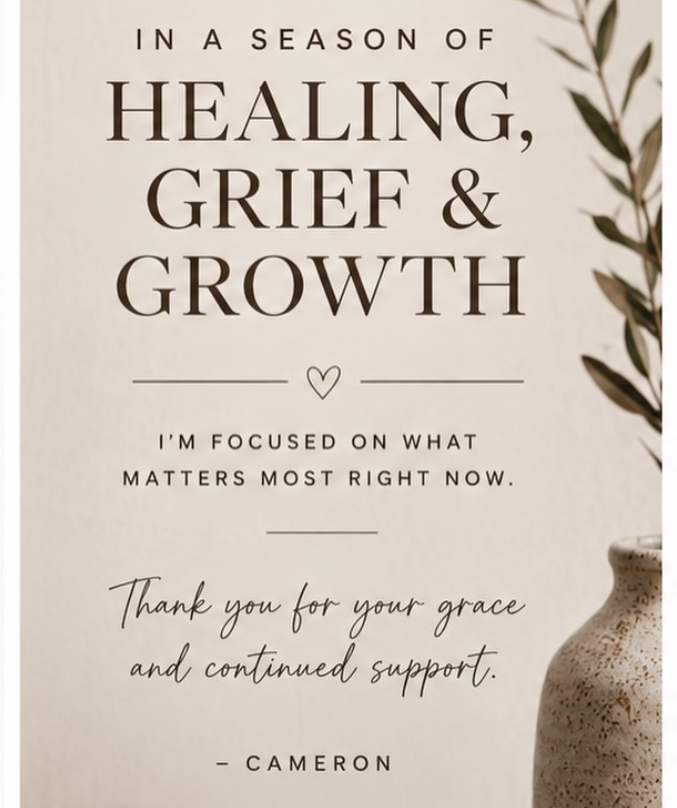
Why I’ve Been So Quiet Lately

There are seasons when words flow freely—and seasons when they don’t.

This is one of those seasons for me.

If you’ve noticed fewer blog posts or podcast episodes, I want to offer a simple and honest update about why. Not as an exhaustive explanation of everything happening in my life, but as a way of being transparent with this community I deeply value.

Since December, I’ve been engaged in counseling and therapy at The Refuge Center. This has been an important part of my ongoing healing journey as I continue to process past trauma and pursue greater wholeness. It is steady, intentional work that requires time, honesty, and emotional presence.

In February, I entered the editing phase of Jubilee’s book while also starting her nonprofit (more details to come). These are sacred responsibilities to me, and they deserve thoughtful attention as these efforts begin to lift off the ground.

In March, I stepped into a new Accounting Manager role with Rural Health Redesign Center. It has been a meaningful professional transition, but also one that requires focus and adjustment as I learn new rhythms and responsibilities. Around the same time, I began a two-month mental health evaluation as part of Vanderbilt’s VUMC Studyfinder program, which confirmed my ASD diagnosis earlier this month.

Alongside these transitions, my roles at The Gate Church and Messenger Fellowship have also shifted. Instead of focusing on admin and tech support, I’m beginning to move more into my wheelhouse—spiritual formation and education. This work has been deeply life-giving, though more inward-facing.

Most importantly, I’m doing my best to be fully present for my kids and support them as they finish their school semesters strong. That responsibility remains one of my highest priorities.

All of these pieces together have created a season in which I simply do not have the same capacity for consistent blogging and podcasting as before.

This is not a step away from this space, but rather a recognition of the season I am currently in.

I still believe in the value of storytelling, reflection, and honest conversation. I still care deeply about this community. And when the time and capacity return, I look forward to engaging more regularly again.

For now, I’m grateful for your patience, your understanding, and your continued presence here.

Thank you for walking with me.

— Cameron

Cover graphic creds: Center for Grief Counseling