When Faith Gets Put on Trial

There is something I have been noticing. It tends to surface after the prayers have been prayed, faith has been exercised, people have contended—and the ending still isn’t the one everyone asked for.

Eventually, someone starts looking for the variable. Maybe there wasn’t enough faith. Maybe doubt got in the way. Maybe someone didn’t believe hard enough.

I have heard enough variations of that idea to think it is worth naming. Somewhere along the way, some corners of the Church created an equation Scripture itself never gave us:

Desired outcome = sufficient faith.
Undesired outcome = insufficient faith.

To be fair, the equation did not appear from nowhere. Jesus tells us to believe when we pray. James warns about asking while doubting. Hebrews tells us that without faith it is impossible to please God. The Gospels even contain moments when Jesus directly confronts unbelief. Those passages matter. Faith matters. Unbelief matters.

I believe God hears us when we pray. I believe He draws near. I believe He heals, restores, delivers and intervenes. I believe we should ask boldly, contend earnestly and invite God to expose unbelief wherever it has taken root in us. But Scripture does not permit us to turn those truths into a formula.

There is a garden just outside Jerusalem where that formula falls apart.

The Cup Didn’t Pass

Jesus entered Gethsemane in anguish and prayed, “Father, if you are willing, remove this cup from me.”

Then He prayed again. And again. Luke tells us that His anguish intensified and that He prayed even more earnestly.

The cup did not pass.

Was the problem Jesus’ faith? Of course not. Jesus’ faith was perfect. And somehow, perfect faith looked like weakness that night. It looked like anguish, persistence, dependence and surrender:

“Nevertheless, not my will, but yours, be done.”

The unanswered request was not evidence of deficient faith. His persistence was faith. His surrender was faith. His trust in the Father while standing inside unbearable anguish was faith. That distinction matters.

Sometimes we treat surrender as the fine print beneath believing prayer—as though “Your will be done” is what we say when we are afraid to expect too much. Gethsemane suggests something very different.

Surrender itself is an expression of faith.

Prayer is worship because prayer acknowledges something fundamental: God is God, and I am not. He invites our participation. He teaches us, encourages us and empowers us. He tells us to ask. But partnership is not parity. God did not surrender His sovereignty when He invited us to pray.

When Faith Becomes About Us

This is where an inflated theology of faith can subtly shift the center of gravity. Faith stops being trust in God and begins becoming confidence in our ability to produce an outcome: my faith, my declaration, my certainty, my ability to receive.

Eventually, God begins looking less like Father and more like a mechanism: apply sufficient belief and receive the requested result.

But faith is not currency. God is not a genie. Grace is not wages for believing correctly.

Paul learned this when he repeatedly asked God to remove his thorn. The thorn remained. Christ answered, “My grace is sufficient for you, for my power is made perfect in weakness.” Apparently grace can be sufficient even when the thorn remains.

Romans 8 tells us something similar. The Spirit helps us in our weakness, even when we do not know how to pray as we ought. Notice where grace enters the story—not after we overcome helplessness, but inside it.

Even the desperate father who cried, “I believe; help my unbelief!” discovered that Jesus was willing to meet a man whose faith and doubt somehow occupied the same sentence. Helplessness is not a disqualification from grace.

That should make us extraordinarily careful about placing additional weight on people who are already suffering. There is enough vulnerability in asking God for something we cannot fix ourselves. When the answer does not resemble what was prayed for, the Church should be very cautious before adding an indictment to the grief.

Same Faith. Different Outcomes.

Hebrews 11 makes that caution unavoidable. Some people, through faith, conquered kingdoms, escaped the sword and received back their dead. Others, through faith, were imprisoned, tortured, afflicted and killed.

Scripture commends them all. Same faith. Different endings.

Faith was never intended to function as a mechanism through which we control God. It is trust in God.

That is why the words of the three Hebrew exiles in Daniel remain so powerful. They believed God was able to deliver them from the furnace. And then came the words that kept faith from becoming entitlement:

“But if not…”

God is able. But if not, He is still God.

That is not unbelief. Sometimes it is one of the bravest expressions of faith available to us.

Don’t Put Their Faith on Trial

So ask. Believe. Contend. Keep praying when the answer has not come. Ask God to expose unbelief and deepen your trust. Believe that He can intervene in ways only He can.

But when someone else’s cup does not pass, resist the temptation to put their faith on trial.

Sometimes grace removes the thorn. Sometimes grace becomes sufficient while it remains. Sometimes what God is doing becomes clearer years later. And some answers may require eternity.

Romans 8 does not promise that we will understand everything that happens to us. It promises something larger: that God is at work even while creation groans.

Our faith is ultimately in the Lord—not our ability to secure the outcome we prayed for.

God is able. And even if not, He is still God.

Gethsemane led to a cross. And for a little while, the cross looked like the end of the story.

It wasn’t.

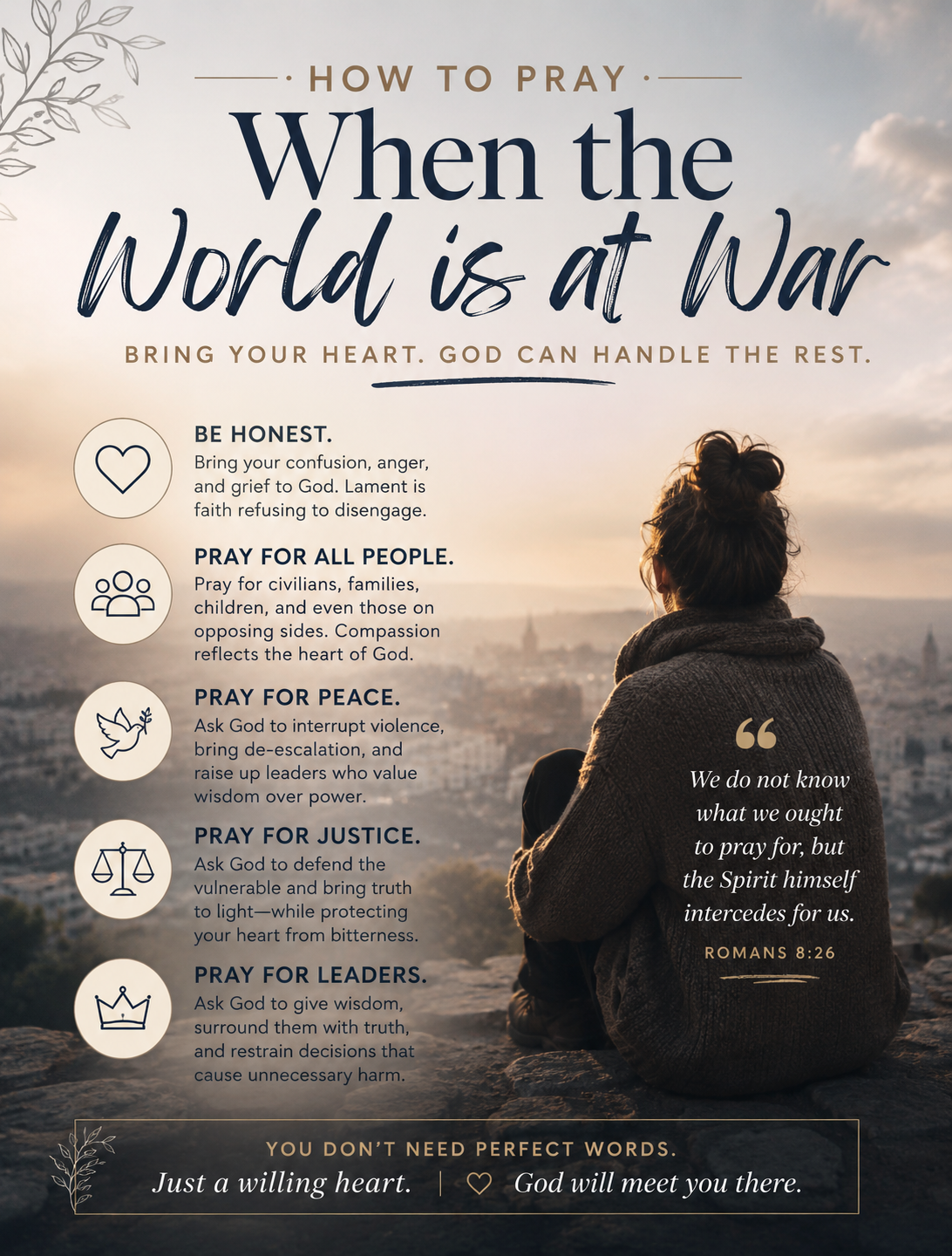
Tension & Turmoil: How Do You Pray When the World Is at War?

When the world is at war—especially during a conflict you disagree with—it can leave you feeling conflicted about how to even approach God. Do you pray for peace? For justice? For protection?

What if you are no longer entirely sure what the “right” outcome is supposed to look like?

And perhaps even more unsettling: What happens when you are no longer fully confident your own perspective is entirely right either?

If that is where you find yourself, you are not alone.

One of the comforting realities of Scripture is that the Bible makes room for this kind of tension. It gives language to grief, uncertainty, confusion, and even disagreement while still drawing us toward prayer instead of away from it.

So, what does it look like to process war faithfully?

First, it starts with honesty, raw as it may be.

One of the greatest misconceptions about prayer is that we are supposed to sound composed and certain before approaching God. Yet throughout Scripture, we see the opposite. The Psalms are filled with unresolved prayers from people who were hurting, confused, and desperate for understanding:

“How long, Lord? Will you forget me forever?” (Psalm 13:1)

There is nothing polished about that prayer. It is emotional. Unfiltered. Human. And maybe that is the point.

When violence unfolds across the world and everything feels heavy or deeply wrong, we do not have to sanitize those emotions before bringing them to God. We can pray honestly:

  • “God, this does not make sense.”
  • “I do not understand why this is happening.”
  • “This feels heartbreaking.”

Lament is not the absence of faith; it is faith refusing to disengage. At the same time, Scripture continually redirects our attention away from political positions and back toward people—an increasingly difficult thing in an age where outrage spreads faster than empathy.

In 1 Timothy 2:1, Paul urges believers to pray “for all people.” Not merely the people we agree with. All people.

That includes civilians caught in the middle of conflict, families grieving unimaginable loss, children living in fear, and even soldiers on opposing sides of war.

It is possible to care deeply about human suffering without endorsing every action tied to it. Prayer allows us to hold that tension without surrendering compassion. And perhaps that matters more than we realize because prolonged conflict has a way of hardening people if they are not careful.

Jesus said, “Blessed are the peacemakers, for they will be called children of God” (Matthew 5:9). Peace in Scripture is not passive sentimentality. It is something God values deeply.

Praying for peace may feel unrealistic in the middle of war, but it is not naive. If anything, it is resistance against the belief that destruction and violence are inevitable.

Sometimes our prayers are simple:

  • “God, interrupt cycles of violence.”
  • “Bring de-escalation where tensions are rising.”
  • “Raise up leaders who value wisdom over power.”

Even when we cannot envision peace ourselves, prayer aligns our hearts with the heart of God.

But Scripture also makes clear that justice matters deeply to Him.

Micah 6:8 reminds us to “act justly, love mercy, and walk humbly with your God.” I think it is significant that mercy and humility remain attached to justice in that verse because, especially during war, the desire for justice can slowly transform into bitterness, vengeance, or hatred if we are not careful.

Prayer has a way of exposing that shift before it consumes us.

We can ask God to defend the vulnerable, bring truth into the light, and hold powerful people accountable while simultaneously asking Him to protect our hearts from becoming hardened in the process.

Because if we are not careful, we can become so consumed with winning arguments that we forget the humanity of the people suffering underneath them.

Which brings me to arguably one of the hardest parts of all: praying for leaders.

Scripture instructs believers to pray “for kings and all those in authority” (1 Timothy 2:2), even when we strongly disagree with them.

That does not mean endorsing every decision they make. It means recognizing that no earthly authority exists outside God’s awareness and asking Him to intervene where human wisdom falls short.

Sometimes those prayers sound like:

  • “Give them wisdom they do not currently have.”
  • “Surround them with truth instead of ego.”
  • “Restrain decisions that would bring unnecessary harm.”

Other times, all we can bring before God is confusion.

Romans 8:26 says, “We do not know what we ought to pray for, but the Spirit himself intercedes for us.” I love that verse because it reminds us that prayer does not require perfect clarity.

Sometimes faithfulness simply sounds like:

  • “God, I feel torn.”
  • “I do not know what the right outcome is.”
  • “Help me not grow numb to suffering.”

God is not waiting for us to say everything perfectly before He listens. He meets us honestly in uncertainty.

And maybe that is one of the hidden invitations within prayer itself: not merely to ask God to change the world around us, but to let Him change what is happening within us too.

Because over time, prayer has a way of softening us instead of hardening us. It makes us more compassionate instead of more reactive, more humble instead of more certain.

As James 3:17 describes wisdom from heaven is “peace-loving, considerate, full of mercy.”

You do not have to solve the world’s problems to pray faithfully in the middle of them. You simply have to show up honestly and trust that God meets you there.

Graphic generated through ChatGPT

Dancing in the Pain: The Secret to Trusting God in the Storm (Intro)

Quick post today – archiving some thoughts for future reference per a recent conversation at work. My plan will be to build a series off this concept in 2026…

There are times in life when ‘yes’ is and will be the right answer. You may not understand the full ‘why’; the logic may trail the intuition. But obedience as goal, we will ultimately encounter moments when reason must yield to faith. Sometimes, it’s as simple as seasoned patience, waiting for an open door to illuminate the path we’re meant to walk. Other times, it’s like guided flight within cloudy turbulence, watching God correct the trajectory as we cling to Him. Either way, God has a plan, a purpose, and a promise behind the places He takes us (Proverbs 16:9, Psalm 37:23-24, Jeremiah 29:11, Ephesians 2:10).

As for the effect of these places, we must expect variability. At any point, we always have the capacity to learn and grow from something for something. To breathe is to absorb. To absorb is to process. And how we process, in most cases, inclines critical choices from trusting God in the midst of challenging circumstances to those micro-moments every day when we must decrease.

So, what then when these impacts net negative on paper and in person? What if the only meaningful consequences are confined to scars and sagacities fortified in fire? For most, if they can’t carry a positive tangible forward, then they write off the exiting season as a failure. ‘Tis a mentality of the world and wisdom of the flesh.

Yet, in truth, in the Word, and every place that matters, the reality is you can’t quantify growth in motion or scale the ripple effect a fallen face turned hopeful can produce. When lessons learned become fastened to the soul, when they click, find momentum, and plant themselves as fertile seeds, what you have is a vital, appreciable asset – one of the most important of all! Some might call it ‘addition by subtraction’ character-building or by a ‘one step back, two steps forward’ platitude. But those wouldn’t serve due justice, let alone what is full in the Lord’s eyes.

Again, you can’t measure or compute the long-term influence humility has in the wake of voids and failures. Do you have much to learn, much to apply, but have subdued the urge to stay where you’ve fallen? If so, rejoice! Shake the dust off your feet and rejoice again.

My friends, we must not undermine the virtue of endurance as God intended. Forgive the versions of yourself that didn’t know better, that didn’t have the support you needed, that lacked the safe space. After all, you can’t move on if you don’t love on and you can’t love on if you’re committed to a hardened state. Remember what you crave, God already is. So…

Don’t just get up, look up. Don’t just sing in the rain; dance in the pain. Why? Because Christ in you, you can count it all joy because who you’re becoming is far more significant than where you’ve been.

Together we will get there, one more cry and one less ‘why’ at a time.

Cover graphic creds: Harvest City Church

Fall Down 7, Get Up 8: A SOAP Bible Study on Proverbs 24

Scripture: Proverbs 24:16 – “For the righteous falls seven times and rises again, but the wicked stumble in times of calamity.”

Prelude: Recently, I was reminded of a late 2000s NBA commercial in which Dwyane Wade collapses to the parquet multiple times over the course of his career. After a montage of tumbles, a new series unfolds in which he rises from each fall before the screen goes to black… 

Coincidently, this connects to a separate memory last decade. Remember the 2017 NAACP Image Awards when Denzel Washington delivered one of his most iconic speeches? 

“Fall down seven times, stand up eight.” 

…still gives me chills to this day.

Understandably, many cite this line as a Japanese proverb with a credit to celebrity enlightenment; however, in reality, its true source is the Word of God; hence, this SOAP Bible study in which we will dissect the contrast in greater detail.

As always, let’s dive in…

Observations: In a vacuum, this verse compares the resilience of the righteous to the cowardice of the wicked. Both sides face setbacks and challenges, but only one perseveres through them. While some assume this verse suggests adversity comes to the unwise, the reality is that calamity finds all of us at one point or another. The key is how we respond and endure the way God intended. 

As mentioned in a recent post, even good people fail sometimes, especially as they face new challenges and situations beyond their ability to handle. Humility applied, we must understand these circumstances are not the product of poor character, but a part of God’s plan to develop it. In what we say and do, are we willing to rely on God’s guidance in the fullness of faith and integrity? If not, we will inevitably succumb to stubbornness and disbelief as the trials undo us.

Symbolically, the number seven is used here to emphasize completion and perfection, as God’s grace empowers the righteous to suffer through their failures. Granted, man, in his finiteness, may be ‘one and done’ on certain matters; however, since God sees the entire picture, we can trust that in HIs faithfulness, He will give us multiple opportunities to clear our hurdles. How sweet it is knowing we can live from victory as we wrestle with and for God!

Following v. 16, we find a subsequent call in v. 17-18:

“Do not rejoice when your enemy falls and let not your heart be glad when he stumbles, lest the Lord see it and be displeased, and turn away his anger from him.”

As people redeemed by faith through the Cross, this charge cannot be understated. While our flesh may snicker at karma and the kind of justice that enhances our ego, we must never rejoice when others fall and can’t get up. If anything, we should intercede and consider our options to help. Even if we can’t directly intervene, we can pray for a person whose peace is in peril and build a broken brother up from a place of boundary.

Applications: Although chaos and conflict are unavoidable in this life, God is the one true constant through it all. When tough times come, we can rest knowing there’s a vertical response with our name on it. To those feeling God is leading you through a desert or wilderness right now, remember how God used Joseph in the Old Testament (Genesis 39) and Paul in the New Testament (2 Corinthians 1:8-10). You may feel lost in the hole or bind you’re currently in, but this could be part of a grander setup in which God is equipping your heart to reach a promise and purpose He has ordained for you. 

Bottom line: God never fails and has the power to restore our confidence and redeem our failures. Although setbacks will come, as long as we fix our eyes on Jesus and follow His lead one step at a time, God will not only forgive us but also bring us to completion according to His Word (Philippians 1:6). Why not let Him be the fall back you crave when all hope seems lost? 

Prayer:

“God, we turn and align to you in this moment. We thank you for being a merciful, faithful God in whom we can trust. Father, as I write this, I think about those in dry valleys, surrounded by bones, needing a spark. As men and women fallen in sin, we confess our need for a Savior, who through His strength and sovereignty, provides the tools and opportunities necessary to rise above the obstacles of life. For those wresting in guilt and shame, for those who feel defeated for not having passed a specific test, we speak peace, grace, truth, and love to their hearts and minds today. May they find you in the wake of their desperation, for others, in the midst of their course-correcting. In our frailty, we admit our limited perspective, our tendency to get way ahead or woefully behind you. Though the ways to faith derailment are many, we choose to lean on your understanding, to follow the prompting of your Holy Spirit, and to press into you with all that is within us. Bless your holy name. Come alive within us. Help us not to give up and give in but as Psalm 57:1 says, lead us from failure’s shadow in and under the shadow of your wings. Amen.“

Cover graphic creds: Redbubble

Real-Life Habits: A Practical Example to Transform Your Life

Written 11/26/24 for our latest MercyTalk podcast…

Back in April 2018, four months removed from a seven-year youth pastor assignment, I had a revelation that produced a habit I still practice to this day.  As a state employee working in a stale environment, I sensed my walk with the Lord was starting to wane. For so long, motivation and inspiration overflowed naturally courtesy of 50 students and an opportunity to mature leadership in a liturgical setting; however, once I released the calling, I realized how much of my identity had become baked into my influence. Without youth in my life, I felt lost. Apart from my family, there was little to no accountability to guide my relationship with Jesus. Needing a spark, I knew my internal compass needed a reset.

So, I decided I would not only have daily quiet times during each morning commute but record them on my iPhone. With my weekly commutes averaging out to 6.5 hours, I figured I might as well talk and pray with God as I battle the banes of Nashville traffic. The decision turned out to be a game-changer as not only did the practice settle my spirit each day before work but allowed me to hear the mix of truth and lies roaming within. On some days, conviction came by declaring God’s Word out into the open; on others, I found grace simply in coming to Jesus as I was. In either case, my quiet time commutes were my happy hours during which I took thoughts captive and replaced them with holy perspective.

Fast-forward to October 2022 and I’m a month removed from losing my daughter, Jubilee, who took her last breath in my lap after a 393-day fight with chronic lung disease. For weeks I had been stone cold, flooding the pavement with tears during my workouts. Yet, everywhere else, the frozen numbness of grief had overtaken me. That’s when I returned to the practice of recording my quiet times on drives to work. During Jubilee’s life, the habit had faded to back-burner status through all the hustle and bustle. While there were times before Juju’s death when I felt as if I was walking on water, I sensed the sinking heading into 2023. If there ever was a time to rekindle the rhythm, this was it.

Like five years prior, I found myself pressing the red record button in my Audio app more frequently. With vulnerability on blast, there was never an intention of sharing the files with anyone. I simply needed to feel a connection with God, to feel His presence and listening ear calming the choppy waters of my soul. Occasionally, I would stumble upon an ‘ah ha’ moment, an epiphany with content-creating potential; however, the end goal was always to make room for God to invade my space and to catch Him doing it so I wouldn’t forget.

Having reached 400 records as of 11/20/2024, I can confidently say this habit has proven effective in stabilizing my mind, emotions, and walk with God all in one swoop. I especially recommend the practice for those in seasons of chaos in which they want to declutter or ‘spring clean’ their heart to hear the Shepherd’s voice more clearly.

Cover photo creds: Medium