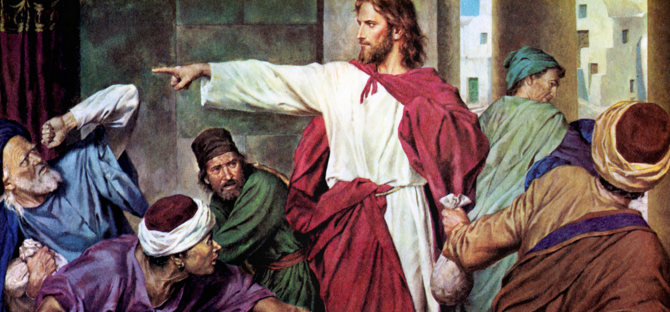
Integrating Ministry & Marketplace: The Temple Template

The vocational life is hard work.

Early mornings, long days, rough nights…if you wear many hats and juggle multiple responsibilities…you know the drill.

Yet, as tempting survival/‘just get ‘er done’ mode may be, truth is: we were never meant to live this way.

Yes, strategic compartmentalization can center the gravity of focus and break busy days into doable, bite-sized moments; however, when we consider our identity as effective influencers in light of Jesus’ ministry,  we ultimately find…

a) Work (what we commit our hands and minds to) and faith (what we commit our beliefs to) were never meant to be mutually exclusive.

b) The marketplace can be just as much a hub of powerful, life-changing ministry as the church1.

Take Matthew 21:12-17 for instance…

After Jesus kicks off the triumphal entry (v. 1-11), note the first place he targets (i.e. the temple – v. 12) and the reason why (i.e. to cleanse it).

I don’t know about you, but when I consider the fact Jesus deliberately went to the temple to make its original intent known as opposed to simply stopping for a cup of coffee and the ‘Daily Jerusalem’…that speaks to me.

Granted, Jesus channels his inner Adele for time, turning tables and all (v. 12b), but the key here isn’t so much Jesus reacting in frustration as much as Jesus setting things right, being fearlessly intentional in speaking truth and breathing life into what had become a lifeless environment.

So while this passage reference may seem random, when we talk about what pastoral ministry in the marketplace looks like and how to rightfully use our spiritual gifts in similar arenas, I believe there’s important application to be found.

First off, to be an effective marketplace minister, we must be courageous and purposeful with the truth. Yes, we can be highly skilled with the gifts God has given us; yes, we can be articulate, persuasive, and emit confidence, but if what we’re divinely given is utilized with limited integrity, it’s like trying to build a sturdy structure on quicksand.

Secondly, when we consider what grieved Jesus most, we deduce how wise marketplace leaders understand the time and place to deal with financial affairs as they understand the providence of God (i.e. the difference between a love for money and a love for God who provides the money2 ;more on this in future posts).

And finally, when we consider Jesus straight up calls the temple “my house” (v. 13 – “My house will be called a house of prayer…”), we find the a) confirmation of marketplace as an extension of sanctuary and b) value in declaring God’s original design over an establishment intended for our good.

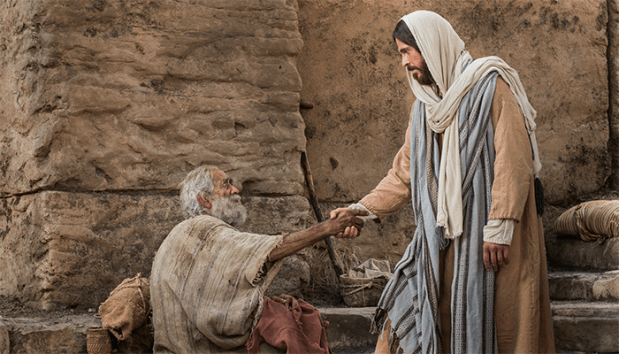
In this case, Jesus calls the temple a “house of prayer” not only to reveal the truth of its purpose3 (i.e. a place of dwelling, influence, and vertical communication), but to set the stage for the spiritually/physically impaired to better know that purpose (v. 14).
I-Was-There-at-the-Temple-Image

Hence, it should be no surprise to see a completely transformed temple by the time Jesus peaces out in v. 17.

Bottom line: when we reflect on how Jesus integrated his ministry and spiritual gifts into the marketplace, we see…

  1. Jesus was intentional (in going to the temple courts)…
  2. Jesus was bold with the truth and how he handled conflict…
  3. Jesus lived out the identity he declared over the temple…
  4. Jesus loved at every opportunity…

Thus, I submit if we’re going to thrive in employing our spiritual gifts in our areas of business, we must be willing to live on purpose, be bold with the truth, pray without ceasing, be the change we long for…and most importantly…love at all cost, at all times.

Next time, I’ll look to build upon this foundation with more specifics, more real-life application, but for now, if any of this hits home with you (or if you want to add a point to the list above), feel free to comment below. And as always, if you have a prayer request/praise report, you’re more than welcome to drop us a line.

‘Til then, may you find peace and joy in abundance as you go about your week…

~ Cameron

Footnotes

  1. Sure, the church may be the heart of the operation, but what’s to say the marketplace can’t be the hands and feet?
  2. Seriously…how often are good leaders corrupted by sneaky, under-the-table, ‘will do anything to get an advantage’ maneuvers? More than we’d like to admit, right?
  3. As well as His authority

Photo creds: gospelmovements.org (edited by Cameron Fry) & lds.net

Dear Church: Get Real, Not Relevant.

I got something to say…

…and gotta get it straight before the sun goes down.

giphy.gif

If the church wants to be a city on a hill, then why is it trying so hard to be relevant?

Not to suggest the church should be indifferent towards evangelism or complacent in discipling; I’m just sayin’ since when did the church become ashamed of the Gospel? Since when did she start making it about you…and your receptivity to truth?

‘Cause truth is: the church was never meant to be culturally relevant or well-received, but contextually real and eagerly given.¹

“For what we have received is not the spirit of the world, but the Spirit who is from God, so that we may know and understand the wonderful things God has given us.” ~ 1 Corinthians 2:12 (AMP)

 “[So I have intended] to come to you, in order that I may reap harvest among you…both to the wise and to the foolish. I am eager to preach the gospel to you…for I am not ashamed of the gospel, for it is the power of God for salvation to everyone who believes…” ~ Romans 1:13-16 (ESV)

Granted, most of you agree; however, in a time when church gets commission, but not Gospel…where truth is seen as content only worth its reach, it shouldn’t surprise us why many struggle to get God since what’s being modeled to them is more marketable than relatable.

Thus, it’s worth asking: How do we conquer the divide (be it deception, segregation, warped ecclesiology, etc.) in a way that gets us back to fishing for men without the bait? 

To answer this, we must accept…

  1. Relatability and relevancy are two completely different thing (more on this in a future post; ’til then, note Jesus’ interaction with outcasts (Luke 15, 1 Corinthians 5, Matthew 21, Mark 5, John 4).
  2. The world isn’t looking for church to be relevant; it’s desperate for something real, radical and revolutionary.
  3. When we’re reaching out, embracing in, and loving like Jesus, we never have to attract people to the Kingdom because it’s already there in front of them.

Remember the church’s call is to draw near to the lost like God, not draw the lost to find God.

Sure, our church may be in the midst of a powerful sermon series with catchy taglines to promote. But at the end of the day, what the world really wants is the reality of grace abounding as people love the way they know how.

‘Til then, I charge the church to get real about her entitled expectations. ‘Cause honestly, whether or not we’re in favor of a church’s peripherals (worship style, tech incorporation, service flow) or demographics (diversity), shouldn’t distract us from what ultimately matters – people fearlessly living and loving like Jesus…who are willing to resonate truth rather than make it relevant.

Remember Jesus didn’t die for you so you could be you; He died so we could be of same mind and heart so those lost and afflicted could join in. He didn’t die so you could be convinced how special you are; He died so you could tell others why they are.  He didn’t die so you could be served; He died so you wouldn’t have to worry whether or not you are.

And that, my friends, is what the Gospel is all about:  serving those deserving, giving to the living, bringing unity to community, telling not selling…I could go on.

Maybe you’re sitting there discouraged wishing things could turn around. If so, I want to encourage you tonight: while it may seem you gotta get your life in order to make a difference, you can make a difference in order to make a life.

Yeah, you may think you have nothing to offer, you make think your faith isn’t ‘attractable’, but given the Word says it’s who you are over what you have (1 Peter 2:9, Galatians 3:27-28), you never have to worry about having something to lose and nothing to give.

As for the church, I also encourage you: whether you’re pitching a product, promoting a series, or marketing a vision, never forget…

  1. The ‘me’ in ‘follow me’ (Matthew 4:19, Mark 1:17) is not about you.
  2. We’re called to make disciple-makers, not gain followers.
  3. Millennials don’t want your relevancy; they want your authenticity.

After all, when we “present a ravishing vision of a loving and holy God”, we not only capture their attention, but their hearts as well.²

tenor

Selah.


Footnotes

  1. Vaters, Karl (2016, March 30). “Forget Being Culturally Relevant.” Christianity Today.
  2. Dyck, Drew. (2017). “Millennials Don’t Need a Hipper Pastor, They Need a Bigger God”). The Aquila Report.

Cover photo creds: Pinterest