
The Part No One Talks About: A Letter to Exhausted NICU Dads

There’s a kind of exhaustion that doesn’t announce itself while you’re in it.

It’s not loud. It doesn’t always look like breaking down in a hallway or sitting in the dark parking lot outside the hospital trying to gather yourself before you go back in. Sometimes it just looks like functioning. Clocking in. Clocking out. Making calls. Answering texts. Sitting beside the hospital bed like you’re holding the whole world together with duct tape and determination.

You do what you have to do.

You become provider, advocate, scheduler, translator of medical jargon, emotional anchor, and sometimes the only stable point in a room full of uncertainty. You learn to live in two worlds at once—one foot in hospital rooms that smell like sanitizer and fear, the other in a life that keeps demanding normalcy from you like nothing has changed.

And somehow, everything has changed.

For a lot of dads, the hardest part isn’t just surviving the NICU or a long hospital season. It’s what comes after.

Because when the alarms stop and the routine of scans, rounds, and consultations fades, there’s this quiet that shows up. And in that quiet, everything you didn’t have space to feel starts asking for attention.

That’s where it gets complicated.

During the crisis, you run on adrenaline and necessity. There’s no room to fall apart, because someone has to keep the wheels turning. But once the urgency lifts, the body finally catches up with what the mind had to postpone.

And sometimes that looks like depression that didn’t have time to introduce itself earlier.

It’s disorienting, because people around you assume the hardest part is over. They’re grateful—and you are too—but they don’t always see that “over” doesn’t mean “undone.” You’re still carrying the weight of decisions, sleepless nights, financial strain, and the quiet fear that lived under every update from a doctor.

“Cast your burden on the Lord, and He will sustain you.” — Psalm 55:2

And if you’re honest, you might not even have the language for what you’re feeling yet. Just heaviness. Irritability. Numbness. A sense that you should be “back to normal” by now, but normal doesn’t quite exist anymore in the same way.

What makes it harder is how isolating it can be.

Not everyone is equipped to hold space for what you’re processing. Some people move on quickly, not out of indifference, but because life keeps moving and they don’t know what to say anymore. Even family, as well-meaning as they are, might be dealing with their own version of grief or fear. So, the support you need doesn’t always show up in the way you need it to show up.

And you can find yourself in this strange place of being surrounded, yet still alone with it.

Then there’s the layer no one talks about enough: your kids still needing care beyond survival. Appointments. Therapies. Counseling. Emotional regulation that requires patience you’re not sure you have left. And you’re trying to be the steady presence for them while quietly wondering who is steady for you.

That tension can feel impossible—like you’re supposed to be both strong and untouched by what you’ve just walked through.

But you’re not untouched. You’re just still standing. And there’s a difference.

If you’re in that in-between space—the season after the season—where everything is quieter but somehow heavier, I want to say this clearly:

What you’re feeling is not a failure of faith, strength, or character. It’s often the delayed impact of prolonged stress and trauma finally finding space to surface.

You were in survival mode. Now you’re in recovery mode, even if it doesn’t feel like recovery yet.

“Come to Me, all who labor and are heavy laden, and I will give you rest.” — Matthew 11:28

And recovery is not linear.

Some days you’ll feel fine. Other days you’ll feel like you’re back in it emotionally, even when nothing is actively wrong. That doesn’t mean you’re going backward. It means your mind and body are processing what they couldn’t process in real time.

You don’t have to rush that.

You also don’t have to do it alone, even if it feels like the support around you is limited. Sometimes the right support isn’t a crowd, it’s one person who can sit with you without trying to fix it.

Sometimes it’s a counselor who understands trauma and transition. Sometimes it’s simply learning to name what’s happening inside you, so it doesn’t stay undefined and heavy.

“Bear one another’s burdens and so fulfill the law of Christ.” — Galatians 6:2

And if you’re struggling to be present the way you want to be, especially for your kids, it doesn’t disqualify you. Conversely, it reflects the reality that you’ve been carrying more than one person is designed to carry for a long time.

Your presence matters more than your perfection.

Even now. Even in the exhaustion. Even in the days when you feel like you’re just getting through.

If no one has told you lately in plain terms: what you carried through that season was significant. What you’re carrying now still matters. And what you need in this season matters just as much as what everyone else needs from you.

There’s no shame in needing time to come back to yourself.

And maybe that starts with letting God meet you honestly instead of trying to meet Him polished.

“The Lord is near to the brokenhearted and saves the crushed in spirit.” — Psalm 34:18

You’re not behind. You’re not broken.

You’re in the aftermath of something heavy—and learning how to breathe again in a different kind of normal.

Cover graphic creds: ChatGPT

Why I’ve Been So Quiet Lately

There are seasons when words flow freely—and seasons when they don’t.

This is one of those seasons for me.

If you’ve noticed fewer blog posts or podcast episodes, I want to offer a simple and honest update about why. Not as an exhaustive explanation of everything happening in my life, but as a way of being transparent with this community I deeply value.

Since December, I’ve been engaged in counseling and therapy at The Refuge Center. This has been an important part of my ongoing healing journey as I continue to process past trauma and pursue greater wholeness. It is steady, intentional work that requires time, honesty, and emotional presence.

In February, I entered the editing phase of Jubilee’s book while also starting her nonprofit (more details to come). These are sacred responsibilities to me, and they deserve thoughtful attention as these efforts begin to lift off the ground.

In March, I stepped into a new Accounting Manager role with Rural Health Redesign Center. It has been a meaningful professional transition, but also one that requires focus and adjustment as I learn new rhythms and responsibilities. Around the same time, I began a two-month mental health evaluation as part of Vanderbilt’s VUMC Studyfinder program, which confirmed my ASD diagnosis earlier this month.

Alongside these transitions, my roles at The Gate Church and Messenger Fellowship have also shifted. Instead of focusing on admin and tech support, I’m beginning to move more into my wheelhouse—spiritual formation and education. This work has been deeply life-giving, though more inward-facing.

Most importantly, I’m doing my best to be fully present for my kids and support them as they finish their school semesters strong. That responsibility remains one of my highest priorities.

All of these pieces together have created a season in which I simply do not have the same capacity for consistent blogging and podcasting as before.

This is not a step away from this space, but rather a recognition of the season I am currently in.

I still believe in the value of storytelling, reflection, and honest conversation. I still care deeply about this community. And when the time and capacity return, I look forward to engaging more regularly again.

For now, I’m grateful for your patience, your understanding, and your continued presence here.

Thank you for walking with me.

— Cameron

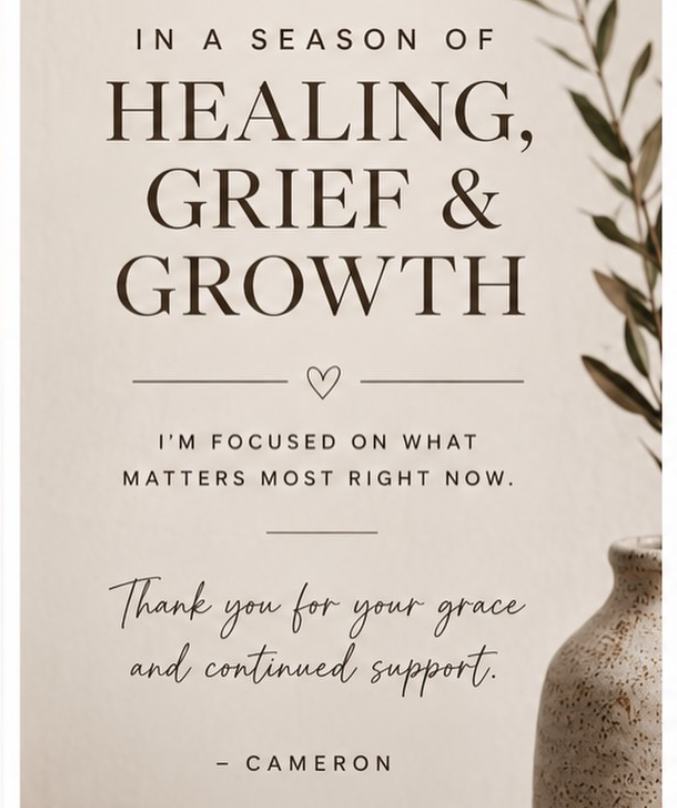
Cover graphic creds: Center for Grief Counseling

Tension & Turmoil: How Do You Pray When the World Is at War?

When the world is at war—especially during a conflict you disagree with—it can leave you feeling conflicted about how to even approach God. Do you pray for peace? For justice? For protection?

What if you are no longer entirely sure what the “right” outcome is supposed to look like?

And perhaps even more unsettling: What happens when you are no longer fully confident your own perspective is entirely right either?

If that is where you find yourself, you are not alone.

One of the comforting realities of Scripture is that the Bible makes room for this kind of tension. It gives language to grief, uncertainty, confusion, and even disagreement while still drawing us toward prayer instead of away from it.

So, what does it look like to process war faithfully?

First, it starts with honesty, raw as it may be.

One of the greatest misconceptions about prayer is that we are supposed to sound composed and certain before approaching God. Yet throughout Scripture, we see the opposite. The Psalms are filled with unresolved prayers from people who were hurting, confused, and desperate for understanding:

“How long, Lord? Will you forget me forever?” (Psalm 13:1)

There is nothing polished about that prayer. It is emotional. Unfiltered. Human. And maybe that is the point.

When violence unfolds across the world and everything feels heavy or deeply wrong, we do not have to sanitize those emotions before bringing them to God. We can pray honestly:

  • “God, this does not make sense.”
  • “I do not understand why this is happening.”
  • “This feels heartbreaking.”

Lament is not the absence of faith; it is faith refusing to disengage. At the same time, Scripture continually redirects our attention away from political positions and back toward people—an increasingly difficult thing in an age where outrage spreads faster than empathy.

In 1 Timothy 2:1, Paul urges believers to pray “for all people.” Not merely the people we agree with. All people.

That includes civilians caught in the middle of conflict, families grieving unimaginable loss, children living in fear, and even soldiers on opposing sides of war.

It is possible to care deeply about human suffering without endorsing every action tied to it. Prayer allows us to hold that tension without surrendering compassion. And perhaps that matters more than we realize because prolonged conflict has a way of hardening people if they are not careful.

Jesus said, “Blessed are the peacemakers, for they will be called children of God” (Matthew 5:9). Peace in Scripture is not passive sentimentality. It is something God values deeply.

Praying for peace may feel unrealistic in the middle of war, but it is not naive. If anything, it is resistance against the belief that destruction and violence are inevitable.

Sometimes our prayers are simple:

  • “God, interrupt cycles of violence.”
  • “Bring de-escalation where tensions are rising.”
  • “Raise up leaders who value wisdom over power.”

Even when we cannot envision peace ourselves, prayer aligns our hearts with the heart of God.

But Scripture also makes clear that justice matters deeply to Him.

Micah 6:8 reminds us to “act justly, love mercy, and walk humbly with your God.” I think it is significant that mercy and humility remain attached to justice in that verse because, especially during war, the desire for justice can slowly transform into bitterness, vengeance, or hatred if we are not careful.

Prayer has a way of exposing that shift before it consumes us.

We can ask God to defend the vulnerable, bring truth into the light, and hold powerful people accountable while simultaneously asking Him to protect our hearts from becoming hardened in the process.

Because if we are not careful, we can become so consumed with winning arguments that we forget the humanity of the people suffering underneath them.

Which brings me to arguably one of the hardest parts of all: praying for leaders.

Scripture instructs believers to pray “for kings and all those in authority” (1 Timothy 2:2), even when we strongly disagree with them.

That does not mean endorsing every decision they make. It means recognizing that no earthly authority exists outside God’s awareness and asking Him to intervene where human wisdom falls short.

Sometimes those prayers sound like:

  • “Give them wisdom they do not currently have.”
  • “Surround them with truth instead of ego.”
  • “Restrain decisions that would bring unnecessary harm.”

Other times, all we can bring before God is confusion.

Romans 8:26 says, “We do not know what we ought to pray for, but the Spirit himself intercedes for us.” I love that verse because it reminds us that prayer does not require perfect clarity.

Sometimes faithfulness simply sounds like:

  • “God, I feel torn.”
  • “I do not know what the right outcome is.”
  • “Help me not grow numb to suffering.”

God is not waiting for us to say everything perfectly before He listens. He meets us honestly in uncertainty.

And maybe that is one of the hidden invitations within prayer itself: not merely to ask God to change the world around us, but to let Him change what is happening within us too.

Because over time, prayer has a way of softening us instead of hardening us. It makes us more compassionate instead of more reactive, more humble instead of more certain.

As James 3:17 describes wisdom from heaven is “peace-loving, considerate, full of mercy.”

You do not have to solve the world’s problems to pray faithfully in the middle of them. You simply have to show up honestly and trust that God meets you there.

Graphic generated through ChatGPT

Space Dangers: How to Deal with Painful Orbiters

There is a quiet but intense pain that comes not from judgment, but from neglect. You confess, open up, step into the light…and for reasons unknown, the other side withdraws.

What does Scripture say about this scenario?

First, the Bible consistently honors confession. “Confess your sins [offenses, insecurities] to one another and pray for one another, that you may be healed” (James 5:16). Confession is not weakness; it is courageous obedience, an expression of virtue rooted in trust both in God and in the community of believers.

But what happens when that trust is not reciprocated?

While the Bible calls believers to bear one another’s burdens (Galatians 6:2), it also prepares us for a sobering reality – not everyone will respond with grace or remain engaged in it. Even within communities of faith, people can fail to reflect Christ’s compassion. Some withdraw out of discomfort. Others stay distant, bypassing love in the name of self-preservation, passive-aggressive retaliation, or simply making a point.

Yet, Scripture gently redirects our expectations: “It is better to take refuge in the Lord than to trust in man” (Psalm 118:8). This is not a call to isolation – but recalibration. While human relationships are imperfect vessels, God alone is absolute and constant.

Consider this: Your confession was never ultimately for them but before God. As hurtful as silence can be, a widening of detachment does not invalidate your obedience, minimize your need for wisdom and encouragement, or erase your healing.

In fact, Jesus Himself experienced relational abandonment in moments of deepest vulnerability. In Gethsemane, His closest friends slept. At the cross, many fled. Some even mocked. Yet, He remained anchored in the Father’s will, not human consistency.

So, what do you do with the ache?

You grieve it honestly. You resist the urge to harden your heart. And you keep pursuing authentic community – because while some may fail you, others will reflect the grace you hoped for.

Put another way…

Being neglected after confession does not mean you chose the wrong path; it just means you chose the narrow one.

My charge to you, my friends, is simple: Keep going, pray for the ghosting orbiters who have strayed, and stay true to God’s path knowing you’re never alone from where it matters most.

Selah.

Cover graphic creds: QuoteFancy

Key to Freedom: A Farewell to Mercy Multiplied

My mind is racing as I behold a cherry blossom shower outside my office window. Heaven knows I will miss this visual as long as I have a career and a nameplate. With whom I’ve conversed with and to what I’ve learned within this space, I will always be grateful.

Still, the bell tolls for transition. There’s so much I wish I could say, so little time. But with wisdom in tow, often less is more. After all, this isn’t the same Cam who left his prior gig, who crashed out under the weight of burnout and bereavement grief. No, this is a new day fueled by fresh perspective and humble beginnings having aged well. With broadened scope, I proceed with gratitude, praising God for what He has done and how He has led.

Granted, this doesn’t mean I’m unruffled within the timing. After a decade in state government and four years at a private nonprofit accounting firm, I expected this season to last longer. Considering my vocational arc, an Accounting Manager opportunity in a ministry non-profit setting made sense. Yet, as I’ve sought the Lord, He has settled and focused my mind onto a critical concept – His use of the ‘lifeboat’ season.

What is a ‘lifeboat’ season? In short, it’s a relatively shorter stretch of time when God moves and matures us from and/or through chaos to sharpen our reliance. Like a bridge or connector between longer, more pronounced periods, a lifeboat season is more than a transient résumé stop but a recalibrating place where God purifies, rehabs, and in some cases, accelerates us to higher ground. If you’ve ever experienced a two-in-one type year with accelerant meeting the growth track, chances are you were in a lifeboat, a gifted opportunity to discover and recover.

In many ways, this is why I can smile when reflecting on my 28 months at Mercy Multiplied. Despite a decent amount of corporate transition during my tenure, the Lord proved faithful in connecting me to the right people at the right time. To the extent I endured, to that extent I sensed my contributions steadying the course during critical moments. The cross-departmental endeavors, the ability to improve systems, the capacity to learn from the past and on-the-go simultaneously, the privilege to mentor a younger associate, these are only a few of the perks I’ll miss moving forward.  

To Keli Haymes and Hanna Noel, thank you for not only bringing me on board but ushing me into a foreign culture with grace while helping me discover my voice. To Patrick Bates and Kathryne Coonce, thank you for the quality guidance and tag-teaming in helping me finish my first year strong. To Melanie Wise, Erin Gentry, Rachel Bedenbaugh, Lauren Hobar, Stephanie Levesque, Jessica Jackson, Julie Bowsher, Canaan Lucas, Caronda Williams, Wendy Nichols, Sharon Manuel, Shantray Smith, Cindi Hagen, Melody Morris, Brittany Porter, thank you for the ways you’ve encouraged me over the years while entertaining my budget/accounting inquiries. Jessica, to you especially, thank you for the patient partnering and bridge-building of late. Working together within God’s ministry of reconciliation, who knew how much adventure we’d find! To Meaghan Briggs, watching your leadership evolution has been a highlight the past year. I wish you nothing but the best as you continue co-captaining the ship!

To Danae Dalbey, Hayley Freels, Adelein Nichols, Ana Holland, Mikaela Moore, Pachion Moore, Katelyn Sehl, Sarah Vaughn, Whitney Robinson, Whitney Thomas, Kristen Mahy, Dawne Shew, Loryann Sanchez, Shakayla Hall, the CWC/KTF support staff, current home staff, as well as all California home alum, I salute you and your hustle in getting things done with professional efficiency! Your effort and the brightness through which it shines, both past and present tense, is worthy of applause.

To the few, the proud, the men of Mercy, Jim Melton, DJ Tidwell, Jonathan Myrick, Daniel Reed, I can’t thank you enough for the laughs, the lunches, and the camaraderie behind the scenes. No question, it was very much needed. Here’s to not being strangers as we voyage into the great beyond.

To Ashton Nawas, holy smokes, I could not have excelled without your ‘safety net’ presence. What a joy it was to work with you and the Inflammo team these past few years! Same shout-out to Blankenship, especially Tommy Wooten for carrying us through some grueling audits! No question, I learned a great deal from you and your teams in the realm of financial storytelling.

Circling back to Jonathan, words only go so far in conveying how proud I am of who you are and the character you’ve modeled since you joined the Mercy team. You can take it to the bank, I will greatly miss the collaboration, the troubleshooting, and serving alongside you in the trenches. Your loyalty and steadfastness tandem is off the charts and has been an inspiration to many. You’re in good hands with Danielle and I look forward to hearing how God uses you and Katy in the years ahead!

And so, there you have it. With a full heart and misty eyes, I sign off on this assignment. I’ve fought the good fight, I’ve finished the race, and I’ve kept the faith. No regrets, no hard feelings. Just love and simply Jesus. Time to flip the page and let the Master Author pen a new chapter.

For the last time on this ground, I toast in triumph…

Lord, have Mercy.