
3 Underrated Life Lessons from ‘Home Alone 2’

As mentioned last December, when it comes to memorable Christmas movies, it’s hard to leave ‘Home Alone’ off the list. The charm, the music, the shenanigans, stir in some holiday vibes and family flavor, and it’s no surprise the film has stood the test of time.

Yet, while the success of Home Alone would ultimately inspire a carbon-copied cash cow sequel, having recently revisited Home Alone 2, it’s worth noting the life lessons embedded in its baggage (pun intended).

Thus, in the spirit of extending tradition and diving into yet another Chris Columbus movie, here are three underrated life lessons inspired by ‘Home Alone 2’…

  1. Keep your heart [pure]…

In this exchange, Kevin and the pigeon lady are in a loft above Carnegie Hall where she explains her mid-life crisis following her lover’s departure.

After admitting relational apprehensions, Kevin suggests she starts trusting people again. Having confided in her, Kevin then shares of past misbehaviors before accepting the pigeon lady’s advice to create good tidings in their place.

For a movie needing to convey a universal message yet remain politically correct, I’m not opposed to this moment of improbable dialogue. That said, if I’m in Kevin’s shoes, I’m not saying, ‘keep you heart open’; rather, I’m likely substituting something less vague like ‘clean’, ‘pure’, ‘vigilant’, etc.

—————————————————————————————————————————————–

Create in me a clean heart, O God, and renew a right spirit within me.” ~ Psalm 51:10

And I will give you a new heart, and a new spirit I will put within you. And I will remove the heart of stone* from your flesh and give you a heart of flesh.” ~ Ezekiel 36:26

Keep you heart with all vigilance, for from it flow the springs of life.” ~ Proverbs 4:23

—————————————————————————————————————————————–

To be fair, the way Kevin uses ‘open’ here is worth some benefit of the doubt. Generally, when we use the word in similar fashions, we’re encouraging someone not only to take inventory of fear, but to count the cost of courage. Still, while Kevin’s advice is admirable for a ten-year-old, I submit had he been more specific and defined certain truths she should be open to, he would have better helped the pigeon lady move on from her past…

…which brings me to my first point…

…if we’re going to employ goodness, why superficially deliver it fearing we may be wrong or intrusive? Not to suggest we disregard decency and modesty, which organically come as we’re led by the Spirit; however, if we’re content in preserving shallow forms of goodwill, are we not reflecting a subtle version  of what we long to see people free from?

As one can relate to the pigeon lady (i.e. the paralyzing effects of crushed dreams and unpruned fears), all I know is whatever love I give or receive…I want it to pierce something…be it pain, confusion, anxiety, whatever. After all, God will take care of my options, but as for you, I just want to see you be brave and, at least, consider telling me something I may not know and/or need to straight-up hear.

Bottom line: If you’re going to encourage someone to keep their heart open, don’t end the sentence with ‘open’. In this way, you’ll charge your encouragement as a springboard rather than a sugarcoated fortune cookie.

*Bonus points to Kevin for this line: “If you’re not going to use your heart, then what’s the difference if it gets broken?” A heart of stone, whether intact or shattered, is still stone.

  1. Know why you battle

It’s hard to ignore your favorite scene in a post like this. Even if it wasn’t, you got to admit the first 36 seconds of this clip, as ex machina they may be, pump the adrenaline.

Yet, before the movie’s climax can commence, consider how the scene starts…

Interesting, how the clip starts with the Star of David. Granted, this makes sense given the song’s lyrics…

Distant stars, at home up in the heavens.
Wonder what they see, are they watching me?
Christmas Star, you spin your strands of silver.
What a sight to see, are you there to guide me?

Star light, shine bright.
See me through the dark night.
Light my pathway;
Guide me home for Christmas Day.

Still, it’s refreshing to see how a symbol of Christ’s birth helped ignite this sequence.

First, you have a Star of David helping harness Kevin’s attention onto an ill peer. From there, Kevin is reminded while he’s still lost in the most populated city on earth, there are others less fortunate worth fighting as confirmed by his battle-cry…

“You can mess with a lot of things, but you can’t mess with kids on Christmas!”

To sum up this scene, if we stop and consider the broken around us, it’s not long until we’re reminded why we battle against evil schemes (Ephesians 6:11)…why what we protect is worth protecting. Kudos to Columbus for somehow capturing it all in only half a minute!

Bottom line: Perspective matures our vulnerability into mobility. If we want to fight the good fight and overcome evil with good, don’t just ponder the good, bask in it.

  1. Dove the one you love

For this one, I’m not so caught up in the actual clip as much as I’m reminded how much deeper turtle-dove significance is in the Bible. A quick systematic overview reveals turtle-doves are more than sentimental emblems. Rather they demonstrate the beauty of sacrificed innocence (Old Testament), passionate devotion (Song of Solomon), imminent healing/thanksgiving (Hezekiah), and prophetic divinity (Gospels).

If you ask me, turtledoves are underrated when we reflect on the true meaning of Christmas. True, we sing of them frequently every time we come to the second day of the ‘Twelves Day of Christmas’ carol; however, if we zoom out and consider why turtledoves have any Christmas connection at all, we find reason in their physical and symbolic splendor represented in Creation to Noah…all the way to the Cross. In essence, they are a genuine reminder that Jesus is the reason for the season and in Him, a) God is pleased and b) we can know true peace and goodwill.

Bottom line: Doves capture the sweet aroma of incarnational love.

Selah.

Cover photo creds: The Daily Edge

ThanksLiving Right

It’s easy to love this time of year.

The smoky smells of autumn, the traces of fall color, the countdown to Christmas…

…the thought of a better year beyond the horizon.

But perhaps you’re like me in the sense the third of week of November has become this pre-holiday rush pedestal, a calm before the storm we all know as ‘the most wonderful time of the year’.

Thanksgiving-Christmas-ov

If so, consider this post a take among many seeking to re-establish Thanksgiving as its own sacred entity.

For while most grasp the importance of giving thanks, not all see it as an unconditional reality as the will of God in Christ Jesus for us (1 Thessalonians 5:18) where gratitude is contagious, sacrifice a cheerful obedience metric, and thanksgiving a light share as opposed to a light switch (see Isaiah 58:8, Matthew 5:15-16; more on this in a moment).

The question is: If thanksgiving is more than periodical expressions of vertical delight, what’s stopping us from employing it horizontally?

Consider the following verses…

And at the dedication of the wall of Jerusalem they sought the Levites in all their places, to bring them to Jerusalem to celebrate the dedication with gladness, with thanksgivings and with singing, with cymbals, harps, and lyres.” ~ Nehemiah 12:27 (ESV)

I wash my hands in innocence and go around your altar, O Lord, proclaiming thanksgiving aloud, and telling all your wondrous deeds. O Lord, I love the habitation of your house and the place where your glory dwells” Psalm 26:6-8 (ESV)

Mark this, then, you who forget God, lest I tear you apart, and there be none to deliver!The one who offers thanksgiving as his sacrifice glorifies me; to one who orders his way rightly I will show the salvation of God!” ~ Psalm 50:22-23 (ESV)

But I am afflicted and in pain;let your salvation, O God, set me on high! I will praise the name of God with a song;I will magnify him with thanksgiving.” ~ Psalm 69:29-30 (ESV)

Let them thank the Lord for his steadfast love,for his wondrous works to the children of man! And let them offer sacrifices of thanksgiving, and tell of his deeds in songs of joy!” ~ Psalm 107:21-22 (ESV)

“Since we have the same spirit of faith according to what has been written, ‘I believed, and so I spoke,’ we also believe, and so we also speak, knowing that he who raised the Lord Jesus will raise us also with Jesus and bring us with you into his presence. For it is all for your sake, so that as grace extends to more and more people it may increase thanksgiving, to the glory of God.” ~ 2 Corinthians 4:13-15 (ESV)

Note when we drill down systematically, we find thanksgiving to be far more than temporary appreciation, but a call to invite people to taste and see that the Lord and His provisions are good (Psalm 34:8, Psalm 107:9,  Philippians 4:19). Applicably, this has profound implications.

For starters, while thanksgiving is often confined to altar calls, staged responses, and special events, when we recognize its pre-Mayflower, pre-creation context, we find sanctified space celebrating what has always been…perpetual love in continuous offering…giving and receiving simultaneously.

Unfortunately, for many of us, when it comes to thanksgiving, it’s easy to compartmentalize giving and receiving. I know for me, ego, independence, entitlement, and agenda can compromise my benevolence and negotiate my generosity if I’m not careful; however, I also know by dying to these rights, I expand the room God has to reveal Himself1

…which brings me the reason I’m writing this.

If we desire the lost and broken to see Jesus, not only must we be intentional in declaring thanksgiving, but sharing it as well. For when we engage thanksgiving as celebratory and communal worship, we inevitably position ourselves to glorify God as fresh revelations of His providence abound. Granted, this doesn’t mean we dial up the decibels of our praise to prove the goodness within. Clearly, our hearts would be misaligned if the visibility of our virtue preceded the availability of God’s power to provide it.

That said, by understanding thanksgiving as an outpouring of interdependent love and vulnerable relationship, we ultimately discover how our loved-by-God identity can extend God’s Kingdom through perfect other-centeredness.

06d47f53b086af0e3ed6c34bc447c1dc

Think of it this way: When I praise God for who He is and what He has done, while the point of my adoration is to love Jesus first and foremost, the posture of my adoration opens me to overflow the love I receive in return. Accordingly, to the extent I abide in this rhythm, to that extent God’s heart (i.e. His love, goodness, kindness, compassion, faithfulness, etc.) inundates the people and places I encounter. Perhaps this is what the author of Hebrews meant when he wrote, “Through him then let us continually offer up a sacrifice of praise to God, that is, the fruit of lips that acknowledge his name” (Hebrews 13:15).

Bottom line: Thanksgiving, at its core, celebrates the Trinitarian nature of God. While Pilgrims and Indians are worthy of mention, their actions in 1621 merely reflected a divine dance that has and will continue on into eternity.

As such, why not extend tomorrow (i.e. Thanksgiving) into each day? Why not [literally] give thanks as opposed to voicing it in isolation? Why not receive from the Lord as you inquire direction on what you have to offer?

After all, not only do you have something to offer, but a specific reason why. And that, my friends, is worth being thankfull for.

From my house to yours, have a Happy Thanks Giving…and don’t forget to look up as you reach out.

617703

IoSlX8W

Footnotes

  1. Also, the room is created for godly fear – not only loving what God loves and hating what God hates, but hearing what God says and seeing what He sees.
Cover photo creds: stmed.net


Chosen to Succeed: A Homily for Vocational Ministers

Shared at The Gate Community on 11/18/18

Many times in this sanctuary we have acknowledged pastoral leaders, ministerial entrepreneurs, and trailblazing missionaries, recognizing their call to churches, organizations, and nations. But until last year, seldom have we, as a local body, celebrated the ministry giftings in vocational leaders and those appointed to corporate frontlines.

For many of us in this room, there’s been a convergence of conviction in recent years centered on the idea that fivefold ministry gifts aren’t exclusive to those with fivefold ministry callings. For instance, like vocational ministers, a CPA with God-given financial skills, a physician, and a businessperson known for quality service can function in pastoral, evangelical, and apostolic anointings.

The question is: Are we helping them make connection between original design and occupation…between sacred and secular offices?

While many answers could be said, the truth is we, at The Gate, believe works of the Spirit are manifold and that there are infinite functional ministries saints can be called to. As such, it is also our belief anyone who is saved and aligned with Christ has difference-making, culture shaking potential as part of their appointed skill and spiritual gift mix…

…which brings us to today where it is with great pleasure we celebrate these individuals who have fulfilled their Commission U course requirements as part of Messenger Fellowship’s initiative to equip and empower marketplace ministers.

For those unaware of what Commission U is all about, in short, it’s more than a credentialing course, more than a biweekly small group, more than a quest for frame-able accomplishment; rather, it’s a pathway for disciple-making believers to discover and apply their spiritual gifts in worldly systems…a training ground for men and women of faith to mature their reach in fallen settings.

Scripturally, the word ‘commission’ is used several times. In Genesis, we find Joseph being commissioned by Pharaoh as the vizier of Egypt. In Numbers, we find Eleazar the priest and Joshua being commissioned in front of large assemblies. In Timothy, we find Timothy being commissioned by Paul to commit to his calling. And in the Gospels, the disciples are commissioned by Jesus to make disciples of all nations.

While these cases may seem random, the point is in each of them God appointed his chosen to succeed. And it’s for this reason we are gathered here: to charge these ambassadors not only to go and make disciples of all nations, but occupational arenas as well, baptizing them in the name of the Father, Son, and Holy Spirit, teaching them to obey not only what they’ve chosen to follow, but what they’re continuously choosing to learn and abide in.

So to our graduates, we employ you to build upon the insight you’ve inherited and to see the Scriptures as God-breathed in what you put your hands to.

As 2 Timothy 3:16-172 Timothy 3:16-17 says…

Do your best to present yourself to God as one approved, a worker who has no need to be ashamed, rightly handling the word of truth [knowing] all Scripture is breathed out by God and profitable for teaching, for reproof, for correction, and for training in righteousness, that the man of God may be competent, equipped for every good work.

And to all of us, understand we carry a priestly, Immanuel’ (God with us) identity embodying the incarnate… with ignitable Kingdom influence wherever we walk…wherever we work.

On this note, we consecrate this moment by commissioning our Commission U graduates.

This slideshow requires JavaScript.

For full service, click here

Photo creds: Lydia Ingegneri

Nothin’ ‘Bout The Blood

So last week I’m on a Messenger Zoom call discussing Triune worldviews when a chilling question is raised:

Are we, as rising, maturing believers valuing the bloodand living in light of that ‘precious flow [making us] white as snow’?

Certainly, it’s easy to think we are given Christ’s death and resurrection is the cornerstone of Christianity.

But what if I told you to the extent we detach God’s communal nature as a foundation of love from our corporate theological foundation, to that extent we reduce the blood as nothing more than a sacrament. Would you agree?

If not, permit me to connect some dots after laying some groundwork…

1. To construct a worldview from the core of God’s nature, we must accept the fact God is a Communion of Three Persons in perfect love.

2. From there, we can establish and grow Biblical community in the same way God does His work: by multiplying what He is as a communion of love.

3. Only then can we value the Gospel and consequentially, understand the destructiveness of sin.

Unfortunately, as we progress in this post-Millennial age, the more young believers are distancing themselves from the saviorhood of Jesus2. As a former student pastor, I can attest to this. For many youth, believing the universal lordship of Jesus having once saved is far less challenging than accepting their current need for a sovereign Redeemer who continues to save.

Granted, our culture’s emphasis of reason over revelation and self-autonomy allots sense to the trend. That said, one must wonder how a world system based on deficiency is affecting the church’s thirst for relevancy.

Take ‘mission’ for example. For most, mission is seen as a journey, an assignment or a means to an end; however, when we note the Godhead, we find ‘mission’ to be an overflow of an established nature.

You see, before love could be extended, there had to be an identity with the ability to love; hence, why so many feel the weight of performance given they’re trying to abide in love not knowing who they really are and as such, forget the key to anything starts and ends with being loved by God.

The question is…

Are we abiding in love…or are we searching in love to find ourselves? Are we trusting God to fill our needs or filling our needs to trust in God? Are we forgiving having received grace or seeking grace in order to forgive?

Either way, it’s worth reminding ourselves…

  1. There’s no depravity God can’t redeem.
  2. Abiding in who we are in Christ is the blueprint to Holy Spirit dependence.
  3. The bedrock of truth, especially as revealed in revelation, is cemented when we allow God to reveal Himself in all circumstances.

giphy-1.gif

As for the blood’s depreciation among ‘next gen’ believers, it’s important we, as the body, perceive the issue as a conflict between identity and performance. For as long as Western individualism exists, so will the temptation to approach mission as drive, fellowship as metric, sin as shame…and thus, the blood as obsolete.

Yet, when we remember we were bought with a price (1 Corinthians 6:20), when we accept Christ’s atonement as the security of our freedom, only then will we understand the blood’s purpose in all things.

For instance…

The blood is central to our community:

Take care and be on guard for yourselves and for the whole flock over which the Holy Spirit has appointed you as overseers, to shepherd (tend, feed, guide) the church of God which He bought with His own blood.” ~ Acts 20:28 (AMP)

The blood is central to reconciliation:

…and through [the intervention of] the Son to reconcile all things to Himself, making peace through the blood of His cross; through Him, [I say,] whether things on earth or things in heaven.” ~ Colossians 1:20 (AMP)

The blood is central to redemption:

In Him we have redemption [that is, our deliverance and salvation] through His blood, [which paid the penalty for our sin and resulted in] the forgiveness and complete pardon of our sin, in accordance with the riches of His grace.” ~ Ephesians 1:7 (AMP)

The blood is central to cleansing:

But when Christ appeared as a High Priest of the good things to come…He went once for all into the Holy Place [the Holy of Holies of heaven, into the presence of God], not through the blood of goats and calves, but through His own blood, having obtained and secured eternal redemption. For if the sprinkling of defiled persons with the blood of goats and bulls and the ashes of a heifer is sufficient for the cleansing of the body, how much more will the blood of Christ, who through the eternal [Holy] Spirit willingly offered Himself unblemished  to God, cleanse your conscience from dead works and lifeless observances to serve the ever living God?”~ Hebrews 9:11-14 (AMP)

Let us approach [God] with a true and sincere heart in unqualified assurance of faith, having had our hearts sprinkled clean from an evil conscience and our bodies washed with pure water.” ~ Hebrews 10:22 (AMP)

Get the picture?

My final thoughts are:

1. To minimize the blood is to minimize our freedom in Christ as it stresses our fear of deficiency over God’s sufficiency (2 Corinthians 12:9).

2. Instead of wanting to be relevant, why make the Good Newsprevalent? After all, the presence of goodwillis a testament to the Good News of the Gospel – the fact Jesus continues to heal the oppressed and set captives free having reconciled us to God through…(wait for it)… His shed blood.

3. Accordingly, by downplaying Christ’s sacrifice, we risk performance systems bridging the gap not only between identity and sin, but also church and mission (more on this in a future post).

I don’t know about you, but give me Jesus and the power of the cross as the divide between those medians.

giphy.gif

Looking ahead, stay tuned for a sequel post where I’ll dive into more detail on how we can better educate young people on how to live in God’s present ministry of reconciliation5.

‘Til then, peace be the journey

~ Cameron

Selah.

Footnotes

  1. Of Jesus
  2. This coming an observation from multiple pastoral colleagues across the country
  3. Which can’t be separated from Christ’s ultimate sacrifice
  4. And our call to extend it
  5. An active reality, not a past occurrence
Cover photo creds: Mudpreacher.org

Begin Again

I’m feeling dry in mid-July as I take to a familiar scene…

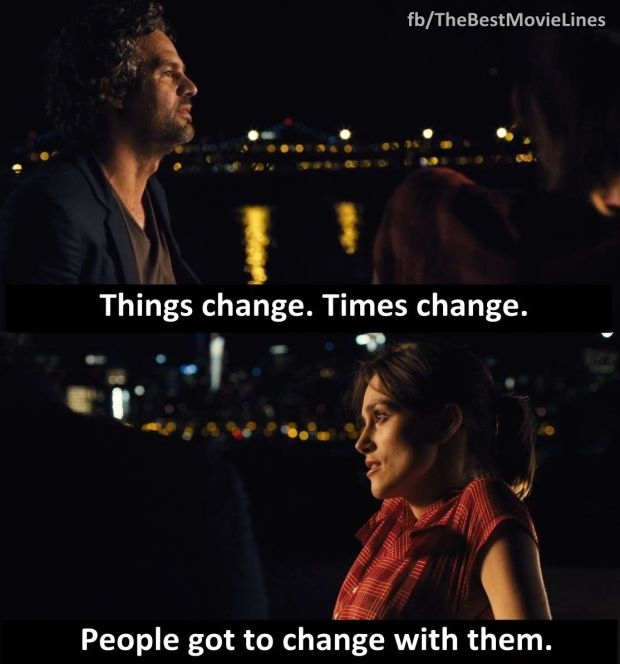
…where Keira Knightley and Mark Ruffalo are, once again…

…deep in nightscape dialogue.

Like them, it’s been a year where nocturnal serenity has frequented my cul-de-sac of vulnerability.

Perhaps this is why I’m watching this, I think to myself.

After all, it’s not every day you catch a cinematic glimpse of what you and God do once the kids go down.

Walk and talk.

Walk and talk.

The perfect end to an imperfect day.

But this time…things are different. For once, I’m inside and idle, content in a still of a different kind.

Riding the rarity, I dive in, the laughs and prose all working towards this one moment…

cba0e11cb0003455e897dafca7344ad6

…sealed by a mic drop for the soul.

And yet, this story, in more ways than one, is just beginning.

For as credits roll, I approach the screen…

…to shelve a case of what was seen…

…only to balk and wonder why.

Why don’t I want to leave this moment, I wonder.

Perhaps it’s a sequence, a song, an emotional call. Perhaps the answer is ‘none at all’.

Either way, I’m at peace. Let it go, let it rest. Sometimes, walking away is best.

Flash-forward to mid-August and I’m cleaning again…the aura of Pledge, a fitting calm.

Then suddenly, it hits me

…what struck me that night was not the scene, but the title itself

…slowly marinating into the stubborn caverns of my disbelief.

Two words…we need, but take for granted; two words…preached, yet breached and slanted.

Two words…an answer once hoped for; two words…a truth igniting my core.

Two words for two months…and likely beyond. Now comes the part I ‘yes’ and respond.

And so it goes…there’s nothing God can’t use to find us and whisper the sweet reminder…

…that sometimes, to go forward, we must go back and…

begin again.

Roll credits.

Photo creds: 7-Themes, Pinterest