
Making Room for New Creation: Do We Still Believe Christ Changes People?

Lately I’ve found myself thinking about something I don’t hear discussed very often.

As a disclaimer, I’m genuinely grateful that the Church has become more willing to talk about healthy boundaries, emotional well-being, and protecting people from abusive or destructive situations. Those conversations matter, and Scripture certainly leaves room for wisdom when safety is at stake. There are circumstances where lasting distance is not only appropriate but necessary.

But I’ve also been asking myself another question: When genuine repentance is present and safety is no longer the issue, are we still making room for God’s ministry of reconciliation?

Sometimes I wonder if we’ve become so accustomed to protecting ourselves that we’ve quietly lost the expectation that Christ still transforms people. Either way, our responsibility remains an absolute as outlined in the Word.

In Acts 11:18, we see that God alone grants repentance—a gift of His grace that Paul echoes in 2 Timothy 2:25. This highlights an essential reality: The grace that forgives is also the grace that transforms.

Consider Jesus’ teaching in Matthew 18. While the passage is often remembered for confronting sin, His aim is ultimately restoration—winning back a brother or sister.

Paul paints the same picture in Corinth. He instructed the church to discipline a man living in open, unrepentant sin. But after that man repented, Paul’s instruction changed:

“You ought rather to forgive and comfort him… reaffirm your love for him.” (2 Corinthians 2:7–8)

Notice the progression: Accountability. Repentance. Restoration.

Repentance doesn’t erase consequences. It doesn’t instantly rebuild trust. It doesn’t obligate anyone to return to an unsafe relationship.

Reconciliation doesn’t always mean restoring a relationship to what it once was. Sometimes it simply means laying down bitterness, extending forgiveness, and remaining open to whatever measure of restoration wisdom permits.

Yet neither should we treat genuine repentance as though it changes nothing.

I’ve also found myself wondering whether our desire to protect our peace can slowly become something else. While boundaries can absolutely be an expression of wisdom, they can also become places where reconciliation quietly stops.

That’s worth examining—not to produce guilt, but to ensure our instinct is still moving toward the ministry Christ entrusted to us whenever wisdom allows.

Every Sunday we proclaim that Jesus makes people new. We celebrate that He removes hearts of stone and gives hearts of flesh. If we truly believe Christ transforms lives, shouldn’t we expect to recognize His work when genuine repentance appears?

Paul writes: “If possible, so far as it depends on you, live peaceably with all.” (Romans 12:18)

I appreciate those opening words: “If possible.” Paul recognizes that reconciliation isn’t always achievable because it doesn’t depend on one person alone. Some wounds require lasting distance. Some relationships remain unsafe. We cannot control another person’s response.

But we can control our own.

As far as it depends on us, we’re called to pursue peace, own our failures, confess our sin, forgive as we’ve been forgiven, and remain open to the restoring work of Christ whenever wisdom allows.

I don’t write this to minimize the importance of boundaries. I write it because I don’t want to miss the work of Christ when He begins changing someone’s heart.

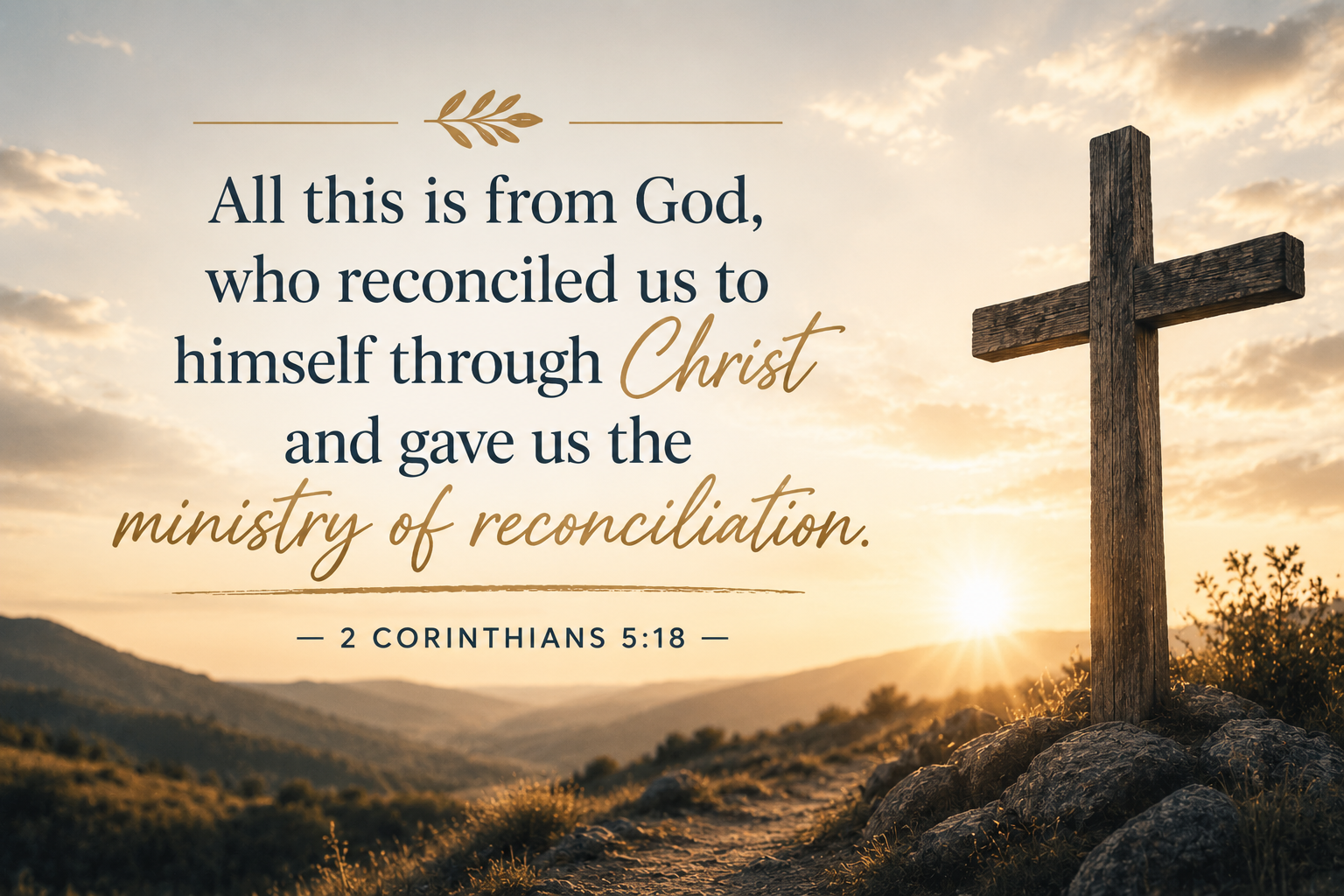
The ministry of reconciliation isn’t only about God reconciling us to Himself. Through Christ, He also entrusts His people with becoming ambassadors of that same reconciliation in a broken world (2 Corinthians 5:18–20).

Perhaps one of the greatest evidences that we truly believe the gospel isn’t simply that we rejoice over God’s power to change us—but that we remain humble enough to recognize His transforming work in someone else.

If we proclaim that Jesus makes all things new, may we never become so guarded that we fail to recognize His new creation standing right in front of us.

Cover graphic creds: ChatGPT


Say the Words: The Bridge Between Forgiveness and Identity

Okay, so I know I promised a ‘part 2’ in my last post; however, I figured a) I’d delay for some storytime and b) You guys wouldn’t mind a change of pace. Accordingly, I’ll retarget the aforementioned sequel to next weekend. 

So yesterday, I’m eating lunch with some colleagues when suddenly an open question becomes an answer to my silence. An opportunity to share now a moment to care…just without the words.

Deep down, my subconscious begins to skew…

‘I thought they said life wasn’t supposed to a spectator sport? I should be in the game, not the sidelines! Why did I accept this invitation anyway?’

Granted, I’m embarrassed having assumed the question was for me when it was for someone else. Still, I’m desperate to quench this oral craving. Time to take the plunge and jump in, I think to myself.

And so I do. Five minutes in…the first unforced tangent, I carpe diem the crap out of it. Like an open book, I’m elated knowing where I’m going, where I’m stopping, and where I’m headed in this midday manuscript.

‘What could go wrong’, I wonder. ‘I just need to wrap up my say and head back to the bleachers. Get in, get out, and go home happy.’

And for a while I’m right. After a relay question to stitch the rabbit trail, I‘m not only out, but home happy – the start of 18 hours of muted conscious.

That is until this morning’s 5:30 am wake-up call – a muffled ‘Beautiful Day’ ringtone softened by the tune of leftfield conviction.

“You totally hijacked that conversation,” I hear.

Sensing that familiar twilight echo, I quickly realize God is talking to me.

“When you go to work today, make sure you apologize to the person you cut off.”

*Sigh* “Okay, God. I get it. You got it. Like my most popular Slack, ‘Will do’.”

Hours later, I’m back in the office, a couple convos into a steady rhythm when my time comes to apologize. Without hesitation, I pivot off a talk of the times to the words of the time.

“About yesterday. I know you probably thought nothing of it. Certainly didn’t mean anything by it. But I just gotta say…I totally hijacked that conversation yesterday. It would have been better for me to listen than chime in out of fear of not being heard. Will you forgive me?“

Like butter to burnt toast, I smell the melting – this friend of mine, a fairly recent acquaintance, touched by such sensitivity.

“Wow, you’re a man of God, aren’t you,” she says.

“Uhhh…yes. Yes, I am a man of God. This is true. Can’t argue…” I stagger.

At this point, I’m reeling like a teenage pop-fan in 2012, stunned by this one direction¹. In no way did I expect the dialogue to end up here of all places.

Yet, as I reflect back, maybe I shouldn’t have been so surprised.

‘Cause truth is: Whether we’re owning a misgiving or repenting for a fault, asking for forgiveness always helps us rediscover who we are. Sure, we may feel like a horse being led to water, eager to rid ourselves the yoke of apology. But as I learned this morning, there’s not only grace behind an “I’m sorry”, but identity calibration as well.

As for the apology, some would say I had nothing to apologize about. But for me, I’m glad I had something to own. For when we own something, it only proves we’ve accepted what’s been given in the first place. And while this could look a number of different ways, I submit at the core of it all is a gentle, gracious reminder that we are loved in and through weakness. Even when we’re not perfect, there’s at least room to be perfected – the space in between the sweet spot of our identity.

Selah.

Later this spring, I’ll discuss this forgiveness/identity dichotomy in greater detail. For now, here are some verses we can revisit for next time…

“And you, child, will be called the prophet of the Most High;
for you will go before the Lord to prepare his ways, to give knowledge of salvation to his people in the forgiveness of their sins, because of the tender mercy of our God, whereby the sunrise shall visit us from on high.” ~ Luke 1:76-78 (ESV)

“Therefore I tell you, her sins, which are many, are forgiven—for she loved much. But he who is forgiven little, loves little.”  – Luke 7:47 (ESV)

“Anyone whom you forgive, I also forgive. Indeed, what I have forgiven, if I have forgiven anything, has been for your sake in the presence of Christ…” 
~ 2 Corinthians 2:10 (ESV)

“I am writing to you, little children, because your sins are forgiven for his name’s sake.”  – 1 John 2:12 (ESV)

‘Til then, you got this, people of God…

giphy

Footnotes

  1. Youth pastor joke from my LEGACYouth days (see linked text)…
Photo cover creds: Healthy Beginnings


The Naked Truth: Why Church Needs a Sex Talk

Since its inception, His Girl Fryday has served as a resource helping bivocational/ marketplace leaders mature their influence…and while our mission has always been to bridge sacred and secular, when it comes to absolute truth, ultimately we’re just as passionate outside our niche as within it.

Thus, as we tackle a hot topic in sexuality, understand this message has not only been internally simmering for years (having been ignited during last week’s Messenger Fellowship summit), but also represents one of my deepest pastoral regrets having rarely addressed it1 during my youth ministry tenure. Of course, much could be said in a testimonial setting; for now, let’s focus on how sexuality has been and should be addressed to effectively equip the emerging generation.

—————————————————————————————————————————————–

When it comes to modern day sexuality, no question we live in a unique time caught up in the crossfire of change. On one hand, we have church and culture experiencing seismic shifts in how intimacy and its abuse are perceived. On the other, we have integrity and cross-generational tension in how the Word is interpreted and behaviorally applied².

Yet, while the divide may seem like a slippery slope, how we close the gap is worth discussion given we all struggle (or have struggled) with sexual identity, temptation, compromise, or at the very least, our identity in Christ.

Take my case for example…

As a child of the ’90’s, I grew up in a time when intimacy was seen as forbidden fruit. Not only was sex not talked about outside ‘the birds and the bees’, but hardly anyone wanted to…apart from a few exceptions.

I remember during one 8th grade chapel, my school brought in a young Christian couple to share their “love story”, a PG-13 account of why they waited. Unfortunately, while their testimony captured the wonder of affection, it failed to connect sex to Scripture leaving many peers in a wake of armor-less intrigue.

A few months later, I invited a friend to summer camp during which the last guest speaker defined purity as avoiding promiscuity. But again, like the married couple, though the message conveyed the mystique of sex, the big picture only grew more convoluted, especially for those like me who had become skilled in evading Cosmopolitan without knowing why.

Enter the day my sophomore year when I discovered Victoria Secret in my parent’s mailbox.

Yes, I had learned not to go looking for lust; however, I hadn’t learned what to do when lust came looking for me. Factor in a freshman year marred by peer rejection and bullying and suddenly those scantily clad women were more than just tempting…they were void-filling.

And so began a decadal stretch where self-gratification and fantasy lust not only became on-and-off defaults to loneliness and self-loathing, but self-seeking manifests in romantic relationships3 (more on this in a future post). Thankfully, after years of denial and compromise, the Spirit would meet me in a point of surrender and reset my course.

qtq80-CYVMS1

But by then, the damage had been done. Despite the fact I was a new creation relearning grace, forgiveness, and perseverance in the midst of shame, insecurity, and depression, the weight of deferred awareness -what could have been had I just trashed the lingerie clippings instead of stashing them ten years earlier – bore heavily on my mind.

Not to mention all the ‘what if’s’…

…like what if someone had taught me the wrongs of self-gratification?

…what if someone had taught me the boundaries of intimacy in dating relationships?

…what if I had a mentor who connected taking thoughts captive to pornographic temptation?

…what if the message of sexuality in my youth had involved discovering God’s intent as opposed to guilting people from living outside it?

Maybe then we wouldn’t be having this conversation.

But the reality is we are…because I believe God not only wants to reshape and ‘de-grey’ the way we teach sex, but purge our family lines of where it’s been abused.  Like me, you may have wrestled with a checkered past, but this doesn’t mean God can’t use your fearless voice to stir implicit trust in places of explicit exposure.

The question is: are we willing to be entirely honest and sensitive when we need to?

For as long as sex is minimally approached and swept under the rug, we set our children up to learn the hard way; however, if we truly desire our youth to see sex through the fear of the Lord/their identity in Christ, if we truly long for them to be content in their singleness, and to understand the positives of purity, the rewards of repentance, and the repercussions of sexual sin4, only then will we set a foundation on which they can stand firm.

‘Til then, I submit the church refreshens her approach on teaching intimacy. To paraphrase John Piper…

…the problem with the church’s guide to sex education isn’t her instruction on walking in light, but her negligence in modeling a hatred of darkness.

As a result, youth are growing up aware sex has a time and place, like fire in a fireplace, but are far less aware of what to do when the chimney starts to crack or when the fire breaches the home. At some point, we must be willing to convey the fire of intimacy not only through the fatherheart of God, but in eager fashion as people unashamed of the Gospel and our testimony (Romans 1:15-16 AMP). Perhaps then will today’s young people know how to ‘house’ their sexuality where the fireplace was designed to be.

tenor

As for me, all I know is far too long I’ve been on my knees crying for help, but now that help has come…and in its wake…my heart yearns to see future generations know the warning signs that flare in the night and proceed against greed in light of the stronger, holy fire burning within5.

In closing, I encourage you, my friends, let’s be unified in advancing a more vulnerable talk on sex while praying generational healing into the roots of our family trees. After all, as great as the struggle or freedom we’re walking in, how much more glorious the triumph when we embrace the legacy of God’s highest?

Selah.

Footnotes

  1. Granted, the effort was made multiple times; at least we got this far…
  2. Hence, why sexuality is such a challenging subject given its taboo label and sandpapery effect on identity/ego/security
  3. Specifically, the lie of ‘as long as it’s not intercourse, it’s okay’
  4. Including the various forms of pornography and self-gratification
  5. Yes, I have DC Talk’s ‘The Hardway’ in my head now; again, I’m a child of the ‘90’s 😉

Cover photo creds: Pond5, Called to be Free