
3 Keys to Communicating Vision

When it comes to quality leadership, no question, one of the hardest challenges is communicating vision (i.e. important information necessary for growth and progress). From filtering content to personal interaction, the marriage of progress to relationship can be a messy process. Thankfully, where there’s a will, there’s a way, even if it doesn’t happen the way we want or when we want.

That said…here are three keys to communicating vision effectively…

  1. Say What You Need to Say

When casting vision, it’s important to remember conciseness is more valuable than eloquence. After all, a platform should never be about exposing what you know (i.e. show off), but rather what your audience needs to know (i.e. show how)…which brings me to my first point:

When communicating what an audience needs to know, start with what you need to say first.

More specifically, don’t just filter your content; break it down into lucid, bite-sized bits. That way, you can better discern what is necessary and what is footnote material before you communicate.

For instance, as a wordsmith in youth ministry, I’ve learned my best points, whether delivering a sermon or leading a team meeting, are best received when they lack syntactic ambiguity. In other words, when I use words and phrases that don’t mean different things to different people, not only do I enable my content to be coherent, but I empower my students to interpret it the way it was intended.

Bottom line: Vision doesn’t just point people in the right direction (i.e. makes it plain; see Romans 1:19), it shows them how to get there (bonus points if you include illustrations). Therefore, if you want your audience to capture the vision, make sure you say what you need to say and what your audience needs to hear, not what you want to say or what they think they want to hear.

giphy

  1. Speak the Truth in Love

Yeah, yeah…you get this in theory, but if you’re like me in the sense this doesn’t come as easy in execution, remember you may be in a time crunch, you may have a lot on your plate; however, if you’re not communicating truth in love along the way, not only do you risk a discouraged team, but a disjointed vision split from purpose.

To piggy-back off point #1: what you need to say can’t be what you need to say if love isn’t a part of it. Sure, you may be brimming with epiphanies and award-winning ideas, but if vision isn’t vision without truth and truth isn’t truth without love, then vision can’t be vision detached from best intention.

Remember vision not only seeks the best possible corporate outcome, but inspires love among its enforcers.  Thus, if you aim to love, not only will team morale enhance, but  the bond between vision and audience will tighten as well.

Bottom line: 1) Without love, vision is nothing more than a good idea. 2) Vision, in the context of love, motivates people to keep pursuing it. 3) If you know the truth, speak it in love; if you don’t, love as you pursue it. Either way, it’s a win-win.

giphy-1

  1. Make it Memorable

While vision, at its core, is the mergence of point #1 and #2, if it lacks conviction or captivation, chances are it’s not memorable either. Granted, truth should never be a function of marketability; however, while good vision knows its audience, great vision considers what they’ll remember.

Hence, it’s worth asking: how do you take an entire vision and frame it into something that’s easy to remember and hard to forget?

For starters, it’s always best to keep it simple and straightforward. Focus on syntax and word selection. Use correct grammar.  Be exact in meaning. Then, if necessary, add some flair and poetic license (i.e. turn it into a jingle, structure it ABC style, pose it with rhyme scheme, integrate a relatable metaphor/simile, etc.) Whatever method you apply, remember the goal is to make sure your audience can extend the vision. While making vision plain may seem contrary to making it memorable, if you consider ‘plain’ as the foundation, it will ultimately enable you to build your vision in a way people can understand and promote.

Bottom line: When vision becomes memorable, the impacts become inevitable.

giphy-2

Photo creds: Trendy Bloggers, Giphy
Integrating Ministry & Marketplace: 2 Big Lies about Spiritual Gifts

So lately I’ve been pondering the divide between vocational and marketplace ministry, specifically its relationship to spiritual gifts.

‘Cause I’ll be honest: I don’t get the chasm…the compartmentalization among these facets.

I mean…it’s not like the seven spiritual gifts (1 Corinthians 12, Romans 12) were ever meant to be exclusive to pastoral leaders or limited to “inside church use” only. Certainly the church would have the common sense to teach/preach the seven motivational gifts (the seven gifts of the Holy Spirit) as gifts designed for everyone to apply anywhere…right?

*Crickets*                                                                                                                                                *Crickets*

Oh snap, did I just stumble into a white elephant?

Eh, maybe I did. But still…this needs to be talked about. After all, if we desire to be the opposite of what Paul warned about in 1 Corinthians 12:1 (i.e. misinformed), it only makes sense to buckle up and dive into the issue.

But before we do, permit me to provide some context.

In my experience, the abuse of ‘spiritual gift teaching’ falls into two primary camps:

  1. The notion that spiritual gift development can only happen in the church.
  2. The notion that spiritual gift application can only happen in the church.

Granted, I know there are more categories, but for now, we’ll narrow our focus on these two criteria in hope to debunk some faulty doctrine.

Lie 1: Spiritual gift development can only happen in the church.

I’m not sure how this deception started, but no question, the legalistic undertones are evident considering it assumes a) life should be nothing more than the work of the ministry1, b) business matters are inherently evil because man is inherently evil, and c) the marketplace is a byproduct of the fall; however, when we look at Adam/Eve’s original design, we find the marketplace and the establishment of institutional order to be a byproduct of creation. After all, when God created man, He also created his role…and considered it good (Genesis 1:26-31)

Thus, it’s important to note how the garden was just as much marketplace as it was ministry…and why it’s dangerous to compare and contrast ministry and marketplace as segregated entities. ‘Cause truth is: we may experience spiritual gift activation in the church; however, this doesn’t mean development can’t happen outside it given God is a God of grace, has the loving power to ignite one’s heart anytime, anywhere, and intended pursuing love and earnestly desiring spiritual gifts to go hand in hand (1 Corinthians 14:1).

Bottom line: The reality of love and the truth of creation give credence to spiritual gift development happening anywhere, not just the church.

Lie 2: Spiritual gift application can only happen in the church.

Dare I say it…this one may be even more baffling than the first. Again, the church was meant to equip and mobilize, not centralize and maintain. So why anyone would think the church was designed to be an entertainment hub as opposed to a stewarding/dispersion center is beyond me, especially when you consider the purpose of church is to worship God through word and prayer, to love one another, partake of baptism and the Lord’s Supper…and oh, yeah…go therefore and make [disciple-makers] (Acts 2:42).

Yes, learning how to apply and mature our spiritual gifts in a koinonia (Greek for fellowship, sharing in common) setting is essential; however, if such demonstration is limited to “in-house”, can we honestly say the our faith is reaching where it needs to?

Bottom line: Spiritual gifts are meant to be shared as salt and light with the world, not stashed as inventory in the secret basements of what we call church. Thus, if what we believe reduces spiritual gifts to an iPhone and church as a charging port, I strongly encourage you: shift your paradigm…and dare to apply/extend what you experience in church to other places of influence.

Looking ahead to next month, expect a more intimate dig into what pastoral ministry in the marketplace looks like (with a more defined emphasis on how to rightfully use spiritual gifts in our areas of business)…with a subsequent series on what marketplace ministry looks like in the church later on.

For now, if any of this content resonates, feel free to comment below. And as always, if you have a prayer request/praise report, there’s a place for that on His Girl Fryday.

Blessings on your week,

~ Cameron

Footnotes

1) More specifically…”ministry as ministry”

Photo creds: Shutterstock (edited by Cameron Fry)ly

Purifying our Priorities (Part 1)

Well, folks…it’s that time of year again.

  • HR Block is heating up its campaign…
  • Companies are sending out their W-2/1099’s…
  • TV’s are going on sale’
  • …and New Year resolutions are officially underway2.

After all, ’tis the season to be better, right? To start afresh and anew…and to grab change by the horns…

But perhaps you’re like me in the sense you wonder how many really know how to do this…or maybe you’re hesitant…afraid of prematurely falling off the resolution bandwagon.

Whatever the case, it’s important we get real about the type of world we live in. ‘Cause when we take a good, hard look into the deep, dark crevices of our culture, we find we’ve grown too content taking matters into our own hands…yet too passive in carrying them out…

6a00e54ee25646883301a73de1e5f9970d

…a paradoxical attribute of a society that constantly suggests having a heartfelt desire is “good enough”.

Not that “heartfelt desires” are bad; by all means, we were created to have them.

I’m just saying if we truly want to reach the next level (in any phase of life), it doesn’t make sense to be self-reliant, given the human tendency to fall short and mishandle change. Conversely, if we want to see growth become a permanent reality in our life, we not only have to accept the existence of a higher alternative, but we must be willing to depend on it as a supreme solution that exists (and only exists) in God Himself.

All that said… How do we turn our heartfelt desires, the seeds God’s plants within us, into lasting realities? How do we change from the inside out in a way that takes deep root within?

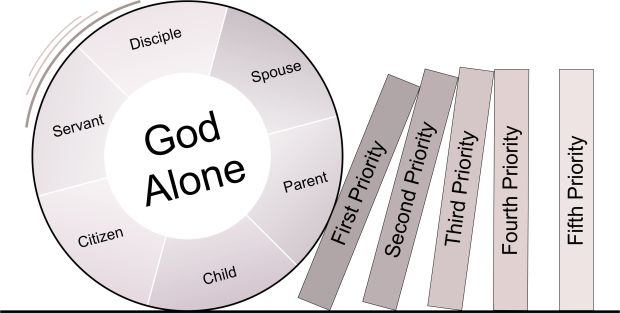
Before we can answer these questions with a customized five-point self-improvement series3, I submit we must first be willing to purify our priorities…

…which can only happen when we become intentional in spending time with God.

But first..what exactly is a “priority”?

According to the Random House Websters Dictionary...

  • A priority is “something that’s regarded as more important…a right to precede above in rank, privilege, etc. …
  • …and “to prioritize” is a process by which we arrange, particularly in order of importance, relevance, value, etc.

Thus, when we consider what a priority is…and apply it to morality…our faith, we ultimately discover the importance of recognizing God’s priorities for our life.

Take Philippians 1, for instance, where in verses 9-10, Paul prays for the Philippians’ love to abound all the more so they could better discern and approve the things that are excellent4.

Essentially, Paul is saying: if you’re feeling overcommitted, overloaded, overwhelmed…if you’re mired in apathy, confusion, striving…or simply trying to decide what is best, what’s best for your spiritual well-being…and those around you…the answer is simple: love at all costs!

when-we-start-spending-time-with-god-178
‘Cause at the end of the day, we all need Jesus in the middle of our everything…not only so we can conquer the burdens of life…but so we can love better in every circumstance (hence Paul’s use of the word “abound”).

My thought is: let’s be unified in seeking first the Kingdom (Matthew 6:33) together…in being fervent in loving one another (1 Peter 4:8; Colossians 3:14)…so we may…

  • Better identify what’s most important in our own life…
  • Better concentrate on the relationships God has called us to…
  • Be quicker in our humble obedience…
  • Be more available to God, our family, those God has called us to be around…
  • Use time more effectively, including family and ministry time (and not sacrificing one for the other)…

…all the while being Spirit-led everywhere in between.

Stay tuned next time for “part 2” of this series, where I’ll discuss a couple practical pointers on how we can better engage God in our midst and live transformationally in 2016.

Footnotes

1) In prep for the Super Bowl

2) Take a good, hard look at gym attendance…and you’ll see what I mean

3) Granted, this is a popular trend this time of year

4) I don’t know about you, but I love this association, specifically how Paul links “the greatest gift of all” (i.e. “love”) to our call to judge righteously.

Photo creds: lightwork.typepad.com, quotesgram.com, indy.shine.fm

3 Ways to Overcome a Fear of Rejection

No doubt, we all burn to belong.

Makes sense…considering we were made for relationship…to put on love and commune in harmony (Romans 12:16; 1 Corinthians 1:10, Colossians 3:14).

But let’s be honest…such desires aren’t always realized, are they.

Relocations…busyness…life changes…even the walls we put up…cycle through as hindrances interfering with our need to find unity in community.

Yet, perhaps the greatest obstacle we face when we talk about healthy relationships is the fear of rejection1.

Now, I admit: I’m still progressing through my own set of relational insecurities. But while I may have much to learn, I’ve also grown a great deal having persevered through idolatrous pursuits of acceptance in my early 20’s , in addition to recent challenges as a bivocational minister.

So when I say a fear of rejection is one of the most paralyzing strongholds, you can take my word to the bank.

As far as dealing with this fear type, you’ve probably heard much on the topic already.

Yet, for bivocationals juggling multiple responsibilities on the fly, it’s worth re-emphasizing given fear’s tendency to find its way on the backburner.

Thus, in the spirit of stirring awareness, here are three practical ways to conquer a fear of rejection:

1) Own it. 

Statistics show the vast majority of what people worry about is either vain (false reality) or beyond their control (false expectations). In most cases, we fear once we sense a loss of control on a desirable outcome. For example, we want people to like us, but find we lack “chemistry”. We want to be living our dream, but find our reality is far from it. We want to reap securities, but find all we have is fractured hope.

No question, the chasms are real; however, this doesn’t mean we’re chained to them until the bridge forms. Why? Because it’s only when we relinquish our lust for control we start to conquer our fears.

So next time you find yourself fearing rejection, questioning your fit, place, image, safety..or that of a loved one, own it, surrender the stress, pray the Word, embrace self-control, and faint not.

2) Reject it.

Sometimes, we treat fear like a giant game of dodgeball. We think if we can just finagle through life without getting hit, then we’ll be okay. The problem with this idea is…at some point, you will get hit, if not with the fear, then the temptation of it.

The best way to combat fear, especially the fear of rejection, is to value what equips you. ‘Cause when you realize you have what it takes to overcome, you won’t hesitate to stand your ground when the dodgeballs start flyin’, not to mention you’ll be in position to catch and dispatch them.

tumblr_mcij592NhJ1qasthro1_400

Just remember: When a fear of rejection is elevated to the point of dodging certain people and situations, you’re ultimately giving it the power to manipulate your emotions and decisions. Instead, why not dare to be a conqueror (Romans 8:37) and reject fear rather than let fear do the rejecting2?

 3) Replace it.

Perhaps one of the most misinterpreted passages in all of Scripture is 1 Peter 4:8: “Above all, love each other deeply, because love covers over a multitude of sins.” At first glance, we may think Peter is suggesting love cancels out certain offenses; however, when we dissect the text, we find love, in this context, is a covering, more specifically…an opportunity for us to confront3, forgive, and press on in love-soaked honesty.

How does this apply to a fear of rejection? Well, for starters, the opposite of love is fear (not hate). Furthermore, love must speak truth (Ephesians 4:15) and requires action with respect to sin. Thus, if we value honesty as the first step of love4 and recognize fear as a reciprocating response, then we’ll realize how a) a fear of rejection numbs us to what we were created for5   and b) the absence of fear is not the endgame, but rather the beginning!

In other words, if you want to move on the right way, but are still burdened by a fear of rejection, don’t just recognize and renounce it. Rather, take the next step and ask God specifically how He wants you to replace it!

‘Cause when you do, you’ll not only discover a new commitment to communicate the truth in love, but also unlock a stronger fear of Him6.   

Footnotes

1) Note: Initially, I had planned to write this piece on the fears of rejection and mediocrity; however, I’ve since decided to split this up into two parts, with today’s discussion focusing on the fear of rejection and next week’s feature on the fear of mediocrity.

2) There’s basically two responses to fear: “Forget everything and run” or “Face everything and rise”

3) …without taking offense

4) Inspired by Steve Fry’s sermon at The Gate Community Church on Sunday, May 31

5) Seriously…what sense does it make to forfeit even the potential for relational restoration and/or clarity in exchange for passive living, isolation, guilt, and dissatisfaction.

6) As honesty abounds, you’ll find a fear of rejection will confound.

Photo credits: shifttohappy.com

Staying the Course: The Importance of Not Quitting (Part 2)

We’ve all been there.

Life in a lifeless cubical world. Surviving the 9-5 vocational jungle. Juggling a bunch of disjointed dreams against the backdrop of reality.

Perhaps you know what it feels like to be a fish in an aquatic Pandora’s Box…

…like you don’t belong no matter how hard you try, no matter how hard the effort.

untitledNo question, it’s in these moments when we’re most tempted to quit…when we’re most likely throw in the towel and walk away.

But as I mentioned in last year’s post, there’s value in not giving up, there’s honor in putting down the white flag in favor of the warpath…and there’s hope in maintaining a posture of perseverance, no matter how hard the challenge.

True, it can be arduous making ends meet and bridging relational divides amidst an unfulfilling environment; it can be difficult loving¹ people in a vacuum where nothing around you seems to give you that much desired sense of accomplishment and worth.

But truth is, at some point or another, we’ve all questioned our place, especially during [what seems like] a fruitless season, where nothing seems to be effective or bear influence.

Yet, I contend we don’t often help our cause at theses points of impasse.

Why? Because of the human tendency to put calling before purpose.

You see, our purpose is simple: to be heaven on earth…

…by choosing to love as Jesus loves…

…and to be an extension of hope through proclaiming the good news².

However, our calling is a bit more complex.

While our purpose boils down to modeling God’s love, our calling is how we model God’s love – an evolving expression, designed to influence different people at different seasons in our lives.

Thus, if our purpose is truly predestined (see 2 Timothy 1:8-9), then it should be clear how a) purpose proceeds calling and b) staying aligned to God’s will with a grateful heart is dependent on being completely satisfied in our purpose, regardless if we understand our calling (or how it should manifest in a given season).

In my case, when I applied this truth, it didn’t take long before my dayjob frustrations started making more sense. I had lost sight of my purpose within my assigned role, instead, fearing I was wasting my calling in a passionless, uninspiring position.

Yet, when I recognized my pride, flipped it through repentance, and returned my focus to loving people where they were at, my whole perspective changed.

No longer did I perceive my situation through an entitled lens…or doubt the handy plan of God on my life. No longer did I shrink in timidity or defeatism based on the incurrence of condescending labels.

Contrarily, I began to understand, in greater measure, how a) our callings aren’t meant to always align with what we think they should (i.e. our innate wirings, our creative passions, giftings, etc.) and b) the disconnect between where we are and where we hope to be doesn’t necessarily mean we’re in the wrong place.

In fact, I submit this wedge is something we all must taste at some point if we’re to truly appreciate and rely on the faithfulness of God.

‘Cause whether we feel relationally abandoned or hopelessly lost in an occupational wasteland, it doesn’t negate the fact God is always up to something. For He knows exactly what we need, when we need it…and will always stay faithful to develop the fine qualities He’s established/establishing in us (Romans 1:20)…even if our workplace environment doesn’t [seem to] value these things.

As for me, the only way I could rightfully deal with my workplace dissatisfaction was by embracing a holy satisfaction in my divinely appointed purpose: to do Father’s work His way…and to allow His Kingdom to reflect in and through my life (Matthew 6:33; John 5:19).

And I’m telling you…it wasn’t long after surrendering my aspirations in this way that I began to feel fulfilled within God’s placement again.³

So in closing, I encourage you, brothers and sisters, to not see your worth through what you do or value your calling ahead of your purpose. Rather, allow yourselves to be fully content on what God has purposed you to do, all the while, being faithful to pray into your calling…regardless if the heartstrings of passion are being presently plucked.

‘Cause at the end of the day, you’ll find when the two are in alignment, you’ll be primed for refinement.

And that, my friends, is a beautiful place to be.

Footnotes

1) Granted, love should never be circumstantial anyway

2) In addition to being disciple-makers

3) Sometimes, a return to basics with a slight twist of perspective is all we need to adjust the way God wants us to.

This work is licensed under a Creative Commons Attribution-NonCommercial-NoDerivs 3.0 United States License.

Photo from motivationgrid.com & mosstotalfitness.com