
Resurrected Community: A SOAP Study on John 13

ScriptureJohn 13:1-9

Now before the Feast of the Passover, when Jesus knew that his hour had come to depart out of this world to the Father, having loved his own who were in the world, he loved them to the end. During supper, when the devil had already put it into the heart of Judas Iscariot, Simon’s son, to betray him, Jesus, knowing that the Father had given all things into his hands, and that he had come from God and was going back to God, rose from supper. He laid aside his outer garments, and taking a towel, tied it around his waist. Then he poured water into a basin and began to wash the disciples’ feet and to wipe them with the towel that was wrapped around him. He came to Simon Peter, who said to him, “Lord, do you wash my feet?” Jesus answered him, “What I am doing you do not understand now, but afterward you will understand.” Peter said to him, “You shall never wash my feet.” Jesus answered him, “If I do not wash you, you have no share with me.”Simon Peter said to him, “Lord, not my feet only but also my hands and my head!

Observation:

While much attention in this passage is given to the washing of feet, it’s interesting to note the towel’s contextual significance in the moment and beyond. With His hour rapidly approaching, Jesus knew now was the time to prepare His disciples for life post-resurrection; however, He also knew ‘now’ was not yet the time to commission them for evangelism. Accordingly, Jesus, through the towel, opted to preview the next ~40 days, a stretch during which He wouldn’t evangelize, but strengthen His community as a future colony of heaven (i.e. Kingdom community)12.

Having said that, before we can dive further into “towel theology” (i.e. the towel as a communal template to daily rising with Christ), we must first talk about what Christ sought to model through it.

Consider this: The resurrection of Jesus Christ is the most powerful event that this planet has ever witnessed. Yet, as for who actually ‘saw’ the resurrection? Nobody but a couple of awe-struck Roman soldiers who in a matter of hours would go from literally trembling in fear to lying about what they had seen. One would think the lives of these guards would instantaneously change à la Paul’s conversion, but truth is the power of the resurrection didn’t change them at all.

Of course, none of this was a surprise to God given He knew what the soldiers denied would be what many believed as they experienced His transformational love working through human hearts3; still, the takeaway here is while Christ’s resurrection was certainly a powerful moment in history, it wasn’t the greatest demonstration of divine power. Rather, as we’ll soon see, the cross,  paved the way for the greatest force of divine power – sustainable agape love.

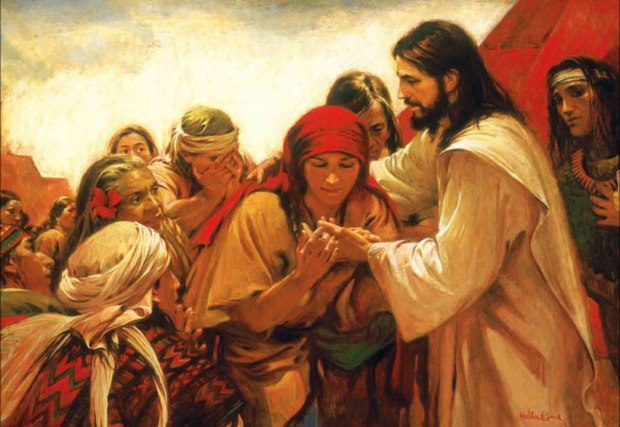
walter-rane

Application:

The application is simple: To be raised with Christ is to build His community as Jesus did after His resurrection.

“If then you have been buried with him in baptism, in which you were also raised with him through faith in the powerful working of God, who raised him from the dead, walk in newness of life and seek the things that are above, where Christ is, seated at the right hand of God.” ~ Colossians 2:12, Colossians 3:1, Romans 6:4 (Blended ESV)

Again, we may think the key to being on mission with God is effective evangelism, but when we consider how Paul and early church perceived being raised with Christ, we find the critical priority to be the community of Jesus serving one another in love with evangelism as the overflow. For when a genuine Christ community exists that’s all the Holy Spirit needs to impact the cultural community it exists in.

Therefore, we must be careful we don’t abuse evangelism as a promotional means to add to ‘our’ number, but rather allow the Spirit to awaken eyes to see the love we have for one another. This, I suggest, was the center of Paul’s approach to mission – we don’t build a colony of heaven through forced rhythms of effort, but instead build Christ’s community through unforced rhythms of service laden with love, kindness, and compassion. Doing this, as Paul saw it, was the way a local church could reflect heaven on earth and the way the Spirit could spread this light into new places.

As for the body of Christ, the recipe for cultural transformation is straightforward: To build communities of agape love and to let the Spirit establish them as colonies of heaven. For as we know, in this life we are plagued by worldly structures bent on dominating, manipulating, and controlling through destructive systems of independence yielding cultures of anxiety, fear, hatred, and pride. However, by living confidently in the assurance of our guaranteed future (Jeremiah 29:11, Romans 4:16, Hebrews 11:1), we can be free to accept a Kingdom, ‘crucified and raised in Christ’ structure as the framework by which we love and serve – a structure that proclaims the good news in this way: We are free because we’re helpless, free because we’re confident, free because we’re crucified in Christ, and free because we’ve been raised with Christ, the foundation to being a Jesus community4. Once we accept our helplessness, then we can better depend on the Holy Spirit, rest in our future completion, and serve in present love.

Paul describes this endgame in Galatians 5:13 and 6:2:

For you were called to freedom, brothers. Only do not use your freedom as an opportunity for the flesh, but through love serve one another.” ~ Galatians 5:13

If you bear one another’s burdens, if you love by serving each other, you’ll stay in the Spirit and remain in alignment with Christ and so fulfill the law of Christ.” ~ Galatians 6:2 (paraphrased)

With Christ’s resurrection in mind, the core of being a community of Christ is experiencing the law of Christ as loving one another by serving one another…

…which brings us to why Jesus took the towel in John 13. 

While many are quick to emphasize Jesus’ humility and modeling of submissive service, what’s often missed is how the washing of His disciples’ feet clinched the founding of His community. Backtrack to v. 3 and we find our first sign of evidence: Jesus knew the Father had given all things into His hands and that He had come from God and was going back to God. This is the real reason why Jesus took the towel5 – to not only achieve a timely metaphor, but to unveil a central commandment (i.e. ‘love one another’) that would soon become the cornerstone of Christianity.

basin-towel1

Remember up until their feet were washed, the disciples were followers, but not a following of disciple-makers. When Peter didn’t want Jesus to wash His feet, Jesus said, ‘If I do not wash you, you have no part with me‘. Why? Because love through serving was the foundation Jesus was laying. In other words, Jesus knew convicting Peter to helplessness would open him up to radical dependence. We see this instantly when Peter replies, ‘Lord, not my feet only but also my hands and my head‘. Yet, even at the utter of this imperative, little did Peter realize this act of total dependence would result in radical freedom, a newness of life where he could experience life as a new human serving and loving.

As Peter discovered, the implications of this reality, specifically how we do church, is huge. In a world screaming ‘make your life count’, it’s worth noting the early church would not have understood such dogma. To them, one didn’t try to make a difference, but rather let their love through service be the difference. As such, having embraced their identity as a resurrection community – a community who loves and serves in the moment – their operation as the new humanity would ultimately revolutionize arguably the world’s greatest superpower in history.

Bottom line: What Jesus did in John 13 went far beyond washing a few stinky feet.

Rather by exchanging outer garment for towel…

  1. He revealed what resurrection community would soon look like – a ‘walk in the Spirit’, ‘serve your spouse, forgive your brother, love your enemy’ way of living far contrary to the ‘life, liberty, and the pursuit of happiness’ lifestyle we know today.
  2. He connected repentance to not only being transformed by the renewal of our minds (Romans 12:2), but also celebrating our helplessness, dependence, and freedom to be a John 13:35 community so, “by this all people will know that [we are His] disciples, [by our] love for one another.”
  3. He redefined church as a body of believers becoming the colony of heaven on earth by living in the Spirit (i.e. daily dying and rising with Christ).

Selah.

Prayer:

Footnotes

  1. As would soon emerge through the Holy Spirit
  2. Not to suggest we don’t prioritize evangelism; after all, the Holy Spirit’s coming was so we could be empowered to be Christ’s witnesses.
  3. Remember after Christ’s resurrection, Jesus not only prepared a community the Holy Spirit would eventually come upon in Acts 2, but also a unified body transformed by Christ’s love as a testament to God’s existence.
  4. Inspired by Messenger Fellowship’s ‘Being the Community of Jesus’ module.
  5. Side note: I love how this moment captures Christ’s baptism and brings it full circle (more on this in a future post).
Photo creds: Highland Park United Methodist Church
*Content inspired by Messenger Fellowship’s ordination course*


3 More Things I’m [Really] Sorry For

If you’re like me, you like to reflect.

So much to say, so much to do…how can either happen when there’s so much to think.

Yet, as we journey another January, the heart behind this series, as made known last year, is still the same:

If we want to think right, then we must get right, if we want to get right, then we must get real…and if we want to get real, we must value cleanse before change.

Not to suggest such internal inventory is easy. Certainly putting all things on the table for examination requires courage, humility, vulnerability…among other things; however, since my goal with these posts is to help us embrace God’s ‘next’, it only makes sense to pray into the substitutions¹ God has for us.

That said, here are three things I’m owning as we turn the page to 2019…

1) Making sense of my surroundings

It’s remarkable the ways we justify our surroundings. I know for me, whenever I find myself in what I can’t explain, living in the moment can almost seem secondary to knowing why it has to exist. ‘If only I can solve the mystery, perhaps then I can find the satisfaction and peace I crave,’ I sometimes think.

But as we know, the journey of life is far from cut and dry. As much as we want to reconcile all our relationships and circumstances, we’ll never be able to given sin and free will’s response to it among other things.

Granted, God’s sovereignty isn’t confined by man’s weakness. But it’s also not restricted by our ability to ‘sherlock’ the past. And it’s this temptation I believe trips many of us up. We long to feel affirmed when we’re down. We yearn to feel validated when we smell injustice. We burn to make sense of our surroundings when they don’t make sense. Yet, in our quest to solve our voids, little do we realize the size of our ego and the numbing effect it has on our attitudes and heart postures.

It’s not always fun to accept, but the way I see it: Often the reason we are where we are is because God wants to help us find our kneel…to show us where our independencies have become idolatries…and to learn reliance within the unforced rhythms of grace. Perhaps you’ve struggled to grasp this feeling in seasons of idleness or stress…in settings where you felt more like a fish in an aquatic Pandora’s box.

If so, take a bite of my 2018 testimony. Our free will exists so we can choose Jesus to find freedom. No 12-step program full of striving. Just a simple decision to resist the fear of man and the impulse to make sense of our surroundings.

Accordingly, if you sense the temptation but not the exit, yield to surrender, voice the heartcry, and receive the serenity of stilled waters. God has not abandoned you, so don’t you abandon ship.

giphy

2) The Nazareth complex

I suppose this could be a subset of point #1, but the nature of this conviction alone is worth emphasizing.

As alluded to in my 2018 Year in Review post, when last year started, going back to The Gate was far from an option. Having phased out of LEGACYouth weeks prior, my hope had clung to a sunset narrative where my last days of youth ministry would coincide with where it took place. While there were many reasons I emotionally did not want to return, the core of my withdrawal² centered on what I call the Nazareth complex.

The Nazareth complex is based out of Luke 4:14-30 when Jesus is driven out of his hometown (i.e. Nazareth) after revealing his true identity at the synagogue. While obviously I’m no Jesus, the personal correlation was this: Among whom whose eyes I had been under for years, there was no way for me to be known as God knew me. As such, what Nazareth was to Jesus, The Gate/local church was to me. To move on with my life, I had to leave the church to find anyone who not only would listen, but see me sans past and last name.

Of course, it’s safe to say Jesus never employed such a self-absorbed attitude. Still, it’s not hard to see why my deception took months to dissipate with resentment rooted in deception and victimization fixed in misapplied Scripture. To justify my isolated ego, I had to constantly cite the past, church gossip, unsurrendered soul/spirit hurts…even assumed vain assumptions (sounds confusing, but that’s unholy fear for you).

Yet, as the story goes, I eventually woke up, realizing if I truly wanted to move on and take hold of the new, I couldn’t keep holding on the way I had been. Six months later, the exchange is still ongoing…however, the door to freedom is much wider, in large part, to having repented of this complex.

tumblr_nikl8pxddz1tq4of6o1_5003) Financial fitness

For many couples, one spouse is the buyer, the other is the saver. In my relationship with Lyssah, the contrast is evident. While I’m a buyer who lives well within his means, Lys is much better at budgeting and sticking to it.

Ironically, you would never know by where our financial anxieties lie. As co-bread winners, to make ends meet, we both must work…whatever the cost with whatever time we can give. Unfortunately, the drive for excellence doesn’t always extinguish the entitlements and justifiers we use to buy (or even save for) momentary contentment/peace.

I know for me, I can only afford to invest so much as I near the end of paying off student loans. The white lie, then, is if I can’t currently invest as much as I want for my family, I should be frugal in my giving and employ generosity through alternative means. Yet, as I’ve been convicted, often my lack of giving ties to a lack of trust manifest as leverage against God for not opening certain doors. And I think for some of us, we forget withdrawing doesn’t just apply to our presence and/or banking transactions. It’s applies to trusting God with our finances…our energy…our time…not just what to sow, but where to sow and how much.

All that said, if you feel financial weak starting 2019, you’re not alone. Yeah, I’m an ex-Ramsey spouse. I have content, lessons, and principles I can pass down to future generations. But I also know…

  • If I’m not maturing my stewardship, those values can only go so far.

  • If’ I’m not maturing my stewardship, my intentionality in inviting God into my budget will be compromised.

As for 2019, no longer will I reduce God to an on-call financial counselor and over-rely on my wife’s strengths to make up the difference. Rather, I’m going to pursue financial fitness, embrace frugality under the context of stewardship, and flex into shape accordingly.

Think of it this way: Even though money isn’t the end-all, be-all of extending God’s providence, in no way should we want God’s faithfulness to be restricted by what we’re not trusting Him in.

Besides if you’re reading this, chances are you have enough and know God as more than enough. Not do you have what it takes…but you can do this. Why not do it together?

giphy-1.gif

Selah.

Footnotes

  1. Where I’m letting go of a stronghold, sin, negative thought pattern, etc. to replace it with something better
  2. Albeit an indefinite sabbatical was necessary
Photo creds: https://buzzerg.com

3 Underrated Life Lessons from ‘Home Alone 2’

As mentioned last December, when it comes to memorable Christmas movies, it’s hard to leave ‘Home Alone’ off the list. The charm, the music, the shenanigans, stir in some holiday vibes and family flavor, and it’s no surprise the film has stood the test of time.

Yet, while the success of Home Alone would ultimately inspire a carbon-copied cash cow sequel, having recently revisited Home Alone 2, it’s worth noting the life lessons embedded in its baggage (pun intended).

Thus, in the spirit of extending tradition and diving into yet another Chris Columbus movie, here are three underrated life lessons inspired by ‘Home Alone 2’…

  1. Keep your heart [pure]…

In this exchange, Kevin and the pigeon lady are in a loft above Carnegie Hall where she explains her mid-life crisis following her lover’s departure.

After admitting relational apprehensions, Kevin suggests she starts trusting people again. Having confided in her, Kevin then shares of past misbehaviors before accepting the pigeon lady’s advice to create good tidings in their place.

For a movie needing to convey a universal message yet remain politically correct, I’m not opposed to this moment of improbable dialogue. That said, if I’m in Kevin’s shoes, I’m not saying, ‘keep you heart open’; rather, I’m likely substituting something less vague like ‘clean’, ‘pure’, ‘vigilant’, etc.

—————————————————————————————————————————————–

Create in me a clean heart, O God, and renew a right spirit within me.” ~ Psalm 51:10

And I will give you a new heart, and a new spirit I will put within you. And I will remove the heart of stone* from your flesh and give you a heart of flesh.” ~ Ezekiel 36:26

Keep you heart with all vigilance, for from it flow the springs of life.” ~ Proverbs 4:23

—————————————————————————————————————————————–

To be fair, the way Kevin uses ‘open’ here is worth some benefit of the doubt. Generally, when we use the word in similar fashions, we’re encouraging someone not only to take inventory of fear, but to count the cost of courage. Still, while Kevin’s advice is admirable for a ten-year-old, I submit had he been more specific and defined certain truths she should be open to, he would have better helped the pigeon lady move on from her past…

…which brings me to my first point…

…if we’re going to employ goodness, why superficially deliver it fearing we may be wrong or intrusive? Not to suggest we disregard decency and modesty, which organically come as we’re led by the Spirit; however, if we’re content in preserving shallow forms of goodwill, are we not reflecting a subtle version  of what we long to see people free from?

As one can relate to the pigeon lady (i.e. the paralyzing effects of crushed dreams and unpruned fears), all I know is whatever love I give or receive…I want it to pierce something…be it pain, confusion, anxiety, whatever. After all, God will take care of my options, but as for you, I just want to see you be brave and, at least, consider telling me something I may not know and/or need to straight-up hear.

Bottom line: If you’re going to encourage someone to keep their heart open, don’t end the sentence with ‘open’. In this way, you’ll charge your encouragement as a springboard rather than a sugarcoated fortune cookie.

*Bonus points to Kevin for this line: “If you’re not going to use your heart, then what’s the difference if it gets broken?” A heart of stone, whether intact or shattered, is still stone.

  1. Know why you battle

It’s hard to ignore your favorite scene in a post like this. Even if it wasn’t, you got to admit the first 36 seconds of this clip, as ex machina they may be, pump the adrenaline.

Yet, before the movie’s climax can commence, consider how the scene starts…

Interesting, how the clip starts with the Star of David. Granted, this makes sense given the song’s lyrics…

Distant stars, at home up in the heavens.
Wonder what they see, are they watching me?
Christmas Star, you spin your strands of silver.
What a sight to see, are you there to guide me?

Star light, shine bright.
See me through the dark night.
Light my pathway;
Guide me home for Christmas Day.

Still, it’s refreshing to see how a symbol of Christ’s birth helped ignite this sequence.

First, you have a Star of David helping harness Kevin’s attention onto an ill peer. From there, Kevin is reminded while he’s still lost in the most populated city on earth, there are others less fortunate worth fighting as confirmed by his battle-cry…

“You can mess with a lot of things, but you can’t mess with kids on Christmas!”

To sum up this scene, if we stop and consider the broken around us, it’s not long until we’re reminded why we battle against evil schemes (Ephesians 6:11)…why what we protect is worth protecting. Kudos to Columbus for somehow capturing it all in only half a minute!

Bottom line: Perspective matures our vulnerability into mobility. If we want to fight the good fight and overcome evil with good, don’t just ponder the good, bask in it.

  1. Dove the one you love

For this one, I’m not so caught up in the actual clip as much as I’m reminded how much deeper turtle-dove significance is in the Bible. A quick systematic overview reveals turtle-doves are more than sentimental emblems. Rather they demonstrate the beauty of sacrificed innocence (Old Testament), passionate devotion (Song of Solomon), imminent healing/thanksgiving (Hezekiah), and prophetic divinity (Gospels).

If you ask me, turtledoves are underrated when we reflect on the true meaning of Christmas. True, we sing of them frequently every time we come to the second day of the ‘Twelves Day of Christmas’ carol; however, if we zoom out and consider why turtledoves have any Christmas connection at all, we find reason in their physical and symbolic splendor represented in Creation to Noah…all the way to the Cross. In essence, they are a genuine reminder that Jesus is the reason for the season and in Him, a) God is pleased and b) we can know true peace and goodwill.

Bottom line: Doves capture the sweet aroma of incarnational love.

Selah.

Cover photo creds: The Daily Edge

Kingdom Carriers: The Reason We Exist (Part 2)

Part 1: Kingdom Agents: The Reason We Exist

So a few weeks back, I’m chillin’ in my humble abode, perusing a couple bivocational pastoral forums when I notice an intriguing update…

I work for UPS and have not taken a salary in the year and a half since I’ve been at my current church. They do provide a parsonage though. I have really been struggling with being bivo[cational]. Outside of my secular job I never feel I’m able to give enough or do enough for my ministry or my family. My job doesn’t build relationships because I’m all way in a different office and on different routes with no real interactions. It really is money only and I hate that. My dream would be to have a job [where] I can truly make money, not a get rich quick gimmick, and that gives flexibility when needed. Actually I’ve always dreamed of opening a coffee and sandwich shop. I have a dream to write but can never get enough time to make much progress. I just have been dealing a lot lately with not being enough, or not achieving enough, in any part of my life. It feels like the duck floating in the water. Things look smooth on the surface but underneath I’m fight what seems to be a losing fight right now. And I don’t know how to fix it or what to do.”

Now, before I continue, understand I’m normally not one to share anonymous posts; however, with this one, I can’t help but resonate given there are people like this all around us…

…questioning their purpose…

…making ends meet…

…all the while desperate to dream in light of their surroundings.

Accordingly, how we engage the chaos in a way that merges ‘hope of glory‘ and ‘hope of freedom‘ within our influence is worth discussion.

My thought is: whether you consider yourself vocational, bivocational, or multi-occupational, regardless of what you’re sacrificing, you desire to lay a foundation of life that pierces the mundane doldrums of an ego-driven culture.

Unfortunately, our desire to build upon this foundation is often offset by discouragement and disorientation. For example, some people know their identity as ‘loved by God’, but feel rudderless in a dead-end situation while for others, they have the ideal situation, but have no idea of who they are and what they’re truly called to.

hsy5VW5

To compound matters, there is dissonance as people who see themselves as a collection of acquired skills and experiences collide with those who view their passions and assignments as functions of their uniqueness. Granted, we live in a fallen world of mixed perspectives where you are what you do outside of what you believe; hence, the tension many believers encounter when they take a servant mentality into the marketplace.

But for the dire dreamer determined to stay up on the down side of life, sometimes acknowledging the fact it’s not supposed to be easy isn’t enough. At some point, we must accept the fact people are not only looking for momentary motivation, but long-term resources and willing availability.

Not to suggest we downplay our readiness in giving answers for the hope we have. I’m just sayin’ if all we’re doing is pointing people, like the UPS man, in the right direction, can we honestly say we’re doing all we can to help? In counseling them to find the tools and direction they’re looking for?

And hear me: I’m not sayin’ we fix all the peoples…all the situations…and make floating ducks feel like power trucks.  I get there are times when all we can do is stand and point people in the way they’re to go.

However, if we see ourselves as Kingdom agents/ambassadors, then we should expect to receive appointed assignments where the only way to reach out is to create room…

…which leads me to why I’m writing this…

…so that we all can be more attuned in extending Jehovah-Jireh hope to the UPS man’s of the world…

…in conveying the promises of God who will not only provide, but get us to the other side…both in trust and in faith.

Perhaps you’re not a fan of who you are or where you’re at right now. Maybe you feel an awkward divide between you and who you wish to pour into1.

If so, I encourage you: stand strong, know you’re loved2, and invite God into the voids you sense. Remember you have what it takes to fight the good fight (1 Timothy 6:11-16)…and by not quitting, you ultimately help others do the same.

As to how we do that?

Well, let’s just say…

that is why we exist.

tenor

Selah.

Footnotes

  1. Or who you wish could pour into you
  2. And never alone
Cover photo creds: benzinga.com


Visions of Vocation (Part 1)

So lately, I’ve been thinking…

…in my quest to resource the church on marketplace ministry, have I been wrong in using the term, ‘bivocational’?

Have I been misleading people through a lack of definition, context…

…or even worse, discouraging people implying the expression as elite?

If so, please know…

  1. My intent is to encourage people where they’re at as opposed to elevating where I’m at.
  2. My goal is to inspire anyone and everyone to run their race to the fullest.
  3. If I’ve given any evidence to the contrary, I sincerely apologize.

Having said that, permit me to press the ‘reset’ button and clean house…

DD4 reset button image2

Going back to our founding in 2014, no question, Lyssah and I were stirred by lessons learned as we balanced jobs in church and out. A quick jaunt to our ‘about’ page confirms this as its composition datestamps a time when our vision, mission, and target audience were finding their niche.

But somewhere during the writing of, ‘The Bottom Line’ in 2016, the tent pegs of what I had thought about ‘bivocational ministry’ began to expand. Suddenly, I saw how ‘bivocational’ in a bifunctional and spiritual gifting context could apply to anyone. As such, by the time I completed the e-book, my thinking had changed so dramatically, what started as a tool for a minority was now a resource for a majority.

Flash-forward to today and the evolution of thought, heart, and content change is still tough to gauge on the outside looking in; hence, why I wanted to take this minute to inform you while we believe occupation and vocation are related, they are not the same thing.

For example, as a youth pastor, what came first: my job or my calling?

If you answered the latter, you’d be correct.

Before I was alive to have an occupation1, God had a specific vocation or klḗsisover my life the same way he had a vocation (i.e. calling) over your life.

2 Timothy 1:8-9 (ESV) confirms this…

Therefore do not be ashamed of the testimony about our Lord, nor of me his prisoner, but share in suffering for the gospel by the power of God, who saved us and called us to a holy calling, not because of our works but because of his own purpose and grace, which he gave us in Christ Jesus before the ages began.

The problem is we often think of ‘calling’ as this one great thing we’re supposed to do whether it’s writing a New York best seller or rising as a top executive at a fortune 500 company; however, when we consider how “in all things God works for the good of those who love him, who have been called according to his purpose” (Romans 8:38), we find God gives us more than one calling.

Take Jesus for example: as a child, he was a faithful student; as a teenager, he was a faithful carpenter (with special guest temple cameos); and by thirty, he was a faithful minister.

Now, we can nit-pick whether ‘student’ and ‘carpenter’ are vocations or occupations. Personally, if you used this model to suggest God designated various occupations to prepare His Son for his ultimate vocation (i.e. Matthew 28:19) – “Go therefore and make disciples of all the nations, baptizing them in the name of the Father and the Son and the Holy Spirit“), I wouldn’t disagree.

jesus-nazareth-110-730x480

Whatever the case, my thoughts are…

  1. At each season in Jesus’ life, God was preparing him for his rabbinical destiny.
  2. While there may be seasons we don’t like what we do, God is always preparing us for what we’re meant to do (a truth that exists today just as much as it exists tomorrow).
  3. Therefore, even if our occupations (what we do) and vocations (what we’re meant to do) don’t seem to line up, we can rest in the common denominator of reflecting Jesus.

In essence, while pastors and ministers are multi-occupational in the sense their time is occupied with multiple responsibilities, given we’re all called to ordained vocations3, it makes no sense to promote one “ational” above the other and accordingly, be offended, trip over semantics, or fear political incorrectness.

After all, if we see “bivocational” as God giving us multiple skills and avenues to be salt and light, then divisive misinterpretations (i.e. clergy is on one level, laity is on another) waste away.

As a wise man recently told me…

Every believer has several vocations (rooted in bearing and restoring the image of God) and many occupations. A pastor or minister working 2-3 jobs is no less ordained than one fully supported.”

To this, I 100% agree.

Bottom line: Whether you refer yourself as bivocational and/or multi-occupational, at the end of the day, a) one is not better than the other and b) on a lifetime scale, we are all bivocational and multi-occupational. Remember being bivocational isn’t about having an occupational ministry outlet, but understanding what you’re meant to do (and more importantly, meant to be) regardless of what you do/want to do. It’s knowing no matter how you’re getting paid, the hope of glory (Colossians 1:27) always resides in you.

Selah.

Stay tuned next time when I’ll dive into a recent forum post from a bivocational colleague that testifies to why His Girl Fryday exists.

In the meantime, in all you say and do, remember what and who you’re meant for.

Peace…

~ Cameron

Footnotes

  1. Hebrew translation – Avodah
  2. Vocation in Greek: klḗsis– “to call, summon”) – a calling or invitation into something, specifically receiving God’s gift of salvation – with all His blessings that go with it (Romans 11:29; Ephesians 4:4; 2 Peter 1:10).
  3. And all bear multiple responsibilities

Ephesians 4:1 conveys this…

* NAS: in a manner worthy of the calling with which
* KJV: worthy of the vocation wherewith
* INT: to walk of the calling in which you were called

Cover photo creds: Medium