When the Church Looks Less Like Jesus

A call to remember who the Church belongs to—and what the world should see in us.

The Church Belongs to Jesus

What should people encounter when they encounter the Church?

Should they leave impressed by our excellence? Inspired by our music? Encouraged by our preaching? Or should they leave saying, “I caught a glimpse of Jesus.”

That question matters because the Church belongs to Him. She is not ours to redefine, market, or mold according to the preferences of any generation. Scripture describes her as the Body of Christ (1 Corinthians 12:27), the household of God (Ephesians 2:19), and the Bride for whom Christ willingly laid down His life (Ephesians 5:25–27).

If she belongs to Christ, every generation must ask one simple question: Are we becoming more like Jesus? Not more successful. Not more influential. Not more visible. More like Jesus.

To look like Him is to love what He loves, serve as He served, welcome as He welcomed, and make disciples as He commanded. Everything else flows from that.

A Shared Life, Not a Weekly Event

The New Testament presents a compelling vision of the Church. Believers devoted themselves to the apostles’ teaching, fellowship, the breaking of bread, and prayer (Acts 2:42). They shared with those in need (Acts 2:44–45), bore one another’s burdens (Galatians 6:2), rejected favoritism (James 2:1–9), practiced hospitality (1 Peter 4:9), and became known by their love (John 13:34–35).

This was not simply a worship service. It was a shared life. They did not merely attend together. They belonged to one another.

The early Church was not perfect. Acts and the New Testament letters reveal conflict, sin, and correction. Yet they also reveal a people willing to repent and reorder their lives around Christ. That picture should challenge us: Have we unintentionally settled for something smaller than what Scripture describes?

When Activity Replaces Faithfulness

The modern Church has become remarkably effective at gathering people. We organize ministries, communicate vision, create excellent environments, and steward resources wisely. Those things can honor God. But excellence must never replace obedience.

  • Programs cannot replace people.
  • Production cannot replace presence.
  • Attendance cannot replace discipleship.

Methods are servants. They must never become masters.

One temptation facing the Western Church is to mistake activity for faithfulness. The question is whether our methods have quietly become our measurements of success. Jesus did not commission His followers to build impressive institutions; He commanded them to make disciples (Matthew 28:19–20). Paul wrote, “I planted, Apollos watered, but God gave the growth” (1 Corinthians 3:6).

Faithfulness belongs to us. Growth belongs to God.

Christ gave leaders to the Church “to equip the saints for the work of ministry” until the whole body matures in Him (Ephesians 4:11–16). Healthy ministry is measured by whether God’s people are becoming more like Jesus together.

The earliest believers did not simply invite people to a gathering. They carried the life of Christ wherever they went. Their worship overflowed into hospitality, their teaching into discipleship, their fellowship into generosity, and their prayers into courageous witness.
Returning to Our First Love

Churches do not drift overnight. Neither do believers. Even the church in Ephesus—commended for perseverance and discernment—heard these sobering words from Jesus: “You have abandoned the love you had at first” (Revelation 2:4). Their greatest problem was not incompetence. It was misplaced affection.

That warning still echoes. We can become more competent while becoming less dependent upon God, more organized while becoming less compassionate, and more influential while becoming less Christlike.

The greatest threat to the Church has rarely been opposition from the outside. More often, it has been gradual drift from the inside.

Sent Belong the Walls

Outreach has not disappeared from the Church. Countless congregations faithfully serve their communities in ways that honor Christ. Yet we should ask whether outreach has slowly moved from being part of the Church’s identity to becoming one ministry among many.

The ministries hardest to promote are often the ministries Scripture emphasizes most: visiting the sick, welcoming the stranger, caring for widows and orphans, bearing burdens, opening our homes, and serving without recognition (James 1:27; Matthew 25:34–40; Galatians 6:2). These acts rarely generate headlines, fill auditoriums, or build anyone’s platform. But they look remarkably like Jesus.

The Church was never called merely to invite people into a building. She was called to carry the presence of Christ into the world.

More Than Consumers

Perhaps nowhere is self-examination more necessary than in the way we approach gathering together. We ask: Did I enjoy the worship? Did the sermon encourage me? Did I feel fed today?

Those are not wrong questions. They are incomplete.

The New Testament invites us to ask another set of questions: Whom did I encourage? Whose burden did I help carry? Who experienced the love of Christ through me? Who did I welcome, forgive, or serve?

Church was never intended to function like a spiritual gas station where we stop once a week to refill before returning to life unchanged. If we leave our gatherings knowing more about Christ but looking no more like Him, we have misunderstood the purpose of gathering.

Worship that truly encounters God does not terminate on itself. It overflows into love, service, mercy, justice, humility, forgiveness, generosity, and sacrificial care.

Hungry Without Agenda

The same examination applies to every gift within the Church. Whether someone teaches, preaches, writes, leads worship, or serves behind the scenes, every ability entrusted by God exists to make much of Christ. Whenever a gift begins drawing attention primarily to the person using it, we have drifted from its purpose.

The platform has never been the center of worship. Christ is.

I believe believers across the world are quietly praying for communities simply hungry for Christ—without agenda, without platform-building, without chasing influence for its own sake. Communities whose greatest ambition is to know Christ and make Him known. Where people serve because they love, give because they have received grace, worship because God is worthy, and gather because they genuinely belong to one another.

Those communities may never become famous. But heaven has never measured faithfulness by fame. The Church has never needed more influence than faithfulness. She has only ever needed more of Christ.

Call Back to Christ

The prophet Micah summarized God’s desire with remarkable simplicity:

“He has told you, O man, what is good; and what does the Lord require of you but to do justice, to love mercy, and to walk humbly with your God?” (Micah 6:8)

Perhaps the Church today needs that reminder as much as any generation before us. This is not a call to abandon Christ’s Bride. It is a call to love her enough to invite her continually back to her first love.

The answer to an imperfect Church has never been abandoning her. The answer has always been allowing Christ to continue sanctifying her—including us.

May we have the humility to examine ourselves before we examine others. May we have the courage to repent wherever we have drifted. May we become people hungry for Christ without agenda—content to decrease so that He might increase.

And until the day we finally see our Savior face to face, may the watching world first catch a glimpse of Him in us.

For that has always been the Church’s greatest witness.

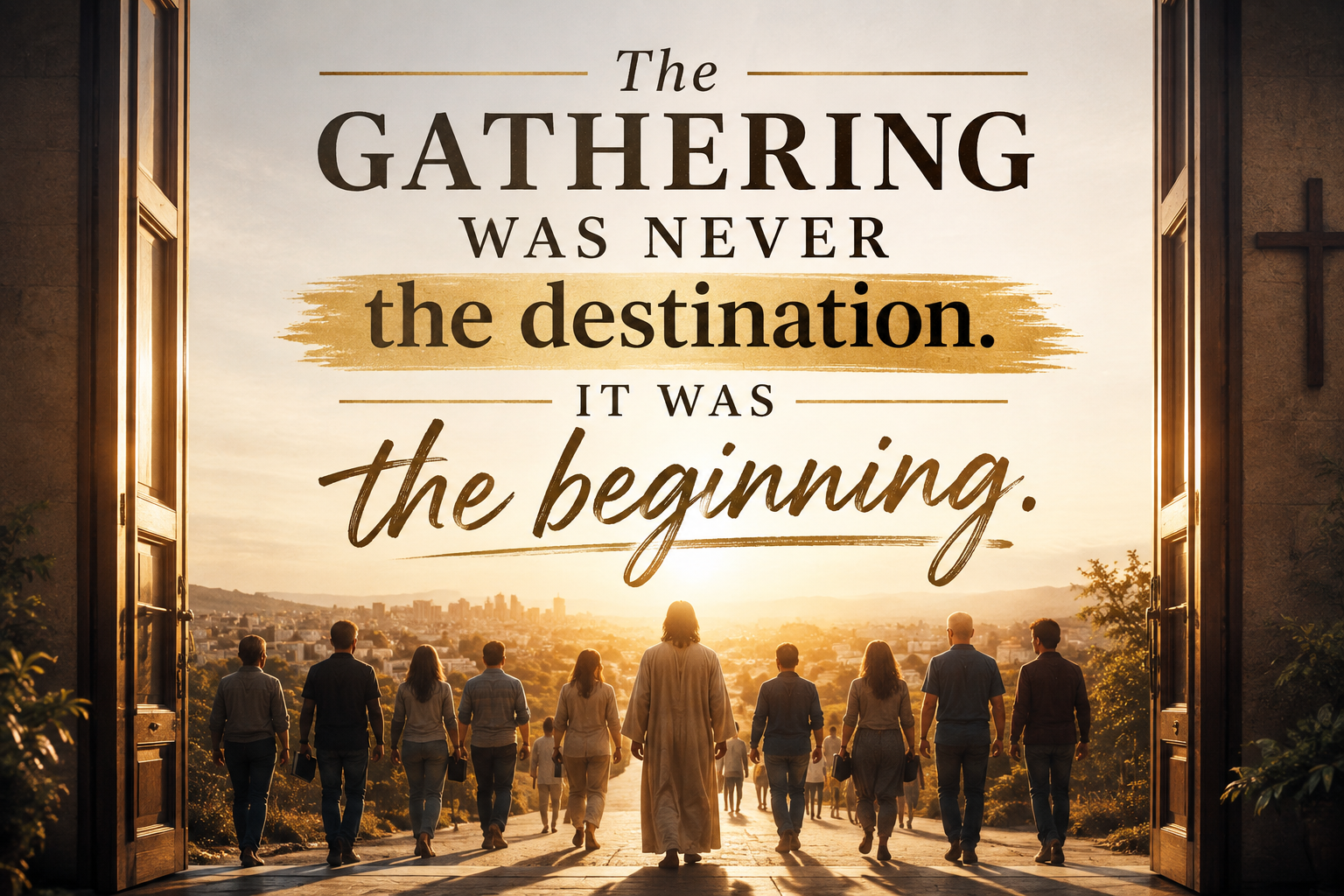
Graphics created in ChatGPT

Proverbial Life: A Quick Guide to Possessing Your Soul

Context: This post was inspired by a May 16 conversation with my dad prior to his Sunday AM message @ The Gate Community Church on May 19. Moving forward, any content centered on internal endurance (and/or a ‘Proverb outside of Proverbs’) will be categorized into this new series called ‘Proverbial Life’.

It’s a complicated theme in Scripture…

God, as love, authoring His will in the deepest still; the epitome of fellowship perfecting faith before it could create.

No question, the infinities of life are complex, sometimes intimidating; however, when we consider God at the beginning, we converge on a central truth:

We were made for connection (for love, with love, by love)…

…to pursue peace with all people1…

…and to be unity in community.

Unfortunately, this is easier said than done in a day when relationships are compromised by  busyness, striving, even insecurity. Perhaps you’ve encountered similar barriers wondering how to navigate around them.

If so, I want to encourage you with a Proverb that somehow found itself in Luke 21.

But before I dive in, allow me to uplift the down heart reading this…

  1. You are not alone. You are not here by accident. You are a treasure. You are an asset to an unshakable Kingdom. You are a chosen child of God. Just marinate in these identity statements a bit.
  2. If you’re not in the rhythm of daily dying2, staying the course in any situation will be challenging. An odd segue, I admit, but one I speak from wanting you, the reader, to surrender all trust in God knowing He understands your wants, needs, desires, and dreams better than you do.
  3. In writing this, I don’t want to downplay the struggle of connecting to those preserving their rhythms, content with you being on the outside looking in. I get it. If there’s one mountain in recent church testimony, it’s this. Still, even though the purest of intentions can become unyoked priorities, you can’t take on the wrong burdens even if you’re the only one who sees them.

Having said that, let’s dig into the Word…

giphy

“By your patience possess your souls.” ~ Luke 21:19 (NKJV)3 4

“By your endurance you will gain your lives.” ~ Luke 21:19 (ESV)

“By your [patient] endurance [empowered by the Holy Spirit] you will gain your souls.” ~ Luke 21:19 (AMP)

“Stand firm, and you will win life.” ~ Luke 21:19 (NIV)

“Staying with it—that’s what is required. Stay with it to the end. You won’t be sorry; you’ll be saved.” ~ Luke 21:19 (MSG)

As expected, wording varies upon translation, but the general concept is the same. When we reference this verse to Matthew 4 and note the heart of Jesus, we find the Son of Man walking in authority by the power of the Holy Spirit. Everywhere he went in this power, every time he returned in this power. Even when Jesus was tempted, Jesus was centered in his identity by…you guessed it…the power of the Holy Spirit.5

Often times, when we think power of the Holy Spirit, we think wonders and miracles, but for Jesus, the most frequent manifestation of the Spirit’s power in him was his reliance upon the Father to possess his emotions. A simple anecdote upon first glance, but one with significant applications when we consider Jesus was tempted in every way like we are today. This in mind, we can’t take lightly the vain thoughts we tolerate in place of deferred hope given the power of fear ultimately numbs us to the power of the Spirit.

Again, Jesus is the way we must model. To him, his ‘standing identity’ wasn’t mutually exclusive from his identity in God. He knew to walk in real authority, whether resisting the enemy or healing the sick, he had to possess his soul to keep it from ruling him. The more opportunities he had to cultivate endurance in this way, the more he walked confidently in his identity and the authority that overflowed.

Furthermore, it’s worth noting Jesus never asserted his authority as a self-evident right, but out of a posture of rest. This is key for us concerning spiritual warfare. To say Jesus asserted his authority out of rest means he didn’t contend for authority with the enemy; rather he exercised it knowing he was free from needing God to approve himself and defend his rights.

This, in turn, allowed his faith to flow from identity and empowered him not to be offended that his purpose was rooted in dying.

So in a weird sense, we should delight in the fact God tests us through relational voids6 given His heart is to refine our rest and trust in our ‘loved by God’ identity. Not to suggest every relational lack is a test from God. I’m just saying when we look at how Jesus lived and what He longs to develop within us, how can we not be grateful knowing our patience can mature as we master our inner man? How can we not be excited our ego-triggered fears can be subdued by the same power Jesus abided in?

giphy (1)

Bottom line: Every day is an opportunity to die to self, receive God’s life, and discover our purpose through our ‘loved by God’ identity.

Accordingly…

  • Next time, you’re alone, remember Jesus was often alone…yet relied on the Father in those moments.
  • Next time, you feel judged, remember Jesus was constantly misunderstood, even in praise…yet consistently ran to the source of his confidence.
  • Next time, you feel drained, remember Jesus was tired on many occasions…yet knew the fruit he bore strengthened his perseverance. 
  • Next time you feel disconnected or discouraged, remember to rejoice as you suffer in steadfastness!

After all, God is always up to something special, something incredible beyond your comprehension. Just keep your eyes centered on the perfecter of your faith, surrender what you think should be present in your life, and stand firm regardless of how you feel…

…knowing no matter what happens…

…the Creator of your soul will be there to gain your souls.

Selah.

Footnotes

  1. Hebrews 12:14 NKJV
  2. To the will of your flesh
  3. Putting NKJV first since I like the way this translation catches the Greek
  4. Patience in Hebrew refers to suffering in steadfastness
  5. So while there’s truth in viewing this verse as a bottom line for a well-disciplined life, the whole point is what connects standing firm to winning life…and that is the power of the Spirit.
  6. And conflicts
Cover photo creds: WallpaperUP

Rolling Stones: Why The Torn Veil & Split Rocks Matter

It’s the most pivotal moment in history…

…Jesus…on the cross…

…a joy once set before him, now the weight of the world.

Battered and bruised, he waits; the darkness of sin in foreign space. The epitome of innocence now weeping for his father…

“My God, My God, why have you forsaken me?”

One can only imagine what it must have been like to be a bystander watching this wonder working power helpless on a tree…to stand amidst this moment in time as it became a moment for eternity.

2ywqod

Would you agree?

If not, permit me to explain through the lens of some rocks, a veil and why it tore immediately after Jesus’ last breath.

During Jesus’ ministry, the holy temple in Jerusalem was the hub of Jewish religious life, a place where animal sacrifices and scroll readings were carried out according to the Law of Moses. In this temple, a veil separated the Holy of Holies from the outer court for three reasons:

  1. The Holy of Holies was a landing spot for God’s presence
  2. The Holy of Holies was a place of consecrated communion between God and the high priest.
  3. The Holy of Holies signified man’s separation from God by sin foreshadowing sanctification through atonement.

Isaiah 59:1-2 (ESV) and Hebrews 9:6-9 (AMP) capture this in tandem:

“Behold, the Lord’s hand is not shortened, that it cannot save, or his ear dull, that it cannot hear; but your iniquities have made a separation between you and your God, and your sins have hidden his face from you so that he does not hear.”

“…the priests continually enter the outer [or first section of the] tabernacle [that is, the Holy Place] performing [their ritual acts of] the divine worship, but into the second [inner tabernacle, the Holy of Holies], only the high priest enters [and then only] once a year, and never without [bringing a sacrifice of] blood, which he offers [as a substitutionary atonement] for himself and for the sins of the people committed in ignorance. By this the Holy Spirit signifies that the way into the Holy Place [the true Holy of Holies and the presence of God] has not yet been disclosed as long as the first or outer tabernacle is still standing [that is, as long as the Levitical system of worship remains a recognized institution], for this [first or outer tabernacle] is a symbol [that is, an archetype or paradigm] for the present time. Accordingly both gifts and sacrifices are offered which are incapable of perfecting the conscience and renewing the [inner self of the] worshiper.”

To recap, that’s over a millennium of one high priest making one annual visit to encounter God under first covenant law. That’s intense. I can only imagine if memes existed back then, how many would hinge on ‘no pressure’ taglines.  Not to mention if John 3:16 was extrapolated back to Exodus:

“Before God could send His one and only Son, He had one and only day to meet one and only mediator1, a high priest oblivious to how the blood of his lambs bode the blood of the Lamb.”

Of course, I’m being jocose in my paraphrasing. But perhaps you’re still wondering, ‘What does any of this have to do with Jesus dying on the cross?’

To answer this, let’s compare Matthew 27:50-51, Mark 15:37-39, Luke 23:44-47 respectively:

“And Jesus cried out again with a loud voice and yielded up his spirit. And behold, the curtain of the temple was torn in two, from top to bottom. And the earth shook, and the rocks were split.”

“And Jesus uttered a loud cry and breathed his last. And the curtain of the temple was torn in two, from top to bottom. And when the centurion, who stood facing him, saw that in this way he breathed his last, he said, “Truly this man was the Son of God!”

“It was now about the sixth hour, and there was darkness over the whole land until the ninth hour, while the sun’s light failed. And the curtain of the temple was torn in two. Then Jesus, calling out with a loud voice, said, ‘Father, into your hands I commit my spirit!’ And having said this he breathed his last. Now when the centurion saw what had taken place, he praised God, saying, ‘Certainly this man was innocent!’”

Now, before we pursue our bottom line, let’s note some contrasts:

  1. In Matthew, we see the veil tearing and rocks splitting; no mention of the centurion.
  2. In Mark, we don’t have rocks splitting, but the centurion is introduced confessing Christ as the Son of God.
  3. In Luke, we have time stamps and are re-introduced to the centurion who this time confesses Christ as innocent. Unlike Matthew and Mark, the veil is said to have been torn prior to Jesus’ death.
  4. Interestingly, the common denominator in all accounts is the torn veil. While not mathematically confirmed by Scripture, Exodus suggests this veil was likely near 60 feet high and four inches thick meaning not even Samson could not tear this thing.

Merging the differences, the moment fleshes out…

 “It was now about the sixth hour, and there was darkness over the whole land until the ninth hour, while the sun’s light failed. Then Jesus, calling out with a loud voice, said, ‘Father, into your hands I commit my spirit!’ Having breathed his last, the earth shook, the rocks were split, and the curtain of the temple was torn in two from top to bottom. Now when the centurion saw what had taken place, he praised God, saying, ‘Certainly this man was the Son of God!’”

From here, we can now grasp the magnitude of the moment.

Once Jesus surrenders his spirit, it’s at this point the veil tears; however, the orientation of the tear is significant as it didn’t occur randomly, but from top to bottom. The commentary on this can be simplified as follows:

  1. The significance of the torn veil was the consummation of Christ’s sacrifice and atonement.
  2. The significance of the torn veil splitting top to bottom was the Holy Holies now being open to all people for all times.

Put another way, the veil tearing top to bottom not only captured the movement of God’s holy temple from manmade structure to internal dwelling, but also foreshadowed the coming of the Holy Spirit in Acts 2.  No longer was the Old Covenant relevant where high priests represented the masses; rather, Christ could now be both our High Priest and the way to get to Him.

Hebrews 8-10 breaks this down beautifully, specifically when 8:13, 9:8-9, and 10:19-20 (ESV) are linked together:

“In speaking of a new covenant, he makes the first one obsolete. And what is becoming obsolete and growing old is ready to vanish away. By this the Holy Spirit indicates that the way into the holy places is not yet opened as long as the first section is still standing (which is symbolic for the present age). According to this arrangement, gifts and sacrifices are offered that cannot perfect the conscience of the worshiper. Therefore, brothers, since we have confidence to enter the holy places by the blood of Jesus, by the new and living way that he opened for us through the curtain, that is, through his flesh.” 2

To quote Michael Houdmann, “The things of the temple were shadows of things to come, and they all ultimately point to Jesus Christ. He was the veil to the Holy of Holies, and through His death the faithful now have free access to God.”

As for the rocks splitting, though often lost in context, this, too, is a meaningful anecdote. While the torn veil signified the tearing of Jesus’ flesh, reconciliation between God and man, and Christ’s post-salvation residence, the split rocks captured the effects these had on the physical world. A preview of the tomb, the split rocks were more than a consequence of the earthquake following Jesus’ final breath, but rather a permanent reminder for humanity that death is the ground of resurrection…that what happens in the spiritual can’t be excluded from the physical.

The rocks, in a way, also signaled the resurrection of our earthly bodies (see 1 Corinthians 15:35-54) and a Kingdom that cannot be shaken (Hebrews 12:18-29). Granted, theologies vary enough to warrant a second post for a different day; the bottom line is the rocks were both imagery and analogy to God’s sovereignty in creation, His power in death, and His intent for new life.

I love how John Piper paints this in Desiring God:  “The earth was shaken and rocks split by a sovereign earth-controller and a powerful rock-ruler. Human deaths don’t shake the earth and split rocks. God does. Rocks don’t have a mind of their own. They do what God bids them do. And they shook and split.”

Come to think of it, what a visual the rocks are to Christ’s identity as our everlasting rock (Isaiah 26:3-5), our fortress in whom we take refuge (Psalm 144:1-2). True, the veil reminds us the barriers once between God and man are now a pathway to walk in boldness (Hebrews 4:14-16), but the rocks remind us that pathway is also one we can walk in confidence.3

And that, my friends, is why we celebrate Easter: To commemorate Christ as our greatest anchor amidst a shaking world and our greatest security amidst a collapsing one. When life is unstable, He is able. How sweet it is to know the power of the Cross will always be enough to crack the rocks of life…

…that at the mention of His name, mountains bow down and the seas roar…

…the work of His hand having taken the nails for us

As we approach Easter, my prayer for you is that as you come into a fresh understanding not only of what Christ came to do, but what He longs to do in and through you in the days to come.

Until then, I wish you all a wonderful Easter full of peace and rest as you reflect on the ultimate sacrifice.

1-1-1-1-He-is-Risen

Selah.

Footnotes

  1. Already the math gives me tingles
  2. Pretty remarkable how fluid those passages run when put together
  3. Courage is for today; boldness is courage matured; confidence is boldness matured. Shout-out to Benji Block for the breakdown. (Edited by Cameron Fry via Canva)
Cover photo creds: newagechristianity.org (Edited by Cameron Fry via Canva)

Resurrected Community: A SOAP Study on John 13

Scripture: John 13:1-9

“Now before the Feast of the Passover, when Jesus knew that his hour had come to depart out of this world to the Father, having loved his own who were in the world, he loved them to the end. 2 During supper, when the devil had already put it into the heart of Judas Iscariot, Simon’s son, to betray him, 3 Jesus, knowing that the Father had given all things into his hands, and that he had come from God and was going back to God, 4 rose from supper. He laid aside his outer garments, and taking a towel, tied it around his waist. 5 Then he poured water into a basin and began to wash the disciples’ feet and to wipe them with the towel that was wrapped around him. 6 He came to Simon Peter, who said to him, “Lord, do you wash my feet?” 7 Jesus answered him, “What I am doing you do not understand now, but afterward you will understand.” 8 Peter said to him, “You shall never wash my feet.” Jesus answered him, “If I do not wash you, you have no share with me.”9 Simon Peter said to him, “Lord, not my feet only but also my hands and my head!”

Observation:

While much attention in this passage is given to the washing of feet, it’s interesting to note the towel’s contextual significance in the moment and beyond. With His hour rapidly approaching, Jesus knew now was the time to prepare His disciples for life post-resurrection; however, He also knew ‘now’ was not yet the time to commission them for evangelism. Accordingly, Jesus, through the towel, opted to preview the next ~40 days, a stretch during which He wouldn’t evangelize, but strengthen His community as a future colony of heaven (i.e. Kingdom community)12.

Having said that, before we can dive further into “towel theology” (i.e. the towel as a communal template to daily rising with Christ), we must first talk about what Christ sought to model through it.

Consider this: The resurrection of Jesus Christ is the most powerful event that this planet has ever witnessed. Yet, as for who actually ‘saw’ the resurrection? Nobody but a couple of awe-struck Roman soldiers who in a matter of hours would go from literally trembling in fear to lying about what they had seen. One would think the lives of these guards would instantaneously change à la Paul’s conversion, but truth is the power of the resurrection didn’t change them at all.

Of course, none of this was a surprise to God given He knew what the soldiers denied would be what many believed as they experienced His transformational love working through human hearts3; still, the takeaway here is while Christ’s resurrection was certainly a powerful moment in history, it wasn’t the greatest demonstration of divine power. Rather, as we’ll soon see, the cross,  paved the way for the greatest force of divine power – sustainable agape love.

walter-rane

Application:

The application is simple: To be raised with Christ is to build His community as Jesus did after His resurrection.

“If then you have been buried with him in baptism, in which you were also raised with him through faith in the powerful working of God, who raised him from the dead, walk in newness of life and seek the things that are above, where Christ is, seated at the right hand of God.” ~ Colossians 2:12, Colossians 3:1, Romans 6:4 (Blended ESV)

Again, we may think the key to being on mission with God is effective evangelism, but when we consider how Paul and early church perceived being raised with Christ, we find the critical priority to be the community of Jesus serving one another in love with evangelism as the overflow. For when a genuine Christ community exists that’s all the Holy Spirit needs to impact the cultural community it exists in.

Therefore, we must be careful we don’t abuse evangelism as a promotional means to add to ‘our’ number, but rather allow the Spirit to awaken eyes to see the love we have for one another. This, I suggest, was the center of Paul’s approach to mission – we don’t build a colony of heaven through forced rhythms of effort, but instead build Christ’s community through unforced rhythms of service laden with love, kindness, and compassion. Doing this, as Paul saw it, was the way a local church could reflect heaven on earth and the way the Spirit could spread this light into new places.

As for the body of Christ, the recipe for cultural transformation is straightforward: To build communities of agape love and to let the Spirit establish them as colonies of heaven. For as we know, in this life we are plagued by worldly structures bent on dominating, manipulating, and controlling through destructive systems of independence yielding cultures of anxiety, fear, hatred, and pride. However, by living confidently in the assurance of our guaranteed future (Jeremiah 29:11, Romans 4:16, Hebrews 11:1), we can be free to accept a Kingdom, ‘crucified and raised in Christ’ structure as the framework by which we love and serve – a structure that proclaims the good news in this way: We are free because we’re helpless, free because we’re confident, free because we’re crucified in Christ, and free because we’ve been raised with Christ, the foundation to being a Jesus community4. Once we accept our helplessness, then we can better depend on the Holy Spirit, rest in our future completion, and serve in present love.

Paul describes this endgame in Galatians 5:13 and 6:2:

“For you were called to freedom, brothers. Only do not use your freedom as an opportunity for the flesh, but through love serve one another.” ~ Galatians 5:13

“If you bear one another’s burdens, if you love by serving each other, you’ll stay in the Spirit and remain in alignment with Christ and so fulfill the law of Christ.” ~ Galatians 6:2 (paraphrased)

With Christ’s resurrection in mind, the core of being a community of Christ is experiencing the law of Christ as loving one another by serving one another…

…which brings us to why Jesus took the towel in John 13. 

While many are quick to emphasize Jesus’ humility and modeling of submissive service, what’s often missed is how the washing of His disciples’ feet clinched the founding of His community. Backtrack to v. 3 and we find our first sign of evidence: Jesus knew the Father had given all things into His hands and that He had come from God and was going back to God. This is the real reason why Jesus took the towel5 – to not only achieve a timely metaphor, but to unveil a central commandment (i.e. ‘love one another’) that would soon become the cornerstone of Christianity.

basin-towel1

Remember up until their feet were washed, the disciples were followers, but not a following of disciple-makers. When Peter didn’t want Jesus to wash His feet, Jesus said, ‘If I do not wash you, you have no part with me‘. Why? Because love through serving was the foundation Jesus was laying. In other words, Jesus knew convicting Peter to helplessness would open him up to radical dependence. We see this instantly when Peter replies, ‘Lord, not my feet only but also my hands and my head‘. Yet, even at the utter of this imperative, little did Peter realize this act of total dependence would result in radical freedom, a newness of life where he could experience life as a new human serving and loving.

As Peter discovered, the implications of this reality, specifically how we do church, is huge. In a world screaming ‘make your life count’, it’s worth noting the early church would not have understood such dogma. To them, one didn’t try to make a difference, but rather let their love through service be the difference. As such, having embraced their identity as a resurrection community – a community who loves and serves in the moment – their operation as the new humanity would ultimately revolutionize arguably the world’s greatest superpower in history.

Bottom line: What Jesus did in John 13 went far beyond washing a few stinky feet.

Rather by exchanging outer garment for towel…

  1. He revealed what resurrection community would soon look like – a ‘walk in the Spirit’, ‘serve your spouse, forgive your brother, love your enemy’ way of living far contrary to the ‘life, liberty, and the pursuit of happiness’ lifestyle we know today.
  2. He connected repentance to not only being transformed by the renewal of our minds (Romans 12:2), but also celebrating our helplessness, dependence, and freedom to be a John 13:35 community so, “by this all people will know that [we are His] disciples, [by our] love for one another.”
  3. He redefined church as a body of believers becoming the colony of heaven on earth by living in the Spirit (i.e. daily dying and rising with Christ).

Selah.

Prayer:

Footnotes

  1. As would soon emerge through the Holy Spirit
  2. Not to suggest we don’t prioritize evangelism; after all, the Holy Spirit’s coming was so we could be empowered to be Christ’s witnesses.
  3. Remember after Christ’s resurrection, Jesus not only prepared a community the Holy Spirit would eventually come upon in Acts 2, but also a unified body transformed by Christ’s love as a testament to God’s existence.
  4. Inspired by Messenger Fellowship’s ‘Being the Community of Jesus’ module.
  5. Side note: I love how this moment captures Christ’s baptism and brings it full circle (more on this in a future post).
Photo creds: Highland Park United Methodist Church
*Content inspired by Messenger Fellowship’s ordination course*


Nothin’ ‘Bout The Blood

So last week I’m on a Messenger Zoom call discussing Triune worldviews when a chilling question is raised:

Are we, as rising, maturing believers valuing the blood1 and living in light of that ‘precious flow [making us] white as snow’?

Certainly, it’s easy to think we are given Christ’s death and resurrection is the cornerstone of Christianity.

But what if I told you to the extent we detach God’s communal nature as a foundation of love from our corporate theological foundation, to that extent we reduce the blood as nothing more than a sacrament. Would you agree?

If not, permit me to connect some dots after laying some groundwork…

1. To construct a worldview from the core of God’s nature, we must accept the fact God is a Communion of Three Persons in perfect love.

2. From there, we can establish and grow Biblical community in the same way God does His work: by multiplying what He is as a communion of love.

3. Only then can we value the Gospel and consequentially, understand the destructiveness of sin.

Unfortunately, as we progress in this post-Millennial age, the more young believers are distancing themselves from the saviorhood of Jesus2. As a former student pastor, I can attest to this. For many youth, believing the universal lordship of Jesus having once saved is far less challenging than accepting their current need for a sovereign Redeemer who continues to save.

Granted, our culture’s emphasis of reason over revelation and self-autonomy allots sense to the trend. That said, one must wonder how a world system based on deficiency is affecting the church’s thirst for relevancy.

Take ‘mission’ for example. For most, mission is seen as a journey, an assignment or a means to an end; however, when we note the Godhead, we find ‘mission’ to be an overflow of an established nature.

You see, before love could be extended, there had to be an identity with the ability to love; hence, why so many feel the weight of performance given they’re trying to abide in love not knowing who they really are and as such, forget the key to anything starts and ends with being loved by God.

The question is…

Are we abiding in love…or are we searching in love to find ourselves? Are we trusting God to fill our needs or filling our needs to trust in God? Are we forgiving having received grace or seeking grace in order to forgive?

Either way, it’s worth reminding ourselves…

  1. There’s no depravity God can’t redeem.
  2. Abiding in who we are in Christ is the blueprint to Holy Spirit dependence.
  3. The bedrock of truth, especially as revealed in revelation, is cemented when we allow God to reveal Himself in all circumstances.

giphy-1.gif

As for the blood’s depreciation among ‘next gen’ believers, it’s important we, as the body, perceive the issue as a conflict between identity and performance. For as long as Western individualism exists, so will the temptation to approach mission as drive, fellowship as metric, sin as shame…and thus, the blood as obsolete.

Yet, when we remember we were bought with a price (1 Corinthians 6:20), when we accept Christ’s atonement as the security of our freedom, only then will we understand the blood’s purpose in all things.

For instance…

The blood is central to our community:

“Take care and be on guard for yourselves and for the whole flock over which the Holy Spirit has appointed you as overseers, to shepherd (tend, feed, guide) the church of God which He bought with His own blood.” ~ Acts 20:28 (AMP)

The blood is central to reconciliation:

“…and through [the intervention of] the Son to reconcile all things to Himself, making peace through the blood of His cross; through Him, [I say,] whether things on earth or things in heaven.” ~ Colossians 1:20 (AMP)

The blood is central to redemption:

“In Him we have redemption [that is, our deliverance and salvation] through His blood, [which paid the penalty for our sin and resulted in] the forgiveness and complete pardon of our sin, in accordance with the riches of His grace.” ~ Ephesians 1:7 (AMP)

The blood is central to cleansing:

“But when Christ appeared as a High Priest of the good things to come…He went once for all into the Holy Place [the Holy of Holies of heaven, into the presence of God], not through the blood of goats and calves, but through His own blood, having obtained and secured eternal redemption. For if the sprinkling of defiled persons with the blood of goats and bulls and the ashes of a heifer is sufficient for the cleansing of the body, how much more will the blood of Christ, who through the eternal [Holy] Spirit willingly offered Himself unblemished  to God, cleanse your conscience from dead works and lifeless observances to serve the ever living God?”~ Hebrews 9:11-14 (AMP)

“Let us approach [God] with a true and sincere heart in unqualified assurance of faith, having had our hearts sprinkled clean from an evil conscience and our bodies washed with pure water.” ~ Hebrews 10:22 (AMP)

Get the picture?

My final thoughts are:

1. To minimize the blood is to minimize our freedom in Christ as it stresses our fear of deficiency over God’s sufficiency (2 Corinthians 12:9).

2. Instead of wanting to be relevant, why make the Good News3 prevalent? After all, the presence of goodwill4 is a testament to the Good News of the Gospel – the fact Jesus continues to heal the oppressed and set captives free having reconciled us to God through…(wait for it)… His shed blood.

3. Accordingly, by downplaying Christ’s sacrifice, we risk performance systems bridging the gap not only between identity and sin, but also church and mission (more on this in a future post).

I don’t know about you, but give me Jesus and the power of the cross as the divide between those medians.

giphy.gif

Looking ahead, stay tuned for a sequel post where I’ll dive into more detail on how we can better educate young people on how to live in God’s present ministry of reconciliation5.

‘Til then, peace be the journey…

~ Cameron

Selah.

Footnotes

  1. Of Jesus
  2. This coming an observation from multiple pastoral colleagues across the country
  3. Which can’t be separated from Christ’s ultimate sacrifice
  4. And our call to extend it
  5. An active reality, not a past occurrence
Cover photo creds: Mudpreacher.org