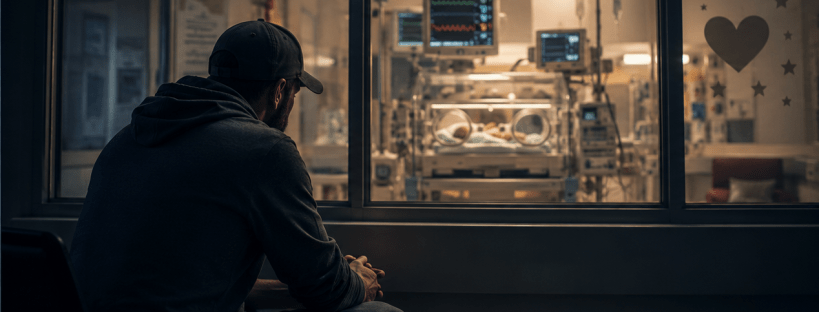

The Part No One Talks About: A Letter to Exhausted NICU Dads

There’s a kind of exhaustion that doesn’t announce itself while you’re in it.

It’s not loud. It doesn’t always look like breaking down in a hallway or sitting in the dark parking lot outside the hospital trying to gather yourself before you go back in. Sometimes it just looks like functioning. Clocking in. Clocking out. Making calls. Answering texts. Sitting beside the hospital bed like you’re holding the whole world together with duct tape and determination.

You do what you have to do.

You become provider, advocate, scheduler, translator of medical jargon, emotional anchor, and sometimes the only stable point in a room full of uncertainty. You learn to live in two worlds at once—one foot in hospital rooms that smell like sanitizer and fear, the other in a life that keeps demanding normalcy from you like nothing has changed.

And somehow, everything has changed.

For a lot of dads, the hardest part isn’t just surviving the NICU or a long hospital season. It’s what comes after.

Because when the alarms stop and the routine of scans, rounds, and consultations fades, there’s this quiet that shows up. And in that quiet, everything you didn’t have space to feel starts asking for attention.

That’s where it gets complicated.

During the crisis, you run on adrenaline and necessity. There’s no room to fall apart, because someone has to keep the wheels turning. But once the urgency lifts, the body finally catches up with what the mind had to postpone.

And sometimes that looks like depression that didn’t have time to introduce itself earlier.

It’s disorienting, because people around you assume the hardest part is over. They’re grateful—and you are too—but they don’t always see that “over” doesn’t mean “undone.” You’re still carrying the weight of decisions, sleepless nights, financial strain, and the quiet fear that lived under every update from a doctor.

Cast your burden on the Lord, and He will sustain you.” — Psalm 55:2

And if you’re honest, you might not even have the language for what you’re feeling yet. Just heaviness. Irritability. Numbness. A sense that you should be “back to normal” by now, but normal doesn’t quite exist anymore in the same way.

What makes it harder is how isolating it can be.

Not everyone is equipped to hold space for what you’re processing. Some people move on quickly, not out of indifference, but because life keeps moving and they don’t know what to say anymore. Even family, as well-meaning as they are, might be dealing with their own version of grief or fear. So, the support you need doesn’t always show up in the way you need it to show up.

And you can find yourself in this strange place of being surrounded, yet still alone with it.

Then there’s the layer no one talks about enough: your kids still needing care beyond survival. Appointments. Therapies. Counseling. Emotional regulation that requires patience you’re not sure you have left. And you’re trying to be the steady presence for them while quietly wondering who is steady for you.

That tension can feel impossible—like you’re supposed to be both strong and untouched by what you’ve just walked through.

But you’re not untouched. You’re just still standing. And there’s a difference.

If you’re in that in-between space—the season after the season—where everything is quieter but somehow heavier, I want to say this clearly:

What you’re feeling is not a failure of faith, strength, or character. It’s often the delayed impact of prolonged stress and trauma finally finding space to surface.

You were in survival mode. Now you’re in recovery mode, even if it doesn’t feel like recovery yet.

Come to Me, all who labor and are heavy laden, and I will give you rest.” — Matthew 11:28

And recovery is not linear.

Some days you’ll feel fine. Other days you’ll feel like you’re back in it emotionally, even when nothing is actively wrong. That doesn’t mean you’re going backward. It means your mind and body are processing what they couldn’t process in real time.

You don’t have to rush that.

You also don’t have to do it alone, even if it feels like the support around you is limited. Sometimes the right support isn’t a crowd, it’s one person who can sit with you without trying to fix it.

Sometimes it’s a counselor who understands trauma and transition. Sometimes it’s simply learning to name what’s happening inside you, so it doesn’t stay undefined and heavy.

Bear one another’s burdens and so fulfill the law of Christ.” — Galatians 6:2

And if you’re struggling to be present the way you want to be, especially for your kids, it doesn’t disqualify you. Conversely, it reflects the reality that you’ve been carrying more than one person is designed to carry for a long time.

Your presence matters more than your perfection.

Even now. Even in the exhaustion. Even in the days when you feel like you’re just getting through.

If no one has told you lately in plain terms: what you carried through that season was significant. What you’re carrying now still matters. And what you need in this season matters just as much as what everyone else needs from you.

There’s no shame in needing time to come back to yourself.

And maybe that starts with letting God meet you honestly instead of trying to meet Him polished.

The Lord is near to the brokenhearted and saves the crushed in spirit.” — Psalm 34:18

You’re not behind. You’re not broken.

You’re in the aftermath of something heavy—and learning how to breathe again in a different kind of normal.

Cover graphic creds: ChatGPT

Healing Declared: A SOAP Study on Luke 13:10-17

**New excerpt from Juju’s book…**

In Luke 13:10-17, Jesus is teaching in the synagogue on the Sabbath when he notices a woman with a disabling spirit. As she totters through the temple gates, Jesus calls the woman over, confirms her restoration, and heals her condition. No longer crooked, she glorifies God and prompts Jesus to criticize the religious leaders for their lack of compassion.

Digging into this summary, we find meaningful implications, especially where sickness and infirmity dwell. For starters, we must not deny those around us who are poor in spirit and health, desperate for Jesus in a way that extends past their margins.

As a NICU alum, I can boldly testify to this. Every day during Juju’s life, Lys and I entered a larger-than-life mystery box, a stream of unknowns where anything could happen. From what we experienced, the emotional highways were unending from dead-end hopelessness to confounding crossroads. In each situation, parents, like the crooked woman, were searching for anything their hope could cling to – comfort, healing, answers, you name it!

Yet, as challenging as that season was, the contrast in processing helped us understand the power within the presence of God. While there were moments when we sought the Lord because there was no other way, there were other times we sensed his call and responded accordingly. So, it was with our protagonist in Luke 13, who not only personified what it meant to be in the right place at the right time but saw her affliction as a catalyst for intervention.

Examining the woman’s transformation, we find some notable takeaways, particularly in v. 10-13, during which Jesus orchestrates his miracle:

1. In v. 10, Jesus sees the woman even though he was already teaching in the synagogue.
2. At the start of v. 12, he calls her over instead of continuing with his message.
3. By the end of v. 12, he declares her freedom before healing her disability.

While circumstantial at the surface, we can behold the intentionality within this order when we assess similar healings in the Gospels. Like the bent woman, Jesus repeatedly modeled his heart alongside his power, relating to the context of suffering even before his presence was recognized. This poses a powerful thought:

To the extent our faith activates when we sense God’s presence, it also stirs when we hear His voice. Like gravity, His Word summons the innermost part of our being in a way that compels us to move in his direction.

No wonder the woman had no issue journeying to Jesus. the joy set before her resonating with the joy set before him.

Upon her arrival, note how Jesus reacts: He doesn’t immediately remove the woman’s iniquity but proclaims her victory! Again, this subtle progression is profound. Though some might question why Jesus would call his shot, the purpose behind his declaration wasn’t to simply highlight his divinity but to deliver salvation while proving his love. Had the purity behind the action lacked, the woman’s response may have reflected differently. But like many before her who battled long-lasting crippling ailments, the outflow of praise rode on the heels of the expectancy. In the end, it was all about Jesus, religious and wishful sentiments be da*rned.

For the griever and/or loved one stuck in the hospital, while our prayers have power and purpose, what we voice as expressions of hope yields the truth of who God is and what he wills from his nature. Ultimately, God is going to finish the good work he started in you (Philippians 1:6) as heaven meets earth in wonder-working fashion (Matthew 6:10). True, we will never have all the answers as to why we must endure in specific ways; however, when we remember how Jesus made space to heal a woman in the middle of a sermon on a day His Father set apart for rest, we can draw encouragement knowing God is always for us, even during the darkest and craziest of days.

Prayer: “Jesus, you told your followers, ‘Do not let your hearts be troubled. You believe in God, so believe in Me as well. Peace, I leave with you; my peace I give you. I do not give to you as the world gives,’ (John 14:1, 27). We confess we need your peace, the peace of God, which transcends all understanding’ (Philippians 4:7) to guard our hearts and minds. We humbly come before you with our weary hearts and pray that you continue to show us fresh levels of love and grace as we go through this season of sorrow and transition. Help us to find peace in your presence. Wipe our tears, Lord, and carry us through this season of mourning and deep sadness. Help us to trust in your unfailing love and to fix our eyes on you, Jesus. As we lift our worries to you, we humbly ask that you lift up our hearts from what may overwhelm us. May your presence bring us joy and comfort as we embark on this journey of healing with you. In your most holy name, we pray. Amen.”

Cover photo creds: Sunflower Seeds

The Endure Cure: A Word on Corporate Suffering

On Monday, I had the privilege of leading devos at Mercy Multiplied’s weekly meeting. Here’s a cut from my share which includes a slice of recent testimony… #lordhavemercy 🦋

…Still, I wonder about those among us, even under our care who are suffering, in full on survival mode. How do we cope as we hope? How do we trust when internally we’re about to bust? How do we endure and suffer the way God intended?

Whatever the answers are, both at the 20,000-foot level and at the surface, the truth is: Suffering is part of our divine call, not just individually but corporately. Often, we take a head-down approach to perseverance. We sense a challenging situation and tackle it through our ‘more than conqueror’ identity. Granted, there is nothing wrong with that in a vacuum; however, the potential problems I see are at least two-fold:

1) In the day-to-day grind, we individualize and compartmentalize our endurance.
2) In the day-to-day chaos, we fail to consider the beauty in our suffering.

The premise of this devo is a charge for us to view perseverance as more than enduring with character but also embracing the beauty in suffering. Are we pausing each day to be still with God, to receive His grace and smiles in the personal and corporate challenges we’re walking in?

I’m reminded of a Point of Grace song from their All the World album. Does anyone remember ‘Heal the Wound’ co-written by Nicole Nordeman? Here is an excerpt from the song:

I have not lived a life that boasts of anything
I don’t take pride in what I bring
But I’ll build an altar with the rubble that You’ve found me in
And every stone will sing of what You can redeem.

Heal the wound but leave the scar
A reminder of how merciful You are
I am broken, torn apart, take the pieces of this heart
And heal the wound but leave the scar.

Don’t let me forget
Everything You’ve done for me
Don’t let me forget
The beauty in the suffering!

This song is music to the ears, inspiration to the heart, and emphasizes certain realities of Scripture.

  1. Jesus, the one we can boast in, has carried our greatest burden (Isaiah 53:3-5) and out of that, still helps us with our sorrows and burdens to this day. Accordingly, we don’t have to strive to ‘make it through’ or ‘get to the other side/the finish line’. We don’t have to carry the burden of making sense of our struggles (as I like to call them – “victories in progress”). Rather, we can lean on Jesus who felt the demands of ministry, who knows what it’s like to feel drained, yet with the joy set before Him, referenced the Father, the ultimate source of His power. Like Him, we’ve been given what we need for goodness and godliness but can still ask for wisdom, help, strength, grace, etc. as paupers in Spirit (Oswald Chambers).
  2. As co-sufferers in Christ (Romans 8:17), we can help others endure through suffering and share with them the comfort we’ve received from God (2 Corinthians 1:3-6) as we bear our own crosses (Matthew 16:24, 1 Peter 2:19-21, Romans 8:16-18). We may feel compromised on account of our weakness, but this can allow the Father’s heart to resonate in realness with people assuming our abiding in Christ is in rhythm.
  3. Difficult circumstances outside of our control can be prompts to remain vertically reliant, to seek first God and His Kingdom. Without adversity, we cannot live as tested, faithful, and dependent vessels. The beauty of suffering is that it gives us the opportunity to become like Jesus, to see our redemption as secure, and our victory as imminent even if the pathway doesn’t make sense, even if the breakthrough and miracles we crave don’t happen the way we anticipated.

Why are these points important? Because they confirm how God works! Specifically, the breakthrough we need, the challenges we endure in Jesus’ name, and the miracles we’re contending for aren’t limited to timely answered prayers (or even answered prayers at all). As Paul writes in his letters, finding freedom isn’t confined to what we get over but what we get through. Put another way, God doesn’t promise us we’ll get over everything, but He does promise we’ll get through anything.

For my wife, Lys, and I, we’ve learned and re-learned this truth many times during our 11-year marriage. Yet, by far, the greatest challenge for us came in August 2021 when our daughter, Jubilee, was diagnosed with intrauterine growth restriction four months ahead of her due date. While Lys and I did everything we could to stay healthy, the combination of Juju’s growth environment and Lys’ preeclampsia proved too much. Only 18 days post-diagnosis, our small Fry would make her worldly debut as a micro preemie coming in at 25 weeks, 10 inches, 1.2 pounds, chronic-lung disease, pulmonary hypertension, less than a <10% of living past day 1, and less than 5% of making it past the first week.

Thankfully, God had other plans and proved Himself mighty as we clung to hope at the end of our rope. While our prayers for Juju to survive the NICU and make it home did not materialize, as our hearts healed, we learned to see her miracle as the impact she made on the thousands of lives, including us, shattering medical expectations and probabilities along the way.

In hindsight, Lys and I know the miracle of Juju’s life would have still been clinched even if she hadn’t lived past the first day. For even as we contended with God in our pain and despair, He was faithful to enlarge our capacity to sense His sovereignty and the sweetness of His nearness, His tender hand holding ours.

Now, were we beyond angry and tempted to fold on certain days? Absolutely! I remember in the weeks following Juju’s death, wrestling intensely with God, asking Him why He would let her overcome her greatest afflictions only to succumb to a freak bout of sepsis. God, why wouldn’t you keep the miracle going having sustained it this long?

Having successfully stiff-armed the why’s (I.e. those subtle entitlements that tempt you to think you must have it all together or understand why you’re going through what you’re going through), throughout Juju’s life, I couldn’t help but be overwhelmed by them in the aftermath. The mental torment was off the charts and on the precipice of depression, I was in desperate need of a spark heading into the last quarter of 2022.

That spark would manifest as a dream right before Juju’s Celebration of Life. In the dream, I’m thrust back in time storybook style. A dusty road, a mass of people, and one Jesus walking in front of me. In a unique role reversal, I’m the woman with the bleeding problem trying to keep pace with Jesus yet unable to do so. Desperate to touch Jesus’ robe, I cry out: ‘Jesus, can you please slow down? I’m trying to get to you. If I can just touch a piece of your robe, I know you can heal Juju!’

Suddenly, I’m on my knees with a warm hand on my shoulder. I can’t make out the face in front of me, but I know such a presence could only be Jesus. As I ponder how He jettisoned a football field in a millisecond, I hear Him speak to me: “You were never meant to touch my robe. You were meant to believe in and follow me. Now, look behind you and see how many are following me because you kept going.”

I look back and see a new body of people who weren’t there before. Picking up steam, I turn my head back to where the voice came from only to wake up…with a fresh understanding of the miracle Jesus accomplished during Juju’s life and how it would continue.

As for us in this room, I share this testimony to remind us how God is faithful to give purpose to suffering and anoint our steps as we walk through adversity…with Him. Sometimes, it takes seasons of discomfort and/or dislodging for a worldview or perspective to reset. Sometimes, it takes a walk through fire for us to see how God can redeem fallenness and fallen spirits alike.

My final encouragement to you is to not view your weaknesses, your limitations, your incompleteness, as something to ‘get through’ or stitch together. Don’t stiff-upper lip and head-down the challenges in front of you, blindly trusting they’ll blow over. Rather persevere in hope…with character…and with your heads up. After all, how can we be still and know He is God if we’re not postured as such? Position yourself to see God’s goodness within the grander scheme unfolding. If you come face to face with what makes you feel uncomfortable, rejoice! If you confront a situation that makes you feel unsettled…rejoice! If you’re reminded of something in your past or hit the wall of your finiteness and feel incomplete…rejoice…knowing we were never created to be completed in this life anyway.

And so, take joy and heart together. Embrace childlikeness in the sense you don’t need to make sense of your circumstances to reference and follow Jesus. Despite what others may say, you can be earnest and eager simultaneously and find peace in times when the lights of life turn off. As long as you let your light shine before men and stiff-arm those why’s, you will reach a promised land with rebuilt temple walls…in the name and wake of Christ.

Those, my friends, are just a few of the many beauties in suffering the way God intended. Again, the why’s, the how to’s, the hurdles we clear may vary, but the nature of God in the presence of our distress is absolute and a foundation for us to walk confidently on.

Selah.

Cover graphic creds: Desiring God

Corona Fight: Why We’re to Be Unshaken, Not Stirred

So recently, I was reading a blog post about how God is using this COVID-19 crisis to help believers see what is still shakable in their own lives (Haggai 2:5-7, Hebrews 12:22-29).

And by all means, my heart resonates with this truth.

Until something is unshakable, there’s always room for greater stability and strength.

Yet, while much focus is on how God is shaking out our co-dependencies¹ (and rightfully so), I can’t help but wonder if we’re forgetting the grander scheme unfolding.

‘Cause truth is: Yes, God wants to prune our dependencies and purify our securities. But I also believe He wants to use this time to train the body to be hope in the face of age-defining uncertainty.

Not to suggest we be insensitive to personal conviction or how God is shaking the nations. Certainly, now is a perfect time to take inventory and ask the Lord to awaken us in this season of chaos.

However, in our quests for enlightenment, let’s not forget the bigger picture either – specifically, how the church must show the way amidst the dismay through love-distance (a.k.a. long-distance) relationship².

As for the days ahead, I wish I knew more. For now, what I can say is a super creative God is illuminating new creative outlets for those He loves. And as the evidence pours in, let’s keep one thing in mind:

The same God who is shaking global foundations is the same God fixing your eyes on what He intends to remain unshaken.

Even though there’s much change to behold, there’s still plenty of life in you purposed for consistency (be it joy, faithfulness, endurance, etc). Accordingly, let’s not lose sight of what God has done as we lean into what He’s about to do.

As for any of you feeling displaced or out of rhythm, be encouraged: God is not one to run out of ideas. If anything, He’s working out a temporary solution with lasting repercussions you can’t see yet.

As for you with spiritual gifts centered on direct services, like giving, compassion or hospitality, be discerning and disciplined, but don’t vacation from your calling either. Rather, research, network, build your technological awareness (To be fair, this goes for all of us 😉)…and dare to see where God’s bridges of benevolence take you.

In closing, I charge you, my friends, to calibrate to God’s character/Word (see verses below) and consider what He’s anchored within you. After all, even when life seems to fall apart, He never stops refining your part in helping others find Jesus.

Selah.

Stay tuned next time when I’ll finally unveil ‘part 2’ to my ‘4 convictions for 2020‘ series. Until then, may God’s hedge of protection cover and calm you in these turbulent days.

“Worship the Lord your God, and his blessing will be on your food and water. I will take away sickness from among you.” ~ Exodus 23:25 (NIV)

“For the LORD protects the bones of the righteous; not one of them is broken!”  ~ Psalm 34:20 (NIV)

“Praise the Lord, my soul; all my inmost being, praise his holy name. Praise the Lord, my soul, and forget not all his benefits—who forgives all your sins and heals all your diseases, who redeems your life from the pit and crowns you with love and compassion, who satisfies your desires with good thing, so that your youth is renewed like the eagle’s.” ~ Psalm 103:1-5 (NIV)

“Gracious words are like a honeycomb, sweetness to the soul and health to the body.”  ~ Proverbs 16:24 (NIV)

Footnotes

  1. For some, you may feel God is sifting your heart Amos 9 style as opposed to shaking it (see video above).
  2. More on this term in a future post; for now, view it as a love that stays in bounds because it knows no bounds.

giphy

6a0192ac343706970d025d9b3673bb200c

Cover photo creds: Action News Now

Woke Faith: A SOAP Study on Luke 7:1-10

Remember the centurion at Capernaum, the one who wows Jesus with his ‘woke’ faith?

If so, I want to take a brief minute to talk about him.

‘Cause truth is: While most read this story as faith leading to healing, we often overlook the context behind the dialogue. For instance, what led to the centurion feeling unworthy? Did he actually meet Jesus1? And what about the servant/centurion relationship? Is their bond in light of the social scene a big deal? Or is there a bigger reason Matthew and Luke included this account in their Gospels?

To be fair, we could be here all day unraveling these mysteries; for now, let’s focus our discussion on why the centurion built the Jewish synagogue and why it’s significant for marketplace leaders today.

Scripture

First, let’s dig in starting with Luke 7:1-10 (ESV)

SmallWelllitJellyfish-size_restricted

 “After he had finished all his sayings in the hearing of the people, he entered Capernaum. Now a centurion had a servant who was sick and at the point of death, who was highly valued by him. When the centurion heard about Jesus, he sent to him elders of the Jews, asking him to come and heal his servant. And when they came to Jesus, they pleaded with him earnestly, saying, “He is worthy to have you do this for him, for he loves our nation, and he is the one who built us our synagogue.” And Jesus went with them. When he was not far from the house, the centurion sent friends, saying to him, “Lord, do not trouble yourself, for I am not worthy to have you come under my roof. Therefore, I did not presume to come to you. But say the word, and let my servant be healed. For I too am a man set under authority, with soldiers under me: and I say to one, ‘Go,’ and he goes; and to another, ‘Come,’ and he comes; and to my servant, ‘Do this,’ and he does it.” When Jesus heard these things, he marveled at him, and turning to the crowd that followed him, said, “I tell you, not even in Israel have I found such faith.” And when those who had been sent returned to the house, they found the servant well.”

Observations

There are several directions we can go from here, but to me, it’s hard to ignore the overarching contrast between Jewish faith and the Roman world. Like the Hebrews and Egyptians, the Jews and Romans were oil and water linked by oppression, an expiring dictatorship, and a deliverer in waiting; however, they were also similar in demographic disparity and the need for legislation. Perhaps this is why Herod Antipas assigned centurions as royal troops exempt from army duty – to balance the frontline action with local jurisdiction.

Either way, centurions were widely regarded as the real professionals of the Roman army. As Helen Bond states in Bible Odyssey...

Most owed their position not to family connections but to their military prowess. Besides a level of command on the battlefield, they engaged in a wide range of other activities: general policing (see Acts 27:1-3, Acts 27:43), customs work, and the supervision of capital penalties (Mark 15:39). The troops of Antipas seem to have been garrisoned within towns. Although centurions are presented positively in the New Testament, contemporary scholarship makes it clear that most were disliked by ordinary folk, who regarded them as cruel, violent, and self-serving.”

However, this was not the case with the centurion at Capernaum. As v. 4-5 confirm, the centurion not only oversaw the construction of the Jewish synagogue but served as a benefactor to the community at large. This seemingly small detail carries radical significance as it proves the centurion’s goodwill was rooted in empathy and unity as well as diligence.

V. 4-5 in the Amplified drives this home…

When they reached Jesus, they pleaded with Him earnestly [to come], saying, “He is worthy for You to do this for him, because he loves our nation and he built us our synagogue [at his own expense].”

A couple of things stand out here:

  1. Note how ‘loves our nation‘ precedes ‘built us our synagogue‘. Based on this order alone, one can assume the centurion’s love was not only contagious before it was constructive but inspired the elders to represent him (v. 3).
  2. Note how the centurion personally funded this operation! This tells me the synagogue was not only a social sacrifice but a financial and likely physical one as well. No wonder the elders pleaded earnestly with Jesus given the centurion was actively entering into their suffering.
  3. While off-script, it’s probable Jesus carried this example into Nain (v. 11) as news of His miracles spread through all of Judea.

Application

The centurion template is a fascinating one to discuss. Whether you analyze it through an exegetical or historical lens, the story reminds us what the power of breaking walls through selfless service can do.

Consider this excerpt from Jon Bloom, Executive Director of Desiring God:

“The centurion is a reminder to us that ‘man looks on the outward appearance, but the Lord looks on the heart’ (1 Samuel 16:7). I think we will be surprised someday when Jesus doles out rewards. Most of the great ones among us will probably have lived in obscurity. Jesus is not as impressed with titles, degrees, and achievements as we are. He is impressed with those who really do humbly believe him. [As Billy Graham once said], ‘God will not reward fruitfulness, he will reward faithfulness.’ The centurion was faith-full. I want to be like him when I grow up.”

As to what we can glean as vocations, starting with the centurion’s rapport with the Jews makes sense. After all, the centurion could have easily constructed a building detached from relational foundation. But as we see, the centurion cared far more about people finding freedom than notoriety and quotas. To him, excellence was not a metric to be measured, but a sacrifice to be invested. Granted, his position offered security, but his heart could not help but share it with those less fortunate.

And it’s here, I submit, we take inventory. Like the centurion, we may struggle to champion the underdog as those in authority. We may wonder if our tasks are being effective or if our bandwidths are hindering our influence; however, as long as we lay down our lives for the sake of another, as long we seek to serve through benevolence and compassion, we will make the difference we crave. For God did not create us to ‘get by’, but to ‘let die’ the reservations and preservations compromising our generosity. Accordingly, we never have to fear the extent of our giving or the bounds of our effort since the Lord will continuously provide outlets for both.

As for our colleagues, no question there will be times of disagreement when organization feels like a lame duck sitting in a sea of chaos. In those moments you feel overwhelmed by what you can’t control, dare to ask God for what you need with a centurion’s heart:

Prayer

Lord, I know by myself I’m not worthy. I don’t ask these things out of entitlement or false expectancy. Rather, I know, as one set under and in authority, you have given me all I need for goodness and godliness at my job. I have the mind of Christ; however, this doesn’t mean I lack weakness. Though you’ve wired me with skill and creativity, I’m not immune to your healing touch… your desire to restore my inner being. Honestly, there’s so much I don’t know or understand. Yet, I know as long as I align to your will, you WILL come through. Though my faith may suffer, I know as long as I say the word, you will be there…and if you say the word, it will be done. With this as my forefront, I make these requests known to you so that your glory be known as faith expresses itself through love. To you and in you I commit the fruit of my labor and the spirit behind it. Amen.

Selah.

Footnotes

  1. Matthew 8:5-13 suggests ‘yes’, Luke 7:1-10 suggests ‘no’