When Faith Gets Put on Trial

There is something I have been noticing. It tends to surface after the prayers have been prayed, faith has been exercised, people have contended—and the ending still isn’t the one everyone asked for.

Eventually, someone starts looking for the variable. Maybe there wasn’t enough faith. Maybe doubt got in the way. Maybe someone didn’t believe hard enough.

I have heard enough variations of that idea to think it is worth naming. Somewhere along the way, some corners of the Church created an equation Scripture itself never gave us:

Desired outcome = sufficient faith.
Undesired outcome = insufficient faith.

To be fair, the equation did not appear from nowhere. Jesus tells us to believe when we pray. James warns about asking while doubting. Hebrews tells us that without faith it is impossible to please God. The Gospels even contain moments when Jesus directly confronts unbelief. Those passages matter. Faith matters. Unbelief matters.

I believe God hears us when we pray. I believe He draws near. I believe He heals, restores, delivers and intervenes. I believe we should ask boldly, contend earnestly and invite God to expose unbelief wherever it has taken root in us. But Scripture does not permit us to turn those truths into a formula.

There is a garden just outside Jerusalem where that formula falls apart.

The Cup Didn’t Pass

Jesus entered Gethsemane in anguish and prayed, “Father, if you are willing, remove this cup from me.”

Then He prayed again. And again. Luke tells us that His anguish intensified and that He prayed even more earnestly.

The cup did not pass.

Was the problem Jesus’ faith? Of course not. Jesus’ faith was perfect. And somehow, perfect faith looked like weakness that night. It looked like anguish, persistence, dependence and surrender:

“Nevertheless, not my will, but yours, be done.”

The unanswered request was not evidence of deficient faith. His persistence was faith. His surrender was faith. His trust in the Father while standing inside unbearable anguish was faith. That distinction matters.

Sometimes we treat surrender as the fine print beneath believing prayer—as though “Your will be done” is what we say when we are afraid to expect too much. Gethsemane suggests something very different.

Surrender itself is an expression of faith.

Prayer is worship because prayer acknowledges something fundamental: God is God, and I am not. He invites our participation. He teaches us, encourages us and empowers us. He tells us to ask. But partnership is not parity. God did not surrender His sovereignty when He invited us to pray.

When Faith Becomes About Us

This is where an inflated theology of faith can subtly shift the center of gravity. Faith stops being trust in God and begins becoming confidence in our ability to produce an outcome: my faith, my declaration, my certainty, my ability to receive.

Eventually, God begins looking less like Father and more like a mechanism: apply sufficient belief and receive the requested result.

But faith is not currency. God is not a genie. Grace is not wages for believing correctly.

Paul learned this when he repeatedly asked God to remove his thorn. The thorn remained. Christ answered, “My grace is sufficient for you, for my power is made perfect in weakness.” Apparently grace can be sufficient even when the thorn remains.

Romans 8 tells us something similar. The Spirit helps us in our weakness, even when we do not know how to pray as we ought. Notice where grace enters the story—not after we overcome helplessness, but inside it.

Even the desperate father who cried, “I believe; help my unbelief!” discovered that Jesus was willing to meet a man whose faith and doubt somehow occupied the same sentence. Helplessness is not a disqualification from grace.

That should make us extraordinarily careful about placing additional weight on people who are already suffering. There is enough vulnerability in asking God for something we cannot fix ourselves. When the answer does not resemble what was prayed for, the Church should be very cautious before adding an indictment to the grief.

Same Faith. Different Outcomes.

Hebrews 11 makes that caution unavoidable. Some people, through faith, conquered kingdoms, escaped the sword and received back their dead. Others, through faith, were imprisoned, tortured, afflicted and killed.

Scripture commends them all. Same faith. Different endings.

Faith was never intended to function as a mechanism through which we control God. It is trust in God.

That is why the words of the three Hebrew exiles in Daniel remain so powerful. They believed God was able to deliver them from the furnace. And then came the words that kept faith from becoming entitlement:

“But if not…”

God is able. But if not, He is still God.

That is not unbelief. Sometimes it is one of the bravest expressions of faith available to us.

Don’t Put Their Faith on Trial

So ask. Believe. Contend. Keep praying when the answer has not come. Ask God to expose unbelief and deepen your trust. Believe that He can intervene in ways only He can.

But when someone else’s cup does not pass, resist the temptation to put their faith on trial.

Sometimes grace removes the thorn. Sometimes grace becomes sufficient while it remains. Sometimes what God is doing becomes clearer years later. And some answers may require eternity.

Romans 8 does not promise that we will understand everything that happens to us. It promises something larger: that God is at work even while creation groans.

Our faith is ultimately in the Lord—not our ability to secure the outcome we prayed for.

God is able. And even if not, He is still God.

Gethsemane led to a cross. And for a little while, the cross looked like the end of the story.

It wasn’t.

Making Room for New Creation: Do We Still Believe Christ Changes People?

Lately I’ve found myself thinking about something I don’t hear discussed very often.

As a disclaimer, I’m genuinely grateful that the Church has become more willing to talk about healthy boundaries, emotional well-being, and protecting people from abusive or destructive situations. Those conversations matter, and Scripture certainly leaves room for wisdom when safety is at stake. There are circumstances where lasting distance is not only appropriate but necessary.

But I’ve also been asking myself another question: When genuine repentance is present and safety is no longer the issue, are we still making room for God’s ministry of reconciliation?

Sometimes I wonder if we’ve become so accustomed to protecting ourselves that we’ve quietly lost the expectation that Christ still transforms people. Either way, our responsibility remains an absolute as outlined in the Word.

In Acts 11:18, we see that God alone grants repentance—a gift of His grace that Paul echoes in 2 Timothy 2:25. This highlights an essential reality: The grace that forgives is also the grace that transforms.

Consider Jesus’ teaching in Matthew 18. While the passage is often remembered for confronting sin, His aim is ultimately restoration—winning back a brother or sister.

Paul paints the same picture in Corinth. He instructed the church to discipline a man living in open, unrepentant sin. But after that man repented, Paul’s instruction changed:

“You ought rather to forgive and comfort him… reaffirm your love for him.” (2 Corinthians 2:7–8)

Notice the progression: Accountability. Repentance. Restoration.

Repentance doesn’t erase consequences. It doesn’t instantly rebuild trust. It doesn’t obligate anyone to return to an unsafe relationship.

Reconciliation doesn’t always mean restoring a relationship to what it once was. Sometimes it simply means laying down bitterness, extending forgiveness, and remaining open to whatever measure of restoration wisdom permits.

Yet neither should we treat genuine repentance as though it changes nothing.

I’ve also found myself wondering whether our desire to protect our peace can slowly become something else. While boundaries can absolutely be an expression of wisdom, they can also become places where reconciliation quietly stops.

That’s worth examining—not to produce guilt, but to ensure our instinct is still moving toward the ministry Christ entrusted to us whenever wisdom allows.

Every Sunday we proclaim that Jesus makes people new. We celebrate that He removes hearts of stone and gives hearts of flesh. If we truly believe Christ transforms lives, shouldn’t we expect to recognize His work when genuine repentance appears?

Paul writes: “If possible, so far as it depends on you, live peaceably with all.” (Romans 12:18)

I appreciate those opening words: “If possible.” Paul recognizes that reconciliation isn’t always achievable because it doesn’t depend on one person alone. Some wounds require lasting distance. Some relationships remain unsafe. We cannot control another person’s response.

But we can control our own.

As far as it depends on us, we’re called to pursue peace, own our failures, confess our sin, forgive as we’ve been forgiven, and remain open to the restoring work of Christ whenever wisdom allows.

I don’t write this to minimize the importance of boundaries. I write it because I don’t want to miss the work of Christ when He begins changing someone’s heart.

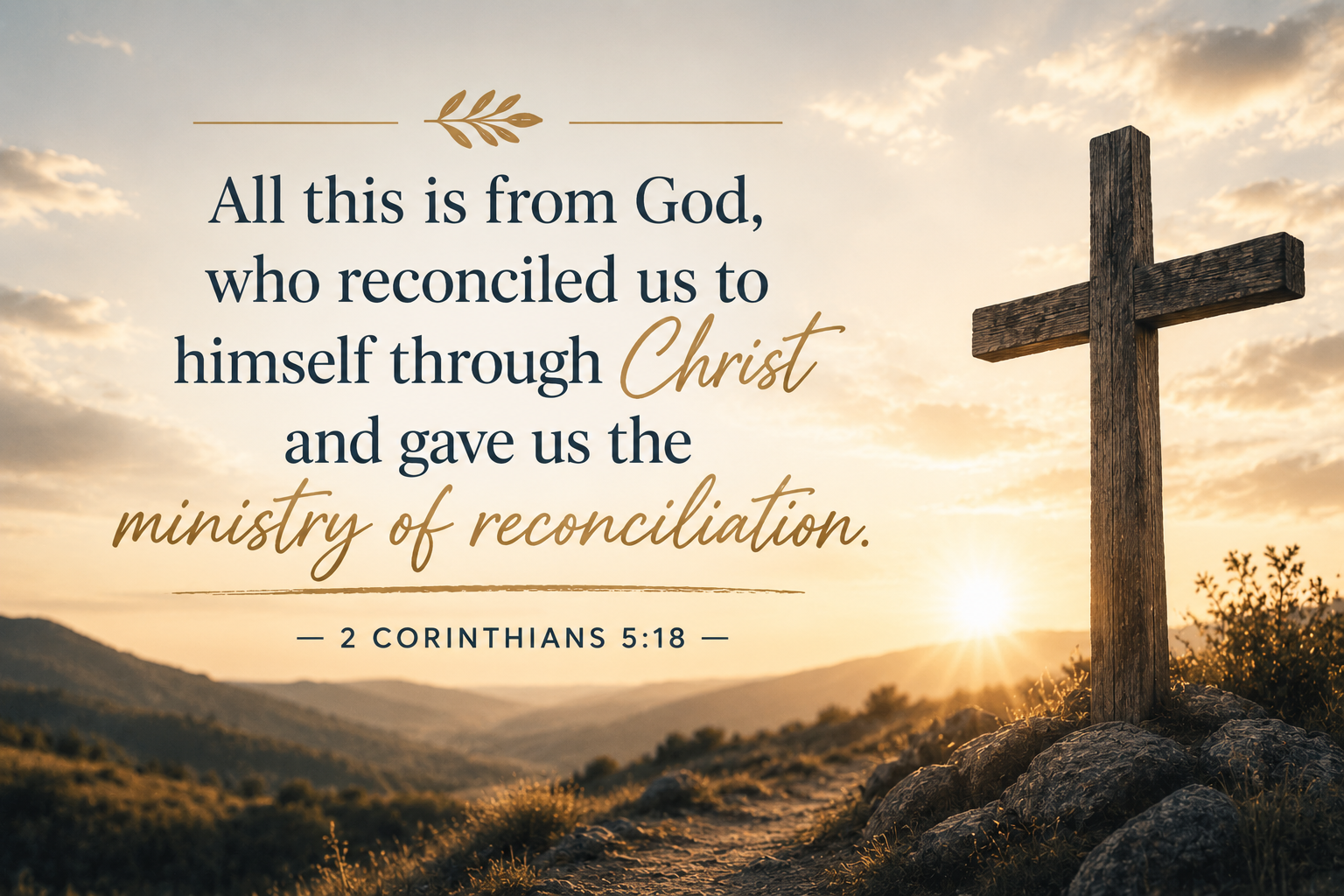
The ministry of reconciliation isn’t only about God reconciling us to Himself. Through Christ, He also entrusts His people with becoming ambassadors of that same reconciliation in a broken world (2 Corinthians 5:18–20).

Perhaps one of the greatest evidences that we truly believe the gospel isn’t simply that we rejoice over God’s power to change us—but that we remain humble enough to recognize His transforming work in someone else.

If we proclaim that Jesus makes all things new, may we never become so guarded that we fail to recognize His new creation standing right in front of us.

Cover graphic creds: ChatGPT

Halftime: Reflections on 2026 and the Road Ahead

Halftime thoughts.

Every year around the year’s midpoint, I find myself pausing long enough to evaluate where God has brought me and where He’s still leading me.

The first half of the year—especially these past three months—has been marked by much-needed growth, course correction, new opportunities, and genuine healing. Not the kind of healing that arrives overnight, but the kind you only recognize when you look over your shoulder and realize the arrow is finally pointing upward again. I’m grateful for that.

Much of this progress has come through a combination of what God has been asking me to lay down and what He has been faithfully replacing it with. As Paul reminds us, God’s grace is made perfect in weakness, not because weakness is desirable, but because it becomes the stage upon which His strength is displayed (2 Corinthians 12:9-10).

That doesn’t mean grief has disappeared.

In many ways, I still consider “the griever” because I am one. I remain a recovering bereaved parent learning how to faithfully navigate a world that often doesn’t know how to care for those carrying profound loss. Scripture tells us to “weep with those who weep” (Romans 12:15), yet many people simply have never learned what that looks like in practice. They don’t intentionally neglect grieving people; they’re simply unequipped to enter pain they have never personally experienced.

For a grieving person, being understood carries tremendous emotional and relational value. As months and years pass, silence can begin to feel like abandonment. Invitations become fewer. Conversations become shorter. Friends move on with life while your world still feels permanently altered. Somewhere in the recesses of our minds, we begin wondering whether the relationship was ever as strong as we believed. Sometimes that conclusion is accurate. More often, it is simply the grief interpreting silence through wounded eyes.

One of the greatest lessons God has been teaching me is that misunderstanding does not automatically equal malice. Sometimes people aren’t withdrawing because they’ve stopped caring. They withdraw because they don’t know how to care. They fear saying the wrong thing, so they say nothing at all. Ironically, that silence often becomes the very thing that wounds us most.

Looking back, I believe one of the deepest forms of forgiveness is releasing people from the offense of misunderstanding you. Some of the harshest words ever spoken to me occurred during seasons when my autistic mind couldn’t fully process my own weakness while simultaneously navigating profound grief. There were moments when neither side truly understood the other. My pain was misunderstood, and their limitations were equally misunderstood by me.

The reality is that ignorance is unavoidable. If we’re living life together—raising families, serving in churches, investing in friendships—we’re all going to have moments of poor execution. We’ll say the wrong thing. We’ll say nothing. We’ll miss opportunities to show up. None of us perfectly reflects the compassion of Christ every single day. That’s why Paul exhorts believers to “bear with one another and forgive one another if any of you has a grievance against someone. Forgive as the Lord forgave you” (Colossians 3:13).

I’ve come to believe that grief matures our understanding of care faster than almost anything else. By the time someone has walked through profound suffering, they’ve learned that presence often matters more than words, consistency matters more than grand gestures, and quiet companionship often ministers more deeply than carefully crafted advice. Our expectations of others naturally rise because our own understanding of compassion has deepened.

But this is where humility must temper wisdom.

Most people haven’t walked through the valleys we’ve walked through. Their capacity to care exists within the boundaries of their own experiences. They aren’t necessarily uncaring; they’re simply still growing. Just as we hope others will extend grace toward grief they cannot fully comprehend, grieving people must also extend grace toward those who are still maturing in their understanding of compassion.

That realization has changed how I read 2 Corinthians 1:3-4. Paul describes God as “the Father of compassion and the God of all comfort, who comforts us in all our troubles, so that we can comfort those in any trouble.” The comfort God gives us isn’t intended to terminate with us. It becomes the pattern through which we learn to comfort others. Sometimes that also means remembering that not everyone has yet received the same lessons suffering has taught us.

At the same time, grief cannot become an entitlement card. It cannot become permission to remain bitter toward a world that no longer understands us. Nor can it become an excuse to avoid relationships and settings simply because awkward conversations might happen. Bitterness feels protective, but it slowly becomes another prison. Scripture repeatedly calls us toward forgiveness, not because every offense is small, but because Christ has forgiven infinitely greater debts within us (Matthew 18:21-22; Ephesians 4:32).

Some people genuinely have abandoned you. Others have failed you. Some will never apologize. Some may never even recognize the hurt they caused. Those realities are painful, but they are not outside God’s ability to redeem. “The Lord is near to the brokenhearted and saves those who are crushed in spirit” (Psalm 34:18). He sees every lonely moment that no one else noticed.

So let God deal with the abandoner and embrace the call to pray for them.

Release the hurt you’ve carried through the valleys and shadows. Don’t allow grief to collect resentment until bitterness disguises itself as conviction. That burden was never yours to carry forever.

If you’re faithfully pressing into Christ day after day, He will gradually give you the strength to surrender every source of hurt into His hands. Forgiveness rarely begins with strength; it begins with surrender. We forgive because we’ve first been forgiven. We extend grace because we’ve first received grace. And we continue moving forward because nothing—not grief, misunderstanding, abandonment, nor even death itself—can separate us from the love of God that is in Christ Jesus our Lord (Romans 8:38-39).

Perhaps that is one of healing’s greatest milestones. Not when grief disappears, because it won’t this side of eternity, but when forgiveness quietly becomes greater than offense, hope becomes stronger than despair, and the arrow—by the grace of God—continues pointing upward.

Cover graphic creds: ChatGPT

Expired Fruit: Why Past Faithfulness Doesn’t Excuse Present Dysfunction

As discussed in my last post, there is a difference between honoring leadership and respecting image preservation.

While Scripture commands us to respect those who labor among us, it also refuses to place any leader beyond examination, correction, or accountability. Somehow, in many churches, ministries, and organizations, we’ve managed to preach the first half while burying the second, using “protect the anointing” phraseology as an umbrella where insecurity, favoritism, micromanagement, even misconduct are tolerated.

But it usually doesn’t start there.

Most toxic cultures don’t begin with self-serving intentions. They begin with leaders who once did tremendous good.

Perhaps they pioneered something meaningful. Maybe they sacrificed deeply. Maybe they built ministries, companies, schools, nonprofits, or movements that changed lives. Maybe they weathered storms that others never saw.

All of that can be true.

But yesterday’s faithfulness does not exempt today’s behavior from scrutiny.

Past fruit is not a lifetime immunity badge. No organization is above the law. No leader is above correction. No “good old days” testimony can serve indefinitely as a veil covering present dysfunction.

The danger emerges when the narrative becomes: “Look at all the good they’ve done.”

As though that somehow settles every concern. As though the people closest to the problems simply lack perspective. As though those asking questions are disloyal. As though silence is maturity.

It isn’t.

Because the moment preserving an image becomes more important than pursuing truth, the culture has already begun to drift.

Jethro Saw What Moses Couldn’t

One of the most overlooked leadership moments in Scripture comes in Exodus 18.

Moses loved God. Moses was called. Moses had demonstrated extraordinary faithfulness. Yet Jethro looked at him and essentially said: “What you’re doing isn’t working.”

“What you are doing is not good. You and these people who come to you will only wear yourselves out.” (Exodus 18:17-18)

Imagine that.

Moses—the man through whom God parted the Red Sea—was told that his leadership structure was unsustainable. Jethro wasn’t dishonoring Moses. He was protecting both Moses and the people.

He recognized something leaders often miss when responsibility concentrates at the top: The people suffer.

Jethro’s solution wasn’t blind loyalty. It wasn’t, “Everyone just support Moses harder.” It wasn’t, “Stop questioning and trust the process.”

It was accountability through structure. Shared responsibility. Distributed leadership. Healthy support systems.

“Select capable men from all the people—men who fear God, trustworthy men who hate dishonest gain—and appoint them…” (Exodus 18:21)

Notice the qualifications. Capable. God-fearing. Trustworthy. Hating dishonest gain. Not merely agreeable. Not merely loyal. Not merely protective of leadership’s reputation.

Their purpose wasn’t to become professional yes-men. Their role was to support both Moses and the people.

Middle Managers Aren’t Human Shields

Healthy organizations understand this instinctively.

Middle leadership exists to bridge. To advocate upward and downward. To communicate concerns from subordinates to executives. To translate vision into practical care. To equip teams. To identify problems before they become crises.

They do not exist to absorb dysfunction generated from above. Nor do they exist to suppress concerns to preserve appearances.

If every concern raised by frontline employees dies in middle management because someone fears upsetting the Executive Director, CEO, President, Senior Pastor, or founder, then leadership has ceased to function as stewardship and has become image management.

The lower half of an organization cannot continually compensate for the gaps left by the upper half. Subordinates cannot indefinitely provide the emotional intelligence, conflict resolution, humility, and accountability that senior leadership refuses to exercise.

People eventually run out of capacity. They burn out. They disengage. Or they leave.

“If You Don’t Like It, Leave”

Sometimes that’s exactly what happens.

And ironically, unhealthy leadership often interprets the exodus as validation.

  • “Good riddance.”
  • “The wrong people are leaving.”
  • “God is purging the disloyal.”
  • “They couldn’t handle authority.”

But what if the departures aren’t evidence of rebellion?

What if they’re evidence of unresolved problems? What if sensible people with both healthy minds and compassionate hearts simply recognize fire when they smell smoke? What if repeated turnover isn’t proof of purification? What if it’s proof of suffocation?

The irony is painful.

The tighter toxic leadership closes its fist to secure control, the more people slip through its fingers. The very thing they fear losing becomes the outcome their methods produce.

Because fear can force compliance for a season. It cannot cultivate trust. Manipulation can manufacture unity for a moment. It cannot sustain genuine loyalty.

Unity Is Not Uniformity

Biblical unity was never intended to mean unanimous agreement with leadership.

Why? Because real unity makes room for truth. For questions. For dissent without retaliation. For hard conversations conducted with humility.

Paul publicly confronted Peter when Peter’s actions compromised the Gospel (Galatians 2:11-14). The early church gathered to reason together through conflict in Acts 15. Even Nathan confronted David.

Correction wasn’t viewed as betrayal. It was understood as love.

“Faithful are the wounds of a friend…” (Proverbs 27:6).

Yet some environments redefine unity to mean certain cooperation, even silence.

Don’t ask. Don’t challenge. Don’t notice patterns. Don’t connect dots. Just smile. Support. Protect the anointing.

At that point, unity becomes something entirely different. It becomes coercion wearing spiritual language.

Everyone Has a Voice

  • Will every complaint be valid? No.
  • Will every accusation prove true? No.
  • Will every frustrated employee be completely objective? Of course not.

But when concerns repeatedly surface from thoughtful people across different levels of an organization, dismissing every voice as bitterness eventually becomes its own form of deception.

Especially if those voices are consistently met with defensiveness rather than curiosity.

People can accept difficult answers.

What they struggle to accept is being unheard. A voice that perpetually falls on deaf ears eventually stops speaking. Not because it lacked merit. But because it learned the outcome had already been decided.

James instructs believers to be:

“Quick to hear, slow to speak, slow to anger” (James 1:19).

How often do organizations reverse that order?

Quick to defend. Quick to explain. Quick to protect. Slow to listen.

The Strongest Leaders Don’t Fear Accountability

The most secure leaders I’ve encountered don’t panic when questioned.

They don’t interpret feedback as mutiny. They don’t demand perpetual affirmation. They don’t surround  themselves exclusively with people who echo their opinions.

They understand something profoundly important:

  • Accountability doesn’t diminish authority. It legitimizes it.
  • Correction doesn’t weaken leadership. It strengthens it.
  • Transparency doesn’t destroy trust. It builds it.

And repentance—when necessary—is not evidence that anointing has departed. It’s evidence that humility remains.

Perhaps protecting the anointing has less to do with shielding leaders from scrutiny and more to do with protecting the integrity of what God entrusted to them in the first place.

Because God’s people deserve healthy leadership. Leaders deserve healthy support.

Middle managers deserve the freedom to advocate truthfully in both directions. And organizations deserve cultures where righteousness is valued more highly than reputation.

Christ-centered institutions should be the safest place in the world to tell the truth. Not because truth is painless. But because Christ Himself said:

“Then you will know the truth, and the truth will set you free.” (John 8:32).

Anything less may preserve appearances for a season.

But eventually, every veil wears thin. And when that happens, the question won’t be whether concerns existed. The question will be whether anyone had the courage to listen before people felt they had no choice but to leave.

Cover graphic creds: Pkfuel.com

Even From Far Away, God Still Speaks: A SOAP Study on Jeremiah 31:1-9

There are seasons where God feels close enough to touch…and seasons where He feels far away.

Yet Jeremiah 31 reminds us of something beautiful: “The LORD appeared to him from far away.”

Even from a distance, God still spoke love. Even through wilderness and grief, His faithfulness remained.

Sometimes we expect God’s presence to look like immediate rescue, instant healing, or emotional certainty. But there are moments when He meets us from what feels like “far away”—not because He has abandoned us, but because He is teaching us that His love is deeper than our current feelings.

If you are walking through sorrow, disappointment, confusion, or exhaustion today, remember this: God’s silence is not the absence of His faithfulness.

The same passage says: “I have loved you with an everlasting love; therefore I have continued my faithfulness to you.”

Everlasting means His love did not begin with your strongest season, and it will not end in your weakest one.

And then comes the promise: “Again I will build you.”

God rebuilds people.

  • He restores what grief tried to hollow out.
  • He brings worship out of wilderness.
  • He teaches trembling hearts to dance again.

Even in chaos, we can posture ourselves in worship because we trust that God’s plans are still unfolding. Worship is not denial of pain—it is confidence that despair does not get the final word.

If God is rebuilding you right now, don’t despise the process. The One who loves you eternally is still being faithful to you presently.

Let’s pray…

Father, in seasons where You feel far away, help me remember that Your love has never left me. When grief, disappointment, or exhaustion cloud my vision, remind me that Your faithfulness is still holding me together. Teach me to trust You not only in moments of clarity, but also in the wilderness where I cannot yet see what You are rebuilding. Heal the places in me that have grown weary, restore what despair has tried to steal, and posture my heart in worship even before the breakthrough comes. Thank You that Your love is everlasting, Your plans are still good, and You are not finished with my story. Build me again, Lord, and let my life become a testimony of Your restoring grace. Amen.

Graphic cover created in ChatGPT