
When the Church Looks Less Like Jesus

A call to remember who the Church belongs to—and what the world should see in us.

The Church Belongs to Jesus

What should people encounter when they encounter the Church?

Should they leave impressed by our excellence? Inspired by our music? Encouraged by our preaching? Or should they leave saying, “I caught a glimpse of Jesus.”

That question matters because the Church belongs to Him. She is not ours to redefine, market, or mold according to the preferences of any generation. Scripture describes her as the Body of Christ (1 Corinthians 12:27), the household of God (Ephesians 2:19), and the Bride for whom Christ willingly laid down His life (Ephesians 5:25–27).

If she belongs to Christ, every generation must ask one simple question: Are we becoming more like Jesus? Not more successful. Not more influential. Not more visible. More like Jesus.

To look like Him is to love what He loves, serve as He served, welcome as He welcomed, and make disciples as He commanded. Everything else flows from that.

A Shared Life, Not a Weekly Event

The New Testament presents a compelling vision of the Church. Believers devoted themselves to the apostles’ teaching, fellowship, the breaking of bread, and prayer (Acts 2:42). They shared with those in need (Acts 2:44–45), bore one another’s burdens (Galatians 6:2), rejected favoritism (James 2:1–9), practiced hospitality (1 Peter 4:9), and became known by their love (John 13:34–35).

This was not simply a worship service. It was a shared life. They did not merely attend together. They belonged to one another.

The early Church was not perfect. Acts and the New Testament letters reveal conflict, sin, and correction. Yet they also reveal a people willing to repent and reorder their lives around Christ. That picture should challenge us: Have we unintentionally settled for something smaller than what Scripture describes?

When Activity Replaces Faithfulness

The modern Church has become remarkably effective at gathering people. We organize ministries, communicate vision, create excellent environments, and steward resources wisely. Those things can honor God. But excellence must never replace obedience.

  • Programs cannot replace people.
  • Production cannot replace presence.
  • Attendance cannot replace discipleship.

Methods are servants. They must never become masters.

One temptation facing the Western Church is to mistake activity for faithfulness. The question is whether our methods have quietly become our measurements of success. Jesus did not commission His followers to build impressive institutions; He commanded them to make disciples (Matthew 28:19–20). Paul wrote, “I planted, Apollos watered, but God gave the growth” (1 Corinthians 3:6).

Faithfulness belongs to us. Growth belongs to God.

Christ gave leaders to the Church “to equip the saints for the work of ministry” until the whole body matures in Him (Ephesians 4:11–16). Healthy ministry is measured by whether God’s people are becoming more like Jesus together.

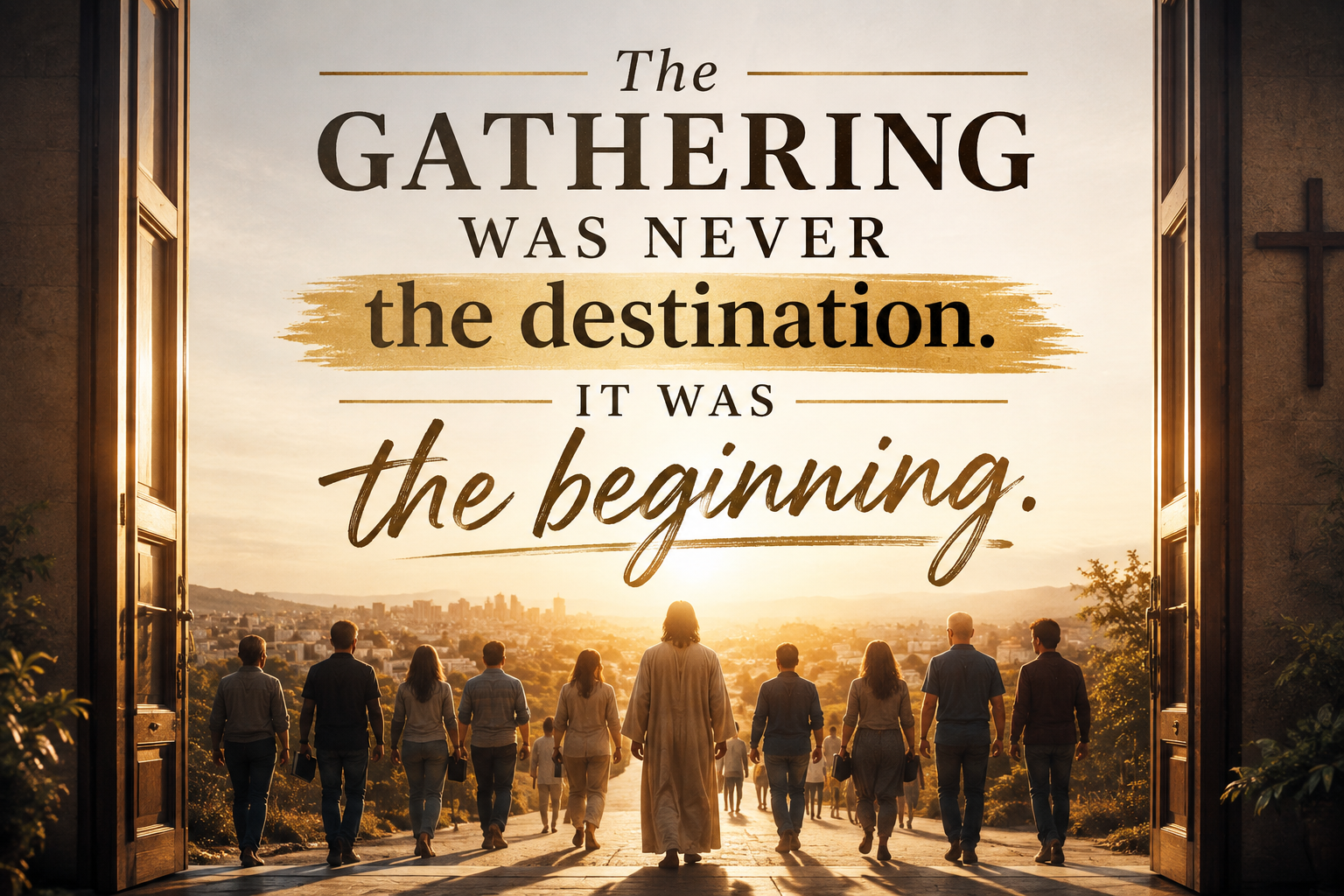
The earliest believers did not simply invite people to a gathering. They carried the life of Christ wherever they went. Their worship overflowed into hospitality, their teaching into discipleship, their fellowship into generosity, and their prayers into courageous witness.
Returning to Our First Love

Churches do not drift overnight. Neither do believers. Even the church in Ephesus—commended for perseverance and discernment—heard these sobering words from Jesus: “You have abandoned the love you had at first” (Revelation 2:4). Their greatest problem was not incompetence. It was misplaced affection.

That warning still echoes. We can become more competent while becoming less dependent upon God, more organized while becoming less compassionate, and more influential while becoming less Christlike.

The greatest threat to the Church has rarely been opposition from the outside. More often, it has been gradual drift from the inside.

Sent Belong the Walls

Outreach has not disappeared from the Church. Countless congregations faithfully serve their communities in ways that honor Christ. Yet we should ask whether outreach has slowly moved from being part of the Church’s identity to becoming one ministry among many.

The ministries hardest to promote are often the ministries Scripture emphasizes most: visiting the sick, welcoming the stranger, caring for widows and orphans, bearing burdens, opening our homes, and serving without recognition (James 1:27; Matthew 25:34–40; Galatians 6:2). These acts rarely generate headlines, fill auditoriums, or build anyone’s platform. But they look remarkably like Jesus.

The Church was never called merely to invite people into a building. She was called to carry the presence of Christ into the world.

More Than Consumers

Perhaps nowhere is self-examination more necessary than in the way we approach gathering together. We ask: Did I enjoy the worship? Did the sermon encourage me? Did I feel fed today?

Those are not wrong questions. They are incomplete.

The New Testament invites us to ask another set of questions: Whom did I encourage? Whose burden did I help carry? Who experienced the love of Christ through me? Who did I welcome, forgive, or serve?

Church was never intended to function like a spiritual gas station where we stop once a week to refill before returning to life unchanged. If we leave our gatherings knowing more about Christ but looking no more like Him, we have misunderstood the purpose of gathering.

Worship that truly encounters God does not terminate on itself. It overflows into love, service, mercy, justice, humility, forgiveness, generosity, and sacrificial care.

Hungry Without Agenda

The same examination applies to every gift within the Church. Whether someone teaches, preaches, writes, leads worship, or serves behind the scenes, every ability entrusted by God exists to make much of Christ. Whenever a gift begins drawing attention primarily to the person using it, we have drifted from its purpose.

The platform has never been the center of worship. Christ is.

I believe believers across the world are quietly praying for communities simply hungry for Christ—without agenda, without platform-building, without chasing influence for its own sake. Communities whose greatest ambition is to know Christ and make Him known. Where people serve because they love, give because they have received grace, worship because God is worthy, and gather because they genuinely belong to one another.

Those communities may never become famous. But heaven has never measured faithfulness by fame. The Church has never needed more influence than faithfulness. She has only ever needed more of Christ.

Call Back to Christ

The prophet Micah summarized God’s desire with remarkable simplicity:

“He has told you, O man, what is good; and what does the Lord require of you but to do justice, to love mercy, and to walk humbly with your God?” (Micah 6:8)

Perhaps the Church today needs that reminder as much as any generation before us. This is not a call to abandon Christ’s Bride. It is a call to love her enough to invite her continually back to her first love.

The answer to an imperfect Church has never been abandoning her. The answer has always been allowing Christ to continue sanctifying her—including us.

May we have the humility to examine ourselves before we examine others. May we have the courage to repent wherever we have drifted. May we become people hungry for Christ without agenda—content to decrease so that He might increase.

And until the day we finally see our Savior face to face, may the watching world first catch a glimpse of Him in us.

For that has always been the Church’s greatest witness.

Graphics created in ChatGPT

Work as Freedom: Hearts of Flesh (Part 2)

After starting a new series on hearts of flesh last week, I want to spend this post extending the theme into the workplace.

‘Cause truth is: While discussing theological intricacies has its place, if a Gospel principle isn’t tangible…if it’s ambiguous in application…one must wonder if we’re fully taking it to heart.

tenor

Thankfully, we’re believers in ‘part 2’s here at His Girl Fryday. As such, the goal of this post is to discuss what hearts of flesh look like in the marketplace using the three core concepts of ‘part 1’ as a foundation.

Without further ado, let’s dive in…

giphy

No question, we live in a complicated world addicted to hurry, prosperity, and high expectation. We want well, we mean well, we work well…but by day’s end, there always seems to more weighing us down than lifting us up. Ever wish you could fix just one issue knowing the ripple effect it could have? I know I do.

However, I also know at the core of many prevalent issues are hearts of stone burdened by systems of performance and self-effort. This arguably is no more evident than our cultural idolization of individual accomplishment over collective partnership. As a society, we say we value the idea of collaboration; we preach the principles of teamwork and leadership. But in an ‘I must get this done’ age, can we honestly say our bottom line emphasis is more ‘done’ than ‘I’? Or are we so caught up in progress and status, we’ve lost the point of why we work all together?

Regardless of where we’re at, as mentioned in ‘part 1’, there’s a common thread we can adhere to: By aligning ourselves to God, we can know not only is our salvation secure for those who believe (Romans 10:9-10), but our purpose, our destiny, and our future as well.

This has massive implications in the marketplace.

For starters, we can enjoy our work free from offense, agenda, and anxiety since our idea of success is rooted in worship and completion, not affirmation and accomplishment. Ever worry about your voice being heard or if ‘x’ project will get done? Perhaps you feel trapped knowing advancement can only happen is certain metrics outside your reach are met.

If so, dare to rely on God as your higher power in those moments. Put into practice, you’ll find this posture will not only free you from insecurity, but also redirect a fear of man/failure to a fear of the Lord.

As Solomon says in Ecclesiastes 12:11,13 (ESV):

“The words of the wise are like goads, and like nails firmly fixed are the collected sayings; they are given by one Shepherd. The end of the matter; all has been heard. Fear God and keep his commandments, for this is the whole duty of man.”

Remember when we surrender our anxieties, when we cast our cares upon the Lord, we create space God can invade.

Note how 2 Peter 3:8-9 literally captures this in the Message translation:

“Don’t overlook the obvious here, friends. With God, one day is as good as a thousand years, a thousand years as a day. God isn’t late with his promise as some measure lateness…He’s giving everyone space and time to change.”

Unfortunately, for many of us, this reality falls flat before we recognize it. We pray before each day, we ingest truth through the Word, and yet somehow the emotional gravity in conflict remains unchanged. Why is that?

I know for me after I graduated college, I’d feel guilty if I had time to kill or margins to clear. I’d think to myself I must be doing something wrong if I’m not productive or ‘on the go’ all the time. But looking back, I realize this burden was self-inflicted having believed no mountain to conquer was a sign of faithlessness. As I now know…

…voids created through surrender is an apex of spiritual maturity.

More specifically, to create voids righteously, one must repent and acknowledge God as the provider of opportunity, the way to resolution, and sustenance when either is lacking. True, our margins and capacities may vary (see parables of the talents), but it’s ultimately God who entrusts us with them. Knowing this, we can experience work as freedom by viewing business ethics, accountability, communication, and motivation as ‘fragrant offerings’ to God.

giphy

Furthermore, if we accept our future as known and pre-determined rather than unknown and self-determined, then we can view our work as done since our purpose is already secure. Granted, this idea may be hard to grasp at first. I’m not suggesting you approach responsibility with a cavalier attitude; however, I am encouraging you to see aligning to God as a way we engage His fullness, faithfulness, and the belief that what good can be done…will be done.

If it helps, consider this: You are made a new creation. To be made is to have an identity. What you do is not your identity. Accordingly, what you make, what you earn is not your identity. So what is your identity? It’s who you are. God…God made you who you are. However, He also made work. Why? So people can know Him and discover their purpose. Hence, why work isn’t your identity, but working unto the Lord is.

2jpc80

Knowing God is why we work means He’s the subject of our work. Our co-workers and supervisors? They are not the subject. They are the object…equal in value, diverse in function…just like you. Even the confusing characters, those who think success is all profit, position, and power, God sees the ‘finished them’…not only what they could be, but what they will be.

In light of this, we can embrace helplessness and accept weakness knowing we’re a new creation continually transformed as we receive from glory to glory (2 Corinthians 3:18). Even when others condescend on weakness, we can take heart knowing the Cross has meaning and power because of it. Oh, how sweet it is to know this same wonder-working power can be alive in and through us…even as we work.

All that said, next time you’re on the clock, delight in the fact you can be open to constructive criticism since work is more than learning; it’s freedom. When you’re micromanaged, manipulated, or indirectly communicated to, rejoice. God hasn’t given you a spirit of fear on what your boss or colleagues can do to you, but of love, power, and a sound mind in what you can give back. Again, if you align to Christ, the reproach, the dying to self…it all takes care of itself. Besides, you can’t control what others do or think, but you can trust in God who works all things for good and is progressively transforming us into His image.

‘Cause to God, it’s not about the bottom line…or even the finish line; it’s about the finished line…

…a reality we can know as Christ’s finished work alive in us.

source

In closing, I bid adieu with one last verse from 2 Peter…

“With these qualities active and growing in your lives, no grass will grow under your feet, no day will pass without its reward as you mature in your experience of our Master Jesus. Without these qualities you can’t see what’s right before you, oblivious that your old sinful life has been wiped off the books.  So, friends, confirm God’s invitation to you, his choice of you. Don’t put it off; do it now. Do this, and you’ll have your life on a firm footing, the streets paved and the way wide open into the eternal kingdom of our Master and Savior, Jesus Christ.” ~ 2 Peter 1:8-11 (MSG)

Stay tuned next time when we’ll discuss how merging bottom lines with finish-ed lines ultimately sets the stage for cultural transformation in our arenas of influence. In addition, we’ll contract intimacy versus independence before relating each reality view to weakness (as Paul describes throughout 2 Corinthians 12).

‘Til then, be blessed and stay refreshed…

Selah.

 Cover photo creds: Steemit


Messiah’s Misfits: Why The Name Says It All

So recently I’m reading 1 Corinthians 4 when suddenly it hits me…

…of all the chapters in all of Paul’s letters, arguably the greatest content on vocational perseverance can be found in v. 9-13 when Paul discusses the nature of true apostleship.

 Let’s check it out…

“For I think that God has exhibited us apostles as last of all, like men sentenced to death, because we have become a spectacle to the world, to angels, and to men. We are fools for Christ’s sake, but you are wise in Christ. We are weak, but you are strong. You are held in honor, but we in disrepute. To the present hour we hunger and thirst, we are poorly dressed and buffeted and homeless, and we labor, working with our own hands. When reviled, we bless; when persecuted, we endure; when slandered, we entreat. We have become, and are still, like the scum of the world, the refuse of all things.” (ESV)

“It seems to me that God has put us who bear his Message on stage in a theater in which no one wants to buy a ticket. We’re something everyone stands around and stares at, like an accident in the street. We’re the Messiah’s misfits. You might be sure of yourselves, but we live in the midst of frailties and uncertainties. You might be well-thought-of by others, but we’re mostly kicked around. Much of the time we don’t have enough to eat, we wear patched and threadbare clothes, we get doors slammed in our faces, and we pick up odd jobs anywhere we can to eke out a living. When they call us names, we say, “God bless you.” When they spread rumors about us, we put in a good word for them. We’re treated like garbage, potato peelings from the culture’s kitchen. And it’s not getting any better.” (MSG)

“For, I think, God has exhibited us apostles at the end of the line, like men sentenced to death [and paraded as prisoners in a procession], because we have become a spectacle to the world [a show in the world’s amphitheater], both to angels and to men. We are [regarded as] fools for Christ, but you are so wise in Christ; we are weak, but you are strong; you are highly esteemed, but we are dishonored. To this present hour we are both hungry and thirsty; we are continually poorly dressed, and we are roughly treated, and wander homeless. We work [for our living], working hard with our own hands. When we are reviled and verbally abused, we bless. When we are persecuted, we take it patiently and endure. When we are slandered, we try to be conciliatory and answer softly. We have become like the scum of the world, the dregs of all things, even until now.” (AMP)

Now, before we dive in, we must understand the broader context.

First, what is the nature of true apostleship? Going back to 4:1, we find the answer: Those who minister Gospel hope as servants/stewards/ambassadors of Christ no matter the cost. The Amplified breaks it down further describing these servants as those who are certain in adoration more than they are uncertain in anything else. Essentially, apostleship goes beyond the office of apostle and involves anyone who is willing to be salt, light, and life in places where there is none. If you are being a faithful steward of God’s call on your life, you’re engaging your apostolic anointing! Whether or not you have a mobile ministry is moot compared to God’s faithfulness being reflected in what you say and do as you draw people to Christ (Colossians 3:17).

Second, how do we abide in the nature of true apostleship? Verses 7-8 give us a hint when paraphrased: We have not only been given everything for goodness and godliness (2 Peter 1:3), but every reason to trust the Lord as our portion (Psalm 73:26)¹. Accordingly, as we reference God in reverence², to live as Christ (Philippians 1:21) becomes the foundation to our perseverance and influence regardless of setting and trial. After all, “there are different kinds of [work], but in all of them and in everyone it is the same God at work (1 Corinthians 12:6).

Finally, we arrive at v. 9 where Paul employs some serious poetic license. Messiah’s misfits (MSG), prisoners of spectacle (AMP, ESV), an accident in the street everyone stands around and stares at…these are all powerful metaphors and similes reminding us there is no earthly honor in apostleship. If, by chance, we are pursuing any glory apart from what is rightfully God’s, our endurance will not stand, but if our satisfaction is rooted in being complete with Christ (Colossians 2:10), if our contentment is secure to His sufficiency, only then will we be victorious as dregs. It’s a paradox to the flesh, but one necessary for our dependence. When we are thirsty, we’ll see the need as being filled as opposed to satisfying a lack. When we are persecuted, we’ll know God is with us as one who relates as opposed to withdrawn as one who can’t. And when we’re struggling to make ends meet, we’ll rest in the mysteries of what God has and hasn’t revealed since our reliance is not contingent on self.

For some of us, it’s hard to accept what doesn’t make sense. It’s like we’re okay being misfits to sin, but not to the minds/culture tolerating it. I know for me, I’d rather be criticized for what I do wrong than be judged for what I do right. At least, with the former I can apply the correction and move on! However, I also know whenever I crave my work to be affirmed and my love to be reciprocated, I can declare God’s grace as sufficient, the fact I can joyfully boast in His power made perfect in my frailty (2 Corinthians 12:9-11). And suddenly those ‘weak as I eke‘ moments fade in something infinitely more…

…the sweet reality that I need JESUS! What a beautiful place to be!

-Jprj2

Bottom line: If you’re a vocational leader, dare to see the identity of what you do through the lens of apostleship, through the lens of being a servant taking light into dark places. And if hard times come, don’t be surprised; rather view them as a sign you’re doing things right³. When you bless others in the face of voids and discouragement, remember the same Christ you ask to bless others is the same Christ who will honor your obedience. If you don’t fit in, remember you were never called to in the first place. Stand out, take what comes, and know the power of you standing through adversity will assuredly have a positive ripple-effect on those around you even if you don’t see it right away.

Selah.

Footnotes

  1. Note how strength in this verse has Hebrew roots to ‘rock’
  2. This form of dependence opens up the Romans 5:1-5 road (more on this in a future post)
  3. Assuming the hard times aren’t consequences of sin, shortcuts, etc.
Cover photo creds: Medium