
Season the Room: When Faithfulness Doesn’t Look Like Permanence

Coming off another solid RHRC onsite, I’ve been thinking about just how much my professional landscape has changed.

During my decade in state government and youth ministry, there was a stretch where not much changed beyond the natural flow of students graduating, new hires arriving, and former coworkers transitioning into whatever came next. Then came the last 82 months—a span featuring not one, not two, but three job changes.

After spending so much of my adult life surrounded by relative continuity, that amount of movement has left me a tad disoriented at times. When our surroundings keep changing, it’s easy to look backward and wonder: Did I miss something? Did I make a wrong turn? Why does everyone else seem to be settling in while I keep starting over?

But I want to encourage some of you not to interpret a higher frequency of change as evidence that you’re consistently missing the mark. Truth is, I think we have a tendency to confuse continuity with confirmation.

When Duration Becomes Our Measuring Stick

Stability, longevity, promotion—most of us yearn to feel secure and recognized within safe settings. When we find something good, we naturally want to keep it good. We root for people to stay, cultures to remain intact, and familiar surroundings to remain familiar. Without realizing it, permanence can become evidence that we must be doing something right.

The inverse is equally dangerous. When jobs change, relationships shift, communities evolve, or assignments end, we wonder what all that movement says about us. But in all this, we must accept a certain notion: Duration is a terrible substitute for discernment. It should not automatically be synonymous with influence, faithfulness, or, dare I say it, a job well done.

You can remain somewhere for fifteen years without longevity proving you heard God correctly, just as you can experience three career changes in 82 months without turnover proving you didn’t. Neither permanence nor transition gets the final word on faithfulness. Paul reminds us that it is ultimately the Lord who evaluates our faithfulness (1 Corinthians 4:2–5). That ought to challenge our tendency to use visible outcomes as the final verdict on someone’s obedience.

The deeper danger is allowing either permanence or transition to become our measuring stick. We can miss what God is forming within us through change while simultaneously failing to appreciate the now for what it is.

The Invitation to Remain Present

Abiding in the present is one of the easiest concepts to understand and one of the hardest places to remain grounded. Perhaps that’s because we crave control over a future we were never given control over in the first place. James 4:13–15 confronts that tendency rather directly. We make plans for tomorrow, often forgetting how little control we actually possess over what tomorrow brings.

Once we encounter a good thing, we want to preserve it. We do this with jobs, churches, ministries, communities, and relationships. Even relationships can become mile markers of maturation and advancement—evidence that life is progressing according to plan. But maybe faithfulness isn’t primarily about preserving the assignment. Maybe it’s about how we receive it while it’s ours.

Ecclesiastes reminds us that there is a season for everything (Ecclesiastes 3:1). Not every season carries the same responsibilities, relationships, opportunities, or duration. That doesn’t make the shorter seasons less meaningful, nor does it make the longer ones inherently more fruitful.

Season the Room

Jesus called us the salt of the earth and the light of the world (Matthew 5:13–16). I’ve been sitting with that imagery differently lately. Our calling isn’t necessarily to preserve the prior functioning of every environment we enter, keeping everything and everyone exactly where we found them. We are called to season those environments with the light and life of Christ.

That means bringing love where cynicism has taken root. Truth where convenience has become easier. Encouragement where people feel unseen. Excellence where apathy has settled in. Reconciliation where relationships have fractured. Curiosity and humility into conversations we could just as easily make about ourselves. Salt affects what it touches. Light changes what can be seen. Neither requires ownership of the room to make a difference within it.

Our responsibility, then, isn’t to guarantee permanence but to faithfully sow. Plant seeds. Water when given the opportunity. Love people well. Tell the truth. Make yourself available. Then trust God with whatever grows after you. Paul captures this beautifully in 1 Corinthians 3:6–7. One plants, another waters, but God gives the growth.

What a freeing reminder. We aren’t responsible for manufacturing every outcome, preserving every relationship, or ensuring every investment produces visible fruit during our tenure. We’re responsible for being faithful with what’s been entrusted to us.

Appreciating What Carries Over

That doesn’t diminish the joy of journeying with people. Some relationships graciously carry over into evolving seasons, surviving changing organizations, titles, churches, assignments, and zip codes. Those relationships are beautiful gifts—but they aren’t guarantees, and they certainly aren’t scorecards. Perhaps part of maturity is learning to appreciate what carries over without requiring everything to.

For me, especially in social settings, the roadmap has become increasingly simple: Show up. Be grateful. Listen. Show up without needing to prove why you belong in the room. Be grateful without demanding that the room remain exactly as you found it. Listen without constantly calculating what the conversation, relationship, or opportunity might become.

Merge humility with curiosity. Ask questions. Learn people. Don’t hide behind your DISC or Enneagram as though a personality profile gets the final word on how available you can become to another human being. Philippians 2:3–4 calls us to humility and genuine consideration for others. That invitation doesn’t disappear simply because engaging with people comes more naturally to some of us than others.

Perhaps that’s another form of faithfulness: being willing to enter the room, invest in the people within it, and resist making every interaction a referendum on ourselves.

Faithfully Tend the Field

Whether you’re still working the same job ten-plus years later or navigating yet another wilderness, receive the assignment with both hands on the plow. Tend what has been entrusted to you without demanding assurances about how long you get to keep it. Colossians 3:23–24 reminds us to approach our work wholeheartedly, ultimately serving the Lord rather than merely seeking the approval of people. That instruction doesn’t come with a minimum tenure requirement.

I’m learning that permanence was never the promise. Presence was the invitation.

So season the room. Shine the light. Plant the seed. Love the people God has placed in front of you. And when the landscape eventually changes, don’t measure the value of the season by whether you were allowed to remain in it.

You were never asked to preserve the field exactly as you found it. You were asked to faithfully tend it while it was yours.

Selah.

When Faith Gets Put on Trial

There is something I have been noticing. It tends to surface after the prayers have been prayed, faith has been exercised, people have contended—and the ending still isn’t the one everyone asked for.

Eventually, someone starts looking for the variable. Maybe there wasn’t enough faith. Maybe doubt got in the way. Maybe someone didn’t believe hard enough.

I have heard enough variations of that idea to think it is worth naming. Somewhere along the way, some corners of the Church created an equation Scripture itself never gave us:

Desired outcome = sufficient faith.
Undesired outcome = insufficient faith.

To be fair, the equation did not appear from nowhere. Jesus tells us to believe when we pray. James warns about asking while doubting. Hebrews tells us that without faith it is impossible to please God. The Gospels even contain moments when Jesus directly confronts unbelief. Those passages matter. Faith matters. Unbelief matters.

I believe God hears us when we pray. I believe He draws near. I believe He heals, restores, delivers and intervenes. I believe we should ask boldly, contend earnestly and invite God to expose unbelief wherever it has taken root in us. But Scripture does not permit us to turn those truths into a formula.

There is a garden just outside Jerusalem where that formula falls apart.

The Cup Didn’t Pass

Jesus entered Gethsemane in anguish and prayed, “Father, if you are willing, remove this cup from me.”

Then He prayed again. And again. Luke tells us that His anguish intensified and that He prayed even more earnestly.

The cup did not pass.

Was the problem Jesus’ faith? Of course not. Jesus’ faith was perfect. And somehow, perfect faith looked like weakness that night. It looked like anguish, persistence, dependence and surrender:

“Nevertheless, not my will, but yours, be done.”

The unanswered request was not evidence of deficient faith. His persistence was faith. His surrender was faith. His trust in the Father while standing inside unbearable anguish was faith. That distinction matters.

Sometimes we treat surrender as the fine print beneath believing prayer—as though “Your will be done” is what we say when we are afraid to expect too much. Gethsemane suggests something very different.

Surrender itself is an expression of faith.

Prayer is worship because prayer acknowledges something fundamental: God is God, and I am not. He invites our participation. He teaches us, encourages us and empowers us. He tells us to ask. But partnership is not parity. God did not surrender His sovereignty when He invited us to pray.

When Faith Becomes About Us

This is where an inflated theology of faith can subtly shift the center of gravity. Faith stops being trust in God and begins becoming confidence in our ability to produce an outcome: my faith, my declaration, my certainty, my ability to receive.

Eventually, God begins looking less like Father and more like a mechanism: apply sufficient belief and receive the requested result.

But faith is not currency. God is not a genie. Grace is not wages for believing correctly.

Paul learned this when he repeatedly asked God to remove his thorn. The thorn remained. Christ answered, “My grace is sufficient for you, for my power is made perfect in weakness.” Apparently grace can be sufficient even when the thorn remains.

Romans 8 tells us something similar. The Spirit helps us in our weakness, even when we do not know how to pray as we ought. Notice where grace enters the story—not after we overcome helplessness, but inside it.

Even the desperate father who cried, “I believe; help my unbelief!” discovered that Jesus was willing to meet a man whose faith and doubt somehow occupied the same sentence. Helplessness is not a disqualification from grace.

That should make us extraordinarily careful about placing additional weight on people who are already suffering. There is enough vulnerability in asking God for something we cannot fix ourselves. When the answer does not resemble what was prayed for, the Church should be very cautious before adding an indictment to the grief.

Same Faith. Different Outcomes.

Hebrews 11 makes that caution unavoidable. Some people, through faith, conquered kingdoms, escaped the sword and received back their dead. Others, through faith, were imprisoned, tortured, afflicted and killed.

Scripture commends them all. Same faith. Different endings.

Faith was never intended to function as a mechanism through which we control God. It is trust in God.

That is why the words of the three Hebrew exiles in Daniel remain so powerful. They believed God was able to deliver them from the furnace. And then came the words that kept faith from becoming entitlement:

“But if not…”

God is able. But if not, He is still God.

That is not unbelief. Sometimes it is one of the bravest expressions of faith available to us.

Don’t Put Their Faith on Trial

So ask. Believe. Contend. Keep praying when the answer has not come. Ask God to expose unbelief and deepen your trust. Believe that He can intervene in ways only He can.

But when someone else’s cup does not pass, resist the temptation to put their faith on trial.

Sometimes grace removes the thorn. Sometimes grace becomes sufficient while it remains. Sometimes what God is doing becomes clearer years later. And some answers may require eternity.

Romans 8 does not promise that we will understand everything that happens to us. It promises something larger: that God is at work even while creation groans.

Our faith is ultimately in the Lord—not our ability to secure the outcome we prayed for.

God is able. And even if not, He is still God.

Gethsemane led to a cross. And for a little while, the cross looked like the end of the story.

It wasn’t.

When the Church Looks Less Like Jesus

A call to remember who the Church belongs to—and what the world should see in us.

The Church Belongs to Jesus

What should people encounter when they encounter the Church?

Should they leave impressed by our excellence? Inspired by our music? Encouraged by our preaching? Or should they leave saying, “I caught a glimpse of Jesus.”

That question matters because the Church belongs to Him. She is not ours to redefine, market, or mold according to the preferences of any generation. Scripture describes her as the Body of Christ (1 Corinthians 12:27), the household of God (Ephesians 2:19), and the Bride for whom Christ willingly laid down His life (Ephesians 5:25–27).

If she belongs to Christ, every generation must ask one simple question: Are we becoming more like Jesus? Not more successful. Not more influential. Not more visible. More like Jesus.

To look like Him is to love what He loves, serve as He served, welcome as He welcomed, and make disciples as He commanded. Everything else flows from that.

A Shared Life, Not a Weekly Event

The New Testament presents a compelling vision of the Church. Believers devoted themselves to the apostles’ teaching, fellowship, the breaking of bread, and prayer (Acts 2:42). They shared with those in need (Acts 2:44–45), bore one another’s burdens (Galatians 6:2), rejected favoritism (James 2:1–9), practiced hospitality (1 Peter 4:9), and became known by their love (John 13:34–35).

This was not simply a worship service. It was a shared life. They did not merely attend together. They belonged to one another.

The early Church was not perfect. Acts and the New Testament letters reveal conflict, sin, and correction. Yet they also reveal a people willing to repent and reorder their lives around Christ. That picture should challenge us: Have we unintentionally settled for something smaller than what Scripture describes?

When Activity Replaces Faithfulness

The modern Church has become remarkably effective at gathering people. We organize ministries, communicate vision, create excellent environments, and steward resources wisely. Those things can honor God. But excellence must never replace obedience.

  • Programs cannot replace people.
  • Production cannot replace presence.
  • Attendance cannot replace discipleship.

Methods are servants. They must never become masters.

One temptation facing the Western Church is to mistake activity for faithfulness. The question is whether our methods have quietly become our measurements of success. Jesus did not commission His followers to build impressive institutions; He commanded them to make disciples (Matthew 28:19–20). Paul wrote, “I planted, Apollos watered, but God gave the growth” (1 Corinthians 3:6).

Faithfulness belongs to us. Growth belongs to God.

Christ gave leaders to the Church “to equip the saints for the work of ministry” until the whole body matures in Him (Ephesians 4:11–16). Healthy ministry is measured by whether God’s people are becoming more like Jesus together.

The earliest believers did not simply invite people to a gathering. They carried the life of Christ wherever they went. Their worship overflowed into hospitality, their teaching into discipleship, their fellowship into generosity, and their prayers into courageous witness.

Returning to Our First Love

Churches do not drift overnight. Neither do believers. Even the church in Ephesus—commended for perseverance and discernment—heard these sobering words from Jesus: “You have abandoned the love you had at first” (Revelation 2:4). Their greatest problem was not incompetence. It was misplaced affection.

That warning still echoes. We can become more competent while becoming less dependent upon God, more organized while becoming less compassionate, and more influential while becoming less Christlike.

The greatest threat to the Church has rarely been opposition from the outside. More often, it has been gradual drift from the inside.

Sent Belong the Walls

Outreach has not disappeared from the Church. Countless congregations faithfully serve their communities in ways that honor Christ. Yet we should ask whether outreach has slowly moved from being part of the Church’s identity to becoming one ministry among many.

The ministries hardest to promote are often the ministries Scripture emphasizes most: visiting the sick, welcoming the stranger, caring for widows and orphans, bearing burdens, opening our homes, and serving without recognition (James 1:27; Matthew 25:34–40; Galatians 6:2). These acts rarely generate headlines, fill auditoriums, or build anyone’s platform. But they look remarkably like Jesus.

The Church was never called merely to invite people into a building. She was called to carry the presence of Christ into the world.

More Than Consumers

Perhaps nowhere is self-examination more necessary than in the way we approach gathering together. We ask: Did I enjoy the worship? Did the sermon encourage me? Did I feel fed today?

Those are not wrong questions. They are incomplete.

The New Testament invites us to ask another set of questions: Whom did I encourage? Whose burden did I help carry? Who experienced the love of Christ through me? Who did I welcome, forgive, or serve?

Church was never intended to function like a spiritual gas station where we stop once a week to refill before returning to life unchanged. If we leave our gatherings knowing more about Christ but looking no more like Him, we have misunderstood the purpose of gathering.

Worship that truly encounters God does not terminate on itself. It overflows into love, service, mercy, justice, humility, forgiveness, generosity, and sacrificial care.

Hungry Without Agenda

The same examination applies to every gift within the Church. Whether someone teaches, preaches, writes, leads worship, or serves behind the scenes, every ability entrusted by God exists to make much of Christ. Whenever a gift begins drawing attention primarily to the person using it, we have drifted from its purpose.

The platform has never been the center of worship. Christ is.

I believe believers across the world are quietly praying for communities simply hungry for Christ—without agenda, without platform-building, without chasing influence for its own sake. Communities whose greatest ambition is to know Christ and make Him known. Where people serve because they love, give because they have received grace, worship because God is worthy, and gather because they genuinely belong to one another.

Those communities may never become famous. But heaven has never measured faithfulness by fame. The Church has never needed more influence than faithfulness. She has only ever needed more of Christ.

Call Back to Christ

The prophet Micah summarized God’s desire with remarkable simplicity:

“He has told you, O man, what is good; and what does the Lord require of you but to do justice, to love mercy, and to walk humbly with your God?” (Micah 6:8)

Perhaps the Church today needs that reminder as much as any generation before us. This is not a call to abandon Christ’s Bride. It is a call to love her enough to invite her continually back to her first love.

The answer to an imperfect Church has never been abandoning her. The answer has always been allowing Christ to continue sanctifying her—including us.

May we have the humility to examine ourselves before we examine others. May we have the courage to repent wherever we have drifted. May we become people hungry for Christ without agenda—content to decrease so that He might increase.

And until the day we finally see our Savior face to face, may the watching world first catch a glimpse of Him in us.

For that has always been the Church’s greatest witness.

Graphics created in ChatGPT

Making Room for New Creation: Do We Still Believe Christ Changes People?

Lately I’ve found myself thinking about something I don’t hear discussed very often.

As a disclaimer, I’m genuinely grateful that the Church has become more willing to talk about healthy boundaries, emotional well-being, and protecting people from abusive or destructive situations. Those conversations matter, and Scripture certainly leaves room for wisdom when safety is at stake. There are circumstances where lasting distance is not only appropriate but necessary.

But I’ve also been asking myself another question: When genuine repentance is present and safety is no longer the issue, are we still making room for God’s ministry of reconciliation?

Sometimes I wonder if we’ve become so accustomed to protecting ourselves that we’ve quietly lost the expectation that Christ still transforms people. Either way, our responsibility remains an absolute as outlined in the Word.

In Acts 11:18, we see that God alone grants repentance—a gift of His grace that Paul echoes in 2 Timothy 2:25. This highlights an essential reality: The grace that forgives is also the grace that transforms.

Consider Jesus’ teaching in Matthew 18. While the passage is often remembered for confronting sin, His aim is ultimately restoration—winning back a brother or sister.

Paul paints the same picture in Corinth. He instructed the church to discipline a man living in open, unrepentant sin. But after that man repented, Paul’s instruction changed:

“You ought rather to forgive and comfort him… reaffirm your love for him.” (2 Corinthians 2:7–8)

Notice the progression: Accountability. Repentance. Restoration.

Repentance doesn’t erase consequences. It doesn’t instantly rebuild trust. It doesn’t obligate anyone to return to an unsafe relationship.

Reconciliation doesn’t always mean restoring a relationship to what it once was. Sometimes it simply means laying down bitterness, extending forgiveness, and remaining open to whatever measure of restoration wisdom permits.

Yet neither should we treat genuine repentance as though it changes nothing.

I’ve also found myself wondering whether our desire to protect our peace can slowly become something else. While boundaries can absolutely be an expression of wisdom, they can also become places where reconciliation quietly stops.

That’s worth examining—not to produce guilt, but to ensure our instinct is still moving toward the ministry Christ entrusted to us whenever wisdom allows.

Every Sunday we proclaim that Jesus makes people new. We celebrate that He removes hearts of stone and gives hearts of flesh. If we truly believe Christ transforms lives, shouldn’t we expect to recognize His work when genuine repentance appears?

Paul writes: “If possible, so far as it depends on you, live peaceably with all.” (Romans 12:18)

I appreciate those opening words: “If possible.” Paul recognizes that reconciliation isn’t always achievable because it doesn’t depend on one person alone. Some wounds require lasting distance. Some relationships remain unsafe. We cannot control another person’s response.

But we can control our own.

As far as it depends on us, we’re called to pursue peace, own our failures, confess our sin, forgive as we’ve been forgiven, and remain open to the restoring work of Christ whenever wisdom allows.

I don’t write this to minimize the importance of boundaries. I write it because I don’t want to miss the work of Christ when He begins changing someone’s heart.

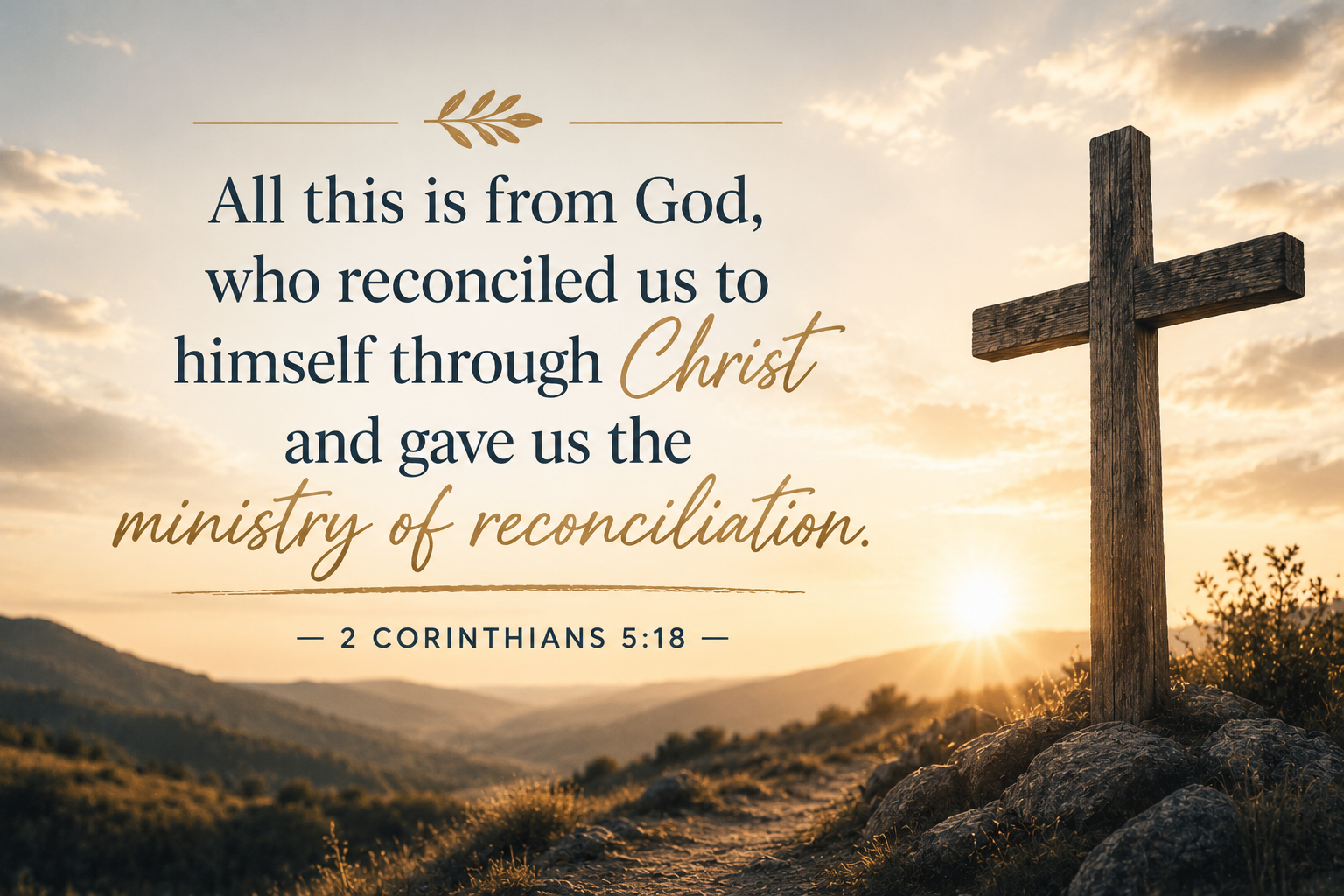
The ministry of reconciliation isn’t only about God reconciling us to Himself. Through Christ, He also entrusts His people with becoming ambassadors of that same reconciliation in a broken world (2 Corinthians 5:18–20).

Perhaps one of the greatest evidences that we truly believe the gospel isn’t simply that we rejoice over God’s power to change us—but that we remain humble enough to recognize His transforming work in someone else.

If we proclaim that Jesus makes all things new, may we never become so guarded that we fail to recognize His new creation standing right in front of us.

Cover graphic creds: ChatGPT

Halftime: Reflections on 2026 and the Road Ahead

Halftime thoughts.

Every year around the year’s midpoint, I find myself pausing long enough to evaluate where God has brought me and where He’s still leading me.

The first half of the year—especially these past three months—has been marked by much-needed growth, course correction, new opportunities, and genuine healing. Not the kind of healing that arrives overnight, but the kind you only recognize when you look over your shoulder and realize the arrow is finally pointing upward again. I’m grateful for that.

Much of this progress has come through a combination of what God has been asking me to lay down and what He has been faithfully replacing it with. As Paul reminds us, God’s grace is made perfect in weakness, not because weakness is desirable, but because it becomes the stage upon which His strength is displayed (2 Corinthians 12:9-10).

That doesn’t mean grief has disappeared.

In many ways, I still consider “the griever” because I am one. I remain a recovering bereaved parent learning how to faithfully navigate a world that often doesn’t know how to care for those carrying profound loss. Scripture tells us to “weep with those who weep” (Romans 12:15), yet many people simply have never learned what that looks like in practice. They don’t intentionally neglect grieving people; they’re simply unequipped to enter pain they have never personally experienced.

For a grieving person, being understood carries tremendous emotional and relational value. As months and years pass, silence can begin to feel like abandonment. Invitations become fewer. Conversations become shorter. Friends move on with life while your world still feels permanently altered. Somewhere in the recesses of our minds, we begin wondering whether the relationship was ever as strong as we believed. Sometimes that conclusion is accurate. More often, it is simply the grief interpreting silence through wounded eyes.

One of the greatest lessons God has been teaching me is that misunderstanding does not automatically equal malice. Sometimes people aren’t withdrawing because they’ve stopped caring. They withdraw because they don’t know how to care. They fear saying the wrong thing, so they say nothing at all. Ironically, that silence often becomes the very thing that wounds us most.

Looking back, I believe one of the deepest forms of forgiveness is releasing people from the offense of misunderstanding you. Some of the harshest words ever spoken to me occurred during seasons when my autistic mind couldn’t fully process my own weakness while simultaneously navigating profound grief. There were moments when neither side truly understood the other. My pain was misunderstood, and their limitations were equally misunderstood by me.

The reality is that ignorance is unavoidable. If we’re living life together—raising families, serving in churches, investing in friendships—we’re all going to have moments of poor execution. We’ll say the wrong thing. We’ll say nothing. We’ll miss opportunities to show up. None of us perfectly reflects the compassion of Christ every single day. That’s why Paul exhorts believers to “bear with one another and forgive one another if any of you has a grievance against someone. Forgive as the Lord forgave you” (Colossians 3:13).

I’ve come to believe that grief matures our understanding of care faster than almost anything else. By the time someone has walked through profound suffering, they’ve learned that presence often matters more than words, consistency matters more than grand gestures, and quiet companionship often ministers more deeply than carefully crafted advice. Our expectations of others naturally rise because our own understanding of compassion has deepened.

But this is where humility must temper wisdom.

Most people haven’t walked through the valleys we’ve walked through. Their capacity to care exists within the boundaries of their own experiences. They aren’t necessarily uncaring; they’re simply still growing. Just as we hope others will extend grace toward grief they cannot fully comprehend, grieving people must also extend grace toward those who are still maturing in their understanding of compassion.

That realization has changed how I read 2 Corinthians 1:3-4. Paul describes God as “the Father of compassion and the God of all comfort, who comforts us in all our troubles, so that we can comfort those in any trouble.” The comfort God gives us isn’t intended to terminate with us. It becomes the pattern through which we learn to comfort others. Sometimes that also means remembering that not everyone has yet received the same lessons suffering has taught us.

At the same time, grief cannot become an entitlement card. It cannot become permission to remain bitter toward a world that no longer understands us. Nor can it become an excuse to avoid relationships and settings simply because awkward conversations might happen. Bitterness feels protective, but it slowly becomes another prison. Scripture repeatedly calls us toward forgiveness, not because every offense is small, but because Christ has forgiven infinitely greater debts within us (Matthew 18:21-22; Ephesians 4:32).

Some people genuinely have abandoned you. Others have failed you. Some will never apologize. Some may never even recognize the hurt they caused. Those realities are painful, but they are not outside God’s ability to redeem. “The Lord is near to the brokenhearted and saves those who are crushed in spirit” (Psalm 34:18). He sees every lonely moment that no one else noticed.

So let God deal with the abandoner and embrace the call to pray for them.

Release the hurt you’ve carried through the valleys and shadows. Don’t allow grief to collect resentment until bitterness disguises itself as conviction. That burden was never yours to carry forever.

If you’re faithfully pressing into Christ day after day, He will gradually give you the strength to surrender every source of hurt into His hands. Forgiveness rarely begins with strength; it begins with surrender. We forgive because we’ve first been forgiven. We extend grace because we’ve first received grace. And we continue moving forward because nothing—not grief, misunderstanding, abandonment, nor even death itself—can separate us from the love of God that is in Christ Jesus our Lord (Romans 8:38-39).

Perhaps that is one of healing’s greatest milestones. Not when grief disappears, because it won’t this side of eternity, but when forgiveness quietly becomes greater than offense, hope becomes stronger than despair, and the arrow—by the grace of God—continues pointing upward.

Cover graphic creds: ChatGPT