When the Church Looks Less Like Jesus

A call to remember who the Church belongs to—and what the world should see in us.

The Church Belongs to Jesus

What should people encounter when they encounter the Church?

Should they leave impressed by our excellence? Inspired by our music? Encouraged by our preaching? Or should they leave saying, “I caught a glimpse of Jesus.”

That question matters because the Church belongs to Him. She is not ours to redefine, market, or mold according to the preferences of any generation. Scripture describes her as the Body of Christ (1 Corinthians 12:27), the household of God (Ephesians 2:19), and the Bride for whom Christ willingly laid down His life (Ephesians 5:25–27).

If she belongs to Christ, every generation must ask one simple question: Are we becoming more like Jesus? Not more successful. Not more influential. Not more visible. More like Jesus.

To look like Him is to love what He loves, serve as He served, welcome as He welcomed, and make disciples as He commanded. Everything else flows from that.

A Shared Life, Not a Weekly Event

The New Testament presents a compelling vision of the Church. Believers devoted themselves to the apostles’ teaching, fellowship, the breaking of bread, and prayer (Acts 2:42). They shared with those in need (Acts 2:44–45), bore one another’s burdens (Galatians 6:2), rejected favoritism (James 2:1–9), practiced hospitality (1 Peter 4:9), and became known by their love (John 13:34–35).

This was not simply a worship service. It was a shared life. They did not merely attend together. They belonged to one another.

The early Church was not perfect. Acts and the New Testament letters reveal conflict, sin, and correction. Yet they also reveal a people willing to repent and reorder their lives around Christ. That picture should challenge us: Have we unintentionally settled for something smaller than what Scripture describes?

When Activity Replaces Faithfulness

The modern Church has become remarkably effective at gathering people. We organize ministries, communicate vision, create excellent environments, and steward resources wisely. Those things can honor God. But excellence must never replace obedience.

  • Programs cannot replace people.
  • Production cannot replace presence.
  • Attendance cannot replace discipleship.

Methods are servants. They must never become masters.

One temptation facing the Western Church is to mistake activity for faithfulness. The question is whether our methods have quietly become our measurements of success. Jesus did not commission His followers to build impressive institutions; He commanded them to make disciples (Matthew 28:19–20). Paul wrote, “I planted, Apollos watered, but God gave the growth” (1 Corinthians 3:6).

Faithfulness belongs to us. Growth belongs to God.

Christ gave leaders to the Church “to equip the saints for the work of ministry” until the whole body matures in Him (Ephesians 4:11–16). Healthy ministry is measured by whether God’s people are becoming more like Jesus together.

The earliest believers did not simply invite people to a gathering. They carried the life of Christ wherever they went. Their worship overflowed into hospitality, their teaching into discipleship, their fellowship into generosity, and their prayers into courageous witness.
Returning to Our First Love

Churches do not drift overnight. Neither do believers. Even the church in Ephesus—commended for perseverance and discernment—heard these sobering words from Jesus: “You have abandoned the love you had at first” (Revelation 2:4). Their greatest problem was not incompetence. It was misplaced affection.

That warning still echoes. We can become more competent while becoming less dependent upon God, more organized while becoming less compassionate, and more influential while becoming less Christlike.

The greatest threat to the Church has rarely been opposition from the outside. More often, it has been gradual drift from the inside.

Sent Belong the Walls

Outreach has not disappeared from the Church. Countless congregations faithfully serve their communities in ways that honor Christ. Yet we should ask whether outreach has slowly moved from being part of the Church’s identity to becoming one ministry among many.

The ministries hardest to promote are often the ministries Scripture emphasizes most: visiting the sick, welcoming the stranger, caring for widows and orphans, bearing burdens, opening our homes, and serving without recognition (James 1:27; Matthew 25:34–40; Galatians 6:2). These acts rarely generate headlines, fill auditoriums, or build anyone’s platform. But they look remarkably like Jesus.

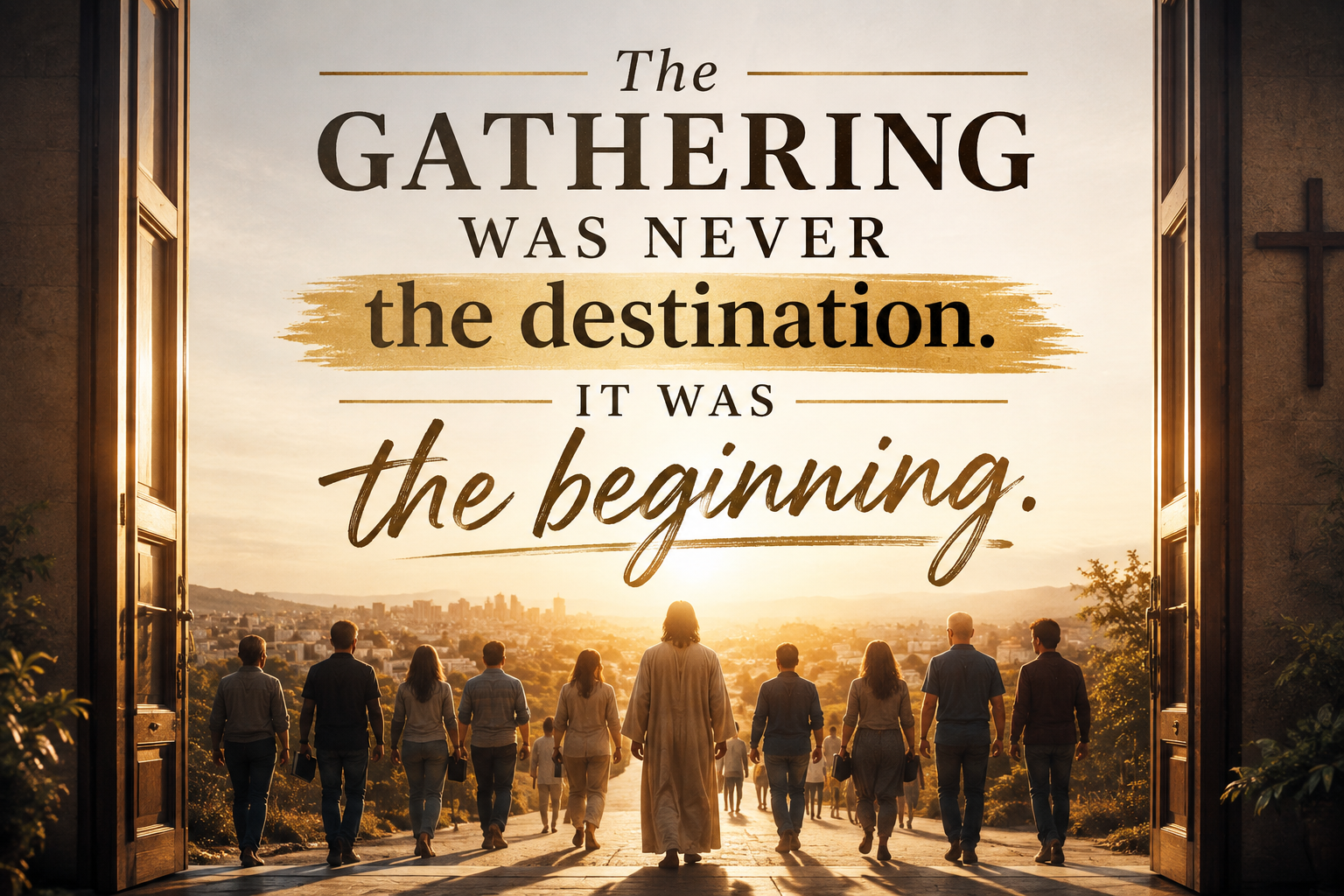
The Church was never called merely to invite people into a building. She was called to carry the presence of Christ into the world.

More Than Consumers

Perhaps nowhere is self-examination more necessary than in the way we approach gathering together. We ask: Did I enjoy the worship? Did the sermon encourage me? Did I feel fed today?

Those are not wrong questions. They are incomplete.

The New Testament invites us to ask another set of questions: Whom did I encourage? Whose burden did I help carry? Who experienced the love of Christ through me? Who did I welcome, forgive, or serve?

Church was never intended to function like a spiritual gas station where we stop once a week to refill before returning to life unchanged. If we leave our gatherings knowing more about Christ but looking no more like Him, we have misunderstood the purpose of gathering.

Worship that truly encounters God does not terminate on itself. It overflows into love, service, mercy, justice, humility, forgiveness, generosity, and sacrificial care.

Hungry Without Agenda

The same examination applies to every gift within the Church. Whether someone teaches, preaches, writes, leads worship, or serves behind the scenes, every ability entrusted by God exists to make much of Christ. Whenever a gift begins drawing attention primarily to the person using it, we have drifted from its purpose.

The platform has never been the center of worship. Christ is.

I believe believers across the world are quietly praying for communities simply hungry for Christ—without agenda, without platform-building, without chasing influence for its own sake. Communities whose greatest ambition is to know Christ and make Him known. Where people serve because they love, give because they have received grace, worship because God is worthy, and gather because they genuinely belong to one another.

Those communities may never become famous. But heaven has never measured faithfulness by fame. The Church has never needed more influence than faithfulness. She has only ever needed more of Christ.

Call Back to Christ

The prophet Micah summarized God’s desire with remarkable simplicity:

“He has told you, O man, what is good; and what does the Lord require of you but to do justice, to love mercy, and to walk humbly with your God?” (Micah 6:8)

Perhaps the Church today needs that reminder as much as any generation before us. This is not a call to abandon Christ’s Bride. It is a call to love her enough to invite her continually back to her first love.

The answer to an imperfect Church has never been abandoning her. The answer has always been allowing Christ to continue sanctifying her—including us.

May we have the humility to examine ourselves before we examine others. May we have the courage to repent wherever we have drifted. May we become people hungry for Christ without agenda—content to decrease so that He might increase.

And until the day we finally see our Savior face to face, may the watching world first catch a glimpse of Him in us.

For that has always been the Church’s greatest witness.

Graphics created in ChatGPT

Making Room for New Creation: Do We Still Believe Christ Changes People?

Lately I’ve found myself thinking about something I don’t hear discussed very often.

As a disclaimer, I’m genuinely grateful that the Church has become more willing to talk about healthy boundaries, emotional well-being, and protecting people from abusive or destructive situations. Those conversations matter, and Scripture certainly leaves room for wisdom when safety is at stake. There are circumstances where lasting distance is not only appropriate but necessary.

But I’ve also been asking myself another question: When genuine repentance is present and safety is no longer the issue, are we still making room for God’s ministry of reconciliation?

Sometimes I wonder if we’ve become so accustomed to protecting ourselves that we’ve quietly lost the expectation that Christ still transforms people. Either way, our responsibility remains an absolute as outlined in the Word.

In Acts 11:18, we see that God alone grants repentance—a gift of His grace that Paul echoes in 2 Timothy 2:25. This highlights an essential reality: The grace that forgives is also the grace that transforms.

Consider Jesus’ teaching in Matthew 18. While the passage is often remembered for confronting sin, His aim is ultimately restoration—winning back a brother or sister.

Paul paints the same picture in Corinth. He instructed the church to discipline a man living in open, unrepentant sin. But after that man repented, Paul’s instruction changed:

“You ought rather to forgive and comfort him… reaffirm your love for him.” (2 Corinthians 2:7–8)

Notice the progression: Accountability. Repentance. Restoration.

Repentance doesn’t erase consequences. It doesn’t instantly rebuild trust. It doesn’t obligate anyone to return to an unsafe relationship.

Reconciliation doesn’t always mean restoring a relationship to what it once was. Sometimes it simply means laying down bitterness, extending forgiveness, and remaining open to whatever measure of restoration wisdom permits.

Yet neither should we treat genuine repentance as though it changes nothing.

I’ve also found myself wondering whether our desire to protect our peace can slowly become something else. While boundaries can absolutely be an expression of wisdom, they can also become places where reconciliation quietly stops.

That’s worth examining—not to produce guilt, but to ensure our instinct is still moving toward the ministry Christ entrusted to us whenever wisdom allows.

Every Sunday we proclaim that Jesus makes people new. We celebrate that He removes hearts of stone and gives hearts of flesh. If we truly believe Christ transforms lives, shouldn’t we expect to recognize His work when genuine repentance appears?

Paul writes: “If possible, so far as it depends on you, live peaceably with all.” (Romans 12:18)

I appreciate those opening words: “If possible.” Paul recognizes that reconciliation isn’t always achievable because it doesn’t depend on one person alone. Some wounds require lasting distance. Some relationships remain unsafe. We cannot control another person’s response.

But we can control our own.

As far as it depends on us, we’re called to pursue peace, own our failures, confess our sin, forgive as we’ve been forgiven, and remain open to the restoring work of Christ whenever wisdom allows.

I don’t write this to minimize the importance of boundaries. I write it because I don’t want to miss the work of Christ when He begins changing someone’s heart.

The ministry of reconciliation isn’t only about God reconciling us to Himself. Through Christ, He also entrusts His people with becoming ambassadors of that same reconciliation in a broken world (2 Corinthians 5:18–20).

Perhaps one of the greatest evidences that we truly believe the gospel isn’t simply that we rejoice over God’s power to change us—but that we remain humble enough to recognize His transforming work in someone else.

If we proclaim that Jesus makes all things new, may we never become so guarded that we fail to recognize His new creation standing right in front of us.

Cover graphic creds: ChatGPT

Even From Far Away, God Still Speaks: A SOAP Study on Jeremiah 31:1-9

There are seasons where God feels close enough to touch…and seasons where He feels far away.

Yet Jeremiah 31 reminds us of something beautiful: “The LORD appeared to him from far away.”

Even from a distance, God still spoke love. Even through wilderness and grief, His faithfulness remained.

Sometimes we expect God’s presence to look like immediate rescue, instant healing, or emotional certainty. But there are moments when He meets us from what feels like “far away”—not because He has abandoned us, but because He is teaching us that His love is deeper than our current feelings.

If you are walking through sorrow, disappointment, confusion, or exhaustion today, remember this: God’s silence is not the absence of His faithfulness.

The same passage says: “I have loved you with an everlasting love; therefore I have continued my faithfulness to you.”

Everlasting means His love did not begin with your strongest season, and it will not end in your weakest one.

And then comes the promise: “Again I will build you.”

God rebuilds people.

  • He restores what grief tried to hollow out.
  • He brings worship out of wilderness.
  • He teaches trembling hearts to dance again.

Even in chaos, we can posture ourselves in worship because we trust that God’s plans are still unfolding. Worship is not denial of pain—it is confidence that despair does not get the final word.

If God is rebuilding you right now, don’t despise the process. The One who loves you eternally is still being faithful to you presently.

Let’s pray…

Father, in seasons where You feel far away, help me remember that Your love has never left me. When grief, disappointment, or exhaustion cloud my vision, remind me that Your faithfulness is still holding me together. Teach me to trust You not only in moments of clarity, but also in the wilderness where I cannot yet see what You are rebuilding. Heal the places in me that have grown weary, restore what despair has tried to steal, and posture my heart in worship even before the breakthrough comes. Thank You that Your love is everlasting, Your plans are still good, and You are not finished with my story. Build me again, Lord, and let my life become a testimony of Your restoring grace. Amen.

Graphic cover created in ChatGPT

Space Dangers: How to Deal with Painful Orbiters

There is a quiet but intense pain that comes not from judgment, but from neglect. You confess, open up, step into the light…and for reasons unknown, the other side withdraws.

What does Scripture say about this scenario?

First, the Bible consistently honors confession. “Confess your sins [offenses, insecurities] to one another and pray for one another, that you may be healed” (James 5:16). Confession is not weakness; it is courageous obedience, an expression of virtue rooted in trust both in God and in the community of believers.

But what happens when that trust is not reciprocated?

While the Bible calls believers to bear one another’s burdens (Galatians 6:2), it also prepares us for a sobering reality – not everyone will respond with grace or remain engaged in it. Even within communities of faith, people can fail to reflect Christ’s compassion. Some withdraw out of discomfort. Others stay distant, bypassing love in the name of self-preservation, passive-aggressive retaliation, or simply making a point.

Yet, Scripture gently redirects our expectations: “It is better to take refuge in the Lord than to trust in man” (Psalm 118:8). This is not a call to isolation – but recalibration. While human relationships are imperfect vessels, God alone is absolute and constant.

Consider this: Your confession was never ultimately for them but before God. As hurtful as silence can be, a widening of detachment does not invalidate your obedience, minimize your need for wisdom and encouragement, or erase your healing.

In fact, Jesus Himself experienced relational abandonment in moments of deepest vulnerability. In Gethsemane, His closest friends slept. At the cross, many fled. Some even mocked. Yet, He remained anchored in the Father’s will, not human consistency.

So, what do you do with the ache?

You grieve it honestly. You resist the urge to harden your heart. And you keep pursuing authentic community – because while some may fail you, others will reflect the grace you hoped for.

Put another way…

Being neglected after confession does not mean you chose the wrong path; it just means you chose the narrow one.

My charge to you, my friends, is simple: Keep going, pray for the ghosting orbiters who have strayed, and stay true to God’s path knowing you’re never alone from where it matters most.

Selah.

Cover graphic creds: QuoteFancy

The Joy Set Before: What’s Driving You Forward?

Written on 3/30/2026

I’m cruising at 31,000 feet, overlooking the spine of the Appalachians. Heaven knows I’m still stunned by this career page turn – relieved and excited as I may be.

Am I anxious? Sure. After all, this is only my second week at a new job, with many faces to meet and much to learn. At the same time, I’m reminded of why I’m in this situation – and, in four words, why any of us are here at all:

The joy set before.

For some of us, we read these words and instantly think of Hebrews 12:2: “Looking to Jesus, the founder and perfecter of our faith, who for the joy that was set before him endured the cross, despising the shame, and is seated at the right hand of the throne of God.”

Fair enough as apart from foreshadowing samples in Psalm 16 and Psalm 110, this is the only direct mention of the phrase in Scripture.

Still, we must be careful with context. For instance, as a younger Christian, I often misinterpreted this passage, thinking the cross – the fruit of Christ’s mission – was the joy set before Him; however, as I now understand, the joy set before Christ was exaltation with the Father in the presence of a redeemed people.

You see, the ultimate sacrifice – the necessity of reconciliation – is only half the story. The other half is the eternal invitation we have with God, in the presence of Jesus, who endured the cross as a prerequisite.

Accordingly, the joy set before us should not be limited to our sins being atoned for but should extend to thy Kingdom come on earth as it is in heaven. Understandably, there is a temptation to base Easter joy primarily on the freedom we have in Christ because of His death and resurrection. Yet, if we are to grow into the likeness of Christ – if we desire to deepen our gratitude for that freedom – we must celebrate where it ultimately leads: the throne room where Jesus resides today and will forever.

What about the part where we “despise the shame” of the cross?

Again, referencing Hebrews 12, we find the answer. Christ did not detest Calvary but rather anything that threatened the joy of redemption – the public humiliation, disgrace, and intense suffering of crucifixion. In full submission to His mission, Jesus never faltered in obedience to the Father or in the intimacy that obedience required. In all He accomplished – in heart and in word – Jesus not only kept joy at the center of His hope but expressed love as the currency of every cost He counted.

Even as a child, Jesus knew where He was going. Unlike most journeys with a fixed endpoint, Christ’s destination was less static and more perpetual, saving those He loved and sanctifying them from His Father’s right hand. In essence, the joy set before Christ was His Father’s house: a dwelling from which He could save from an exalted place, draw near to the brokenhearted, and prepare a place for them.

Yes, Jesus anticipated completion (i.e., “It is finished”), but what He truly desired was to give people the opportunity to experience what He knew – to invite them into a place where pain and strife fade into glory.

My question to you, my friends, is simple: Is joy set before you? If not, what is? What is driving you, calling you, fueling your purpose?

Whatever your answers, let the cross be a prompt to recalibrate your perspective – your heart, and all the aims and burdens you carry. Do not let them drift. Instead, let them compel you to look to Jesus, not just as the founder of your faith, but as the restorer of your faith, who purifies your sin and shame, from where joy was, and still is, set before you.

Selah.

Cover photos creds: Shutterstock