Road to Healing: Why Even in Pain, There’s Still Jubilee

It’s been three years to the day since Juju’s death.
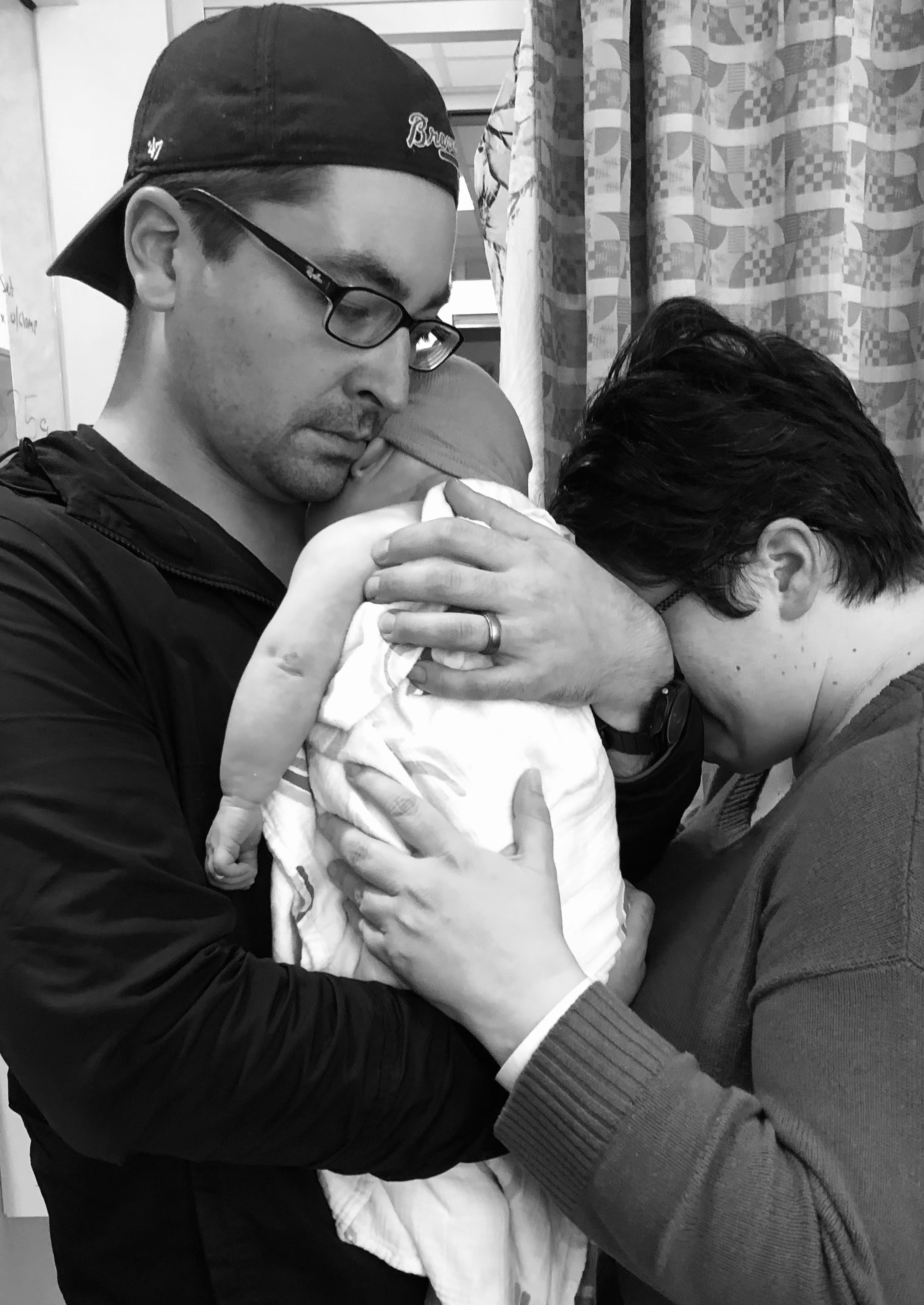
For better and worse, Lys and I haven’t been the same since that fateful day. While grief intensity has lessened, life still feels like a tightrope. One false step and we’re praying for a safety net, just trying to survive – like when Juju was alive only without the hope of tomorrow. If only I were better at patience, maybe this whole waiting thing would be easier.

As Juju proved during her NICU tenure, progression and regression aren’t always mutually exclusive. At times within her fragile body, one element was improving while another was degrading. Her recovery and, at times, lack thereof, was anything but a linear wave. Like life itself, her journey was a winding roller coaster with unexpected turns and unprecedented breakthroughs. Her butterfly tattoo on my heart, not a day goes by that I don’t think of her and consider the glory of what she constantly experiences.


Yet, though the tears have remained mostly at bay the past year, there’s still a temptation to anger. God, why didn’t you somehow, someway cap her suffering? If you knew she was going to barely make it past a year, why defer the inevitable?

In most cases, I can convert those ‘whys’ into ‘look what God did’ and carry on. Where I stumble is the next level down: God, why aren’t people more naturally geared towards the broken-hearted? Why does the silence sometimes increase when it needs to decrease? In the shadows, you were there after Juju’s death. What about those who may not even be able to find you at all? What about them?

These questions have been raised before, and they’ll be raised again. Until the answers come, I, along with the rest of us, must settle in Christ (1 Peter 5:10; Colossians 2:6-7). For those who have lost a child, we don’t have any other option. At day’s end, everyone has a call to embrace their suffering and ditch their baggage. No exceptions. I know for me, sometimes I get into trouble tolerating the baggage while trying to ditch the suffering in a quest to find meaning in pain; however, in times of reset, I catch myself in the striving and commit my ways to God whether I feel like it. It’s hard as heck, don’t get me wrong. I just know as low as I feel sometimes, I’m only hindering my perspective when I punt prayer and vertical reliance.

I love how Paul opens Colossians 3:1: “Therefore if you have been raised with Christ, keep seeking the things that are above, where Christ is, seated at the right hand of God.”

For starters, the chapter unpacks our ‘new self’ identity as a garment we can wear regardless of the day. But even more promising, we’re reminded in the intro how we’ve been raised with Christ to a new life, sharing in His resurrection from the dead. In a weird way, this hits home even more so these days. Even when I feel dead on the inside, somehow, I know I’m that much closer to the type of life I crave. Among all the things that are above, where Christ is, seated at the right hand of God is also my daughter. Your son. His grandson. Her granddaughter. Their mother, their father, our friend, etc.

The way God’s lap is designed, there is always a comfort and rest to draw from, even if it’s simply His presence and nothing more.

The problem is we’re not often content with the safety of God’s nearness because we’re dissatisfied with the security of it. Our kid passed away, so we doubt if God is who says He is. If God is a God of love, then why didn’t His sovereignty meet my faith in the middle? If God has the capability, why didn’t His power take pity on a soul that could have done wonders for Him if given the opportunity?

While I’m not condoning this as the correct posture to take, admittingly, this is a popular contention bereaved parents wrestle through. We desire the improbable; we believe in the impossible. We just wish it could have looked a certain way. And that’s okay…assuming we regularly surrender our grief, anxiety, fear, and anger. As Juju reminds us, there’s beauty to be found in the ashes of our sorrow, especially when we reframe our perspective to see a life well fought as an altar pointing people to Jesus. Our lives may always sound like a sad song, but that doesn’t mean what other people hear is the same tenor.

Trust me, life has been brutal, dare I say, savage, this decade. Despite the positive turn in recent years, my debates with God are still on the regular.

Dear Lord, thank you for what you did during Juju’s life and gifting my family with this incredible light, this testimony unfolding, but surely you know what it’s like to grieve. You know what it’s like to be separated from your only begotten Son. If you’re stripping me of anything my life could cling to other than you, so be it. I don’t have to know how you’re exalted in those moments as long you’re exalted at all. And with a daughter dancing in your courts, I dare not lose sight of the new life I have in Christ, knowing that’s exactly what she has.

For all you readers and co-sufferers out there, ask yourself: Will I be too stubborn in my grief to don new garments of praise? To serve and think within new wineskins? Or am I too scared to endure because I don’t want God to let me down again? I know for me, I don’t have the margin, nor do I want to give that question room to manifest. Thus, I will keep looking up and pressing on one step at a time, with Juju’s rays forever on the horizon. The victory’s been won. Let’s choose to walk it in. God, show us the way…

Selah.

Sevenfold: A Workman’s Guide to the Leadership Gifts

Last decade (2010-2019), I worked in state government: The Department of Labor and Workforce for 2.5 years, and TDOT (Tennessee Department of Transportation) for 7.5 years. As one might expect, the environments, well, they were kind of like your favorite soda but flat – very little in terms of bubbliness, morale, positivity, widespread humility, grace, selflessness, and other hallmarks of a healthy culture.

After my first year at TDOT, I started getting frustrated with God as to why He opened a door for me into a place I didn’t fit, let alone have a clear, defined future. At the time, I was two years into a six-year youth ministry assignment, which provided some sense of purpose punch. But by day, I sometimes wondered ‘God, why did you bring me to this desert? I know you made me for much more than this.’  

After a few months of wrestling, I decided to meet up with my dad and my wife, Lyssah, for lunch. During our talk, we discussed our royal priesthood (1 Peter 2:9) identity and how the concept of being commissioned for ministry was largely confined to licensed liturgy (I.e. only pastors and those called to ‘ministry’ can be ordained, etc.). As we dissected this issue, Lyssah and I disclosed some of our frustrations, one of them being how much energy we were sowing outside our calling, or rather, our perception of calling.

But by conversation’s end, I started to realize how my construct of God-given purpose was off.

Our purpose isn’t given to us by our settings and surroundings, but is given as an inheritance, a faith downpayment, a gift from above that not only connects to our original design but one we’re called to exercise throughout our lives from home to church, from market to marketpla

Once this lightbulb went off, I immediately understood why God called me to the desert – not only did He want to break off strongholds, like pride, ego, and faulty belief structures, but He wanted me to see how it was because He had more for me that He called me there.

For years, I compartmentalized my view of what being on mission, what being in ministry, looked like. Yes, I had a youth pastor outlet; however, I was still often annoyed given the pressure to cram a full-time effort within part-time hours. This is partly why my grudge against the state grew before my eyes were opened to see how God was calling me to lead in both church and marketplace arenas.

While there’s more I could say about this season, what I can speak to now concerns one of the initial impacts. Starting in 2015, I started to study the spiritual gifts (as unpacked in Paul’s letters) with a fresh pair of eyes, all the while creating content catered to two sets of vocationals:

  • Those who had a leg in corporate and ministerial arenas.
  • Those who were called to ministry outside the church.

In some of my explorations, I started to assess the spiritual gifts through work-based themes like work/home/church life balance, leadership, conflict resolution, networking, technology, goal setting, time management, etc. The more I dug in, the more I realized there is no hierarchy or exclusivity when it comes to “working with Jesus”, partnering with Him in daily tasks and fulfilling God’s purpose on our lives. We may be diverse in function but we’re co-equal in value given we’re co-laborers with Christ (1 Corinthians 3:9). The same worldly systems that promote entitlement, reciprocity, self-gratification/preservation/medication, etc. are the same systems that push leadership as a ladder to climb when the Word is clear in its trope of leading being the overflow of serving one another in the hope of unity, in the spirit of humility. 

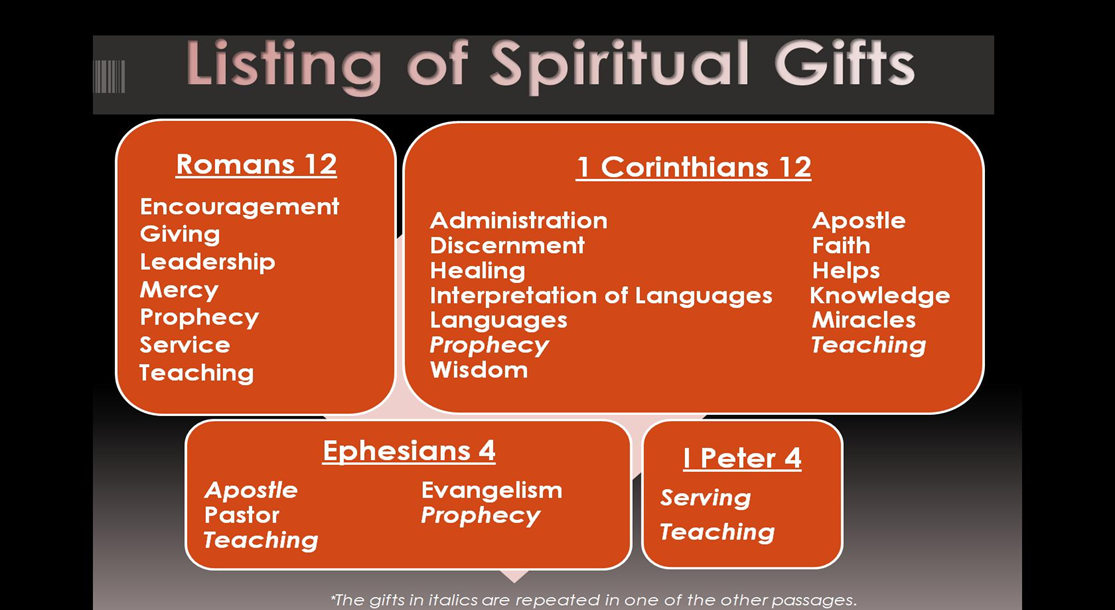
Concerning the spiritual gifts, not only are there more than we might remember, but our spiritual identity with respect to them is no stranger to God. For each person, there is a divine order with varying weights that often goes unknown or misunderstood in spiritual journeys. Accordingly, it is my belief that any faith-based institution should be keen on helping its participants discover their ‘loved by God’ identity through the gifts and then seeing how they can be at work…at work. 

I like this graphic primarily due to its layout. While we don’t have time in this post to dive into all of them, I want to focus today on the seven gifts at the bottom of the screen, starting with the fivefold ministry gifts described in Ephesians 4: Apostles, Prophets, Evangelists, Pastors, and Teachers. These are leadership gifts given by Christ not just to the ordained ministers of the world but too all believers to equip the saints for ministry, build up the body of Christ, and foster unity and maturity in the faith.

As for the two in the bottom-right, these are grace gifts as defined in 1 Peter 4:10-11, service (deacon) and ‘teaching’ (elder) in an exhortation capacity, In this passage, Peter states how God has given every believer a spiritual gift to serve one another as good stewards of God’s grace, with the goal that all things glorify God through Christ. These gifts are not self-focused but are for the benefit and building up of the body at large with different gifts being empowered by the same Spirit and needing to be used with God’s strength for His glory. 

Having said all this, here’s the ‘crashiest’ of courses you may ever receive on the seven leadership gifts and how they’re meant to function in the marketplace…

Prophets…call God’s people to God’s ways. They are more about developing the design of organizational mission, less about developing people. They ‘redeem’ an environment by expressing a wisdom that gives clarifies organization’s vision/mission for co-workers.

Evangelists…those who are gifted to reach unbelievers. They tend to be more gatherers with acts of service being their community gift. Evangelists are more concerned about developing the organization through developing people. They ‘redeem’ an environment by creating an inclusive team environment through love and acceptance.

Pastors…those who encourage believers with the spoken word. More concerned about developing people than managing systems. They ‘redeem’ their environment by creating joy through encouraging people on how important they are as people to the organization and by helping them see how their temperaments complement the organization.

Teachers…those who systematically make disciples and develop management systems. More concerned about preserving the organization. They ‘redeem’ their environment by raising team morale through breaking down systems into easy action steps and by helping them see how the systems help everyone reach their mutual goals.

Apostles…coordinate the other gifts and helps them work together. Leading and directing are their community gifts. They ‘redeem’ their environment by coordinating a team in a way that generates hope by maximizing each team member’s gift and designing products/projects that emphasize a redemptive gift of the organization.

Elders…those who impart themselves. More about managing people/Less about developing people. They are big picture minded in that that they see the value of systems, but they REALLY see the value of helping people find their places in the system. They are manager-developers who gravitate to systems but are motivated to help people find their seat on the bus.

Deacons…more about managing systems for the sake of people. They are motivated to implement proven systems that help people work together*. A deacon is part of the pastoral gift cluster, but in the workplace may not be in a direct support capacity but a ‘hidden’ support capacity. They ‘redeem’ their environment by creating an atmosphere of goodness and gratitude through giving and bringing order to the organizational environment.

*Note: A deacon’s gift is the broader concept of “serving others” through the use of whatever spiritual gifts one has received from God. This isn’t limited to a specific role, but encompasses a general ability to use God-given talents, like mercy, hospitality, administration, and giving, to serve the needs of the Christian community.

Graphic creds: Walk with Scripture

Healing Declared: A SOAP Study on Luke 13:10-17

**New excerpt from Juju’s book…**

In Luke 13:10-17, Jesus is teaching in the synagogue on the Sabbath when he notices a woman with a disabling spirit. As she totters through the temple gates, Jesus calls the woman over, confirms her restoration, and heals her condition. No longer crooked, she glorifies God and prompts Jesus to criticize the religious leaders for their lack of compassion.

Digging into this summary, we find meaningful implications, especially where sickness and infirmity dwell. For starters, we must not deny those around us who are poor in spirit and health, desperate for Jesus in a way that extends past their margins.

As a NICU alum, I can boldly testify to this. Every day during Juju’s life, Lys and I entered a larger-than-life mystery box, a stream of unknowns where anything could happen. From what we experienced, the emotional highways were unending from dead-end hopelessness to confounding crossroads. In each situation, parents, like the crooked woman, were searching for anything their hope could cling to – comfort, healing, answers, you name it!

Yet, as challenging as that season was, the contrast in processing helped us understand the power within the presence of God. While there were moments when we sought the Lord because there was no other way, there were other times we sensed his call and responded accordingly. So, it was with our protagonist in Luke 13, who not only personified what it meant to be in the right place at the right time but saw her affliction as a catalyst for intervention.

Examining the woman’s transformation, we find some notable takeaways, particularly in v. 10-13, during which Jesus orchestrates his miracle:

1. In v. 10, Jesus sees the woman even though he was already teaching in the synagogue.
2. At the start of v. 12, he calls her over instead of continuing with his message.
3. By the end of v. 12, he declares her freedom before healing her disability.

While circumstantial at the surface, we can behold the intentionality within this order when we assess similar healings in the Gospels. Like the bent woman, Jesus repeatedly modeled his heart alongside his power, relating to the context of suffering even before his presence was recognized. This poses a powerful thought:

To the extent our faith activates when we sense God’s presence, it also stirs when we hear His voice. Like gravity, His Word summons the innermost part of our being in a way that compels us to move in his direction.

No wonder the woman had no issue journeying to Jesus. the joy set before her resonating with the joy set before him.

Upon her arrival, note how Jesus reacts: He doesn’t immediately remove the woman’s iniquity but proclaims her victory! Again, this subtle progression is profound. Though some might question why Jesus would call his shot, the purpose behind his declaration wasn’t to simply highlight his divinity but to deliver salvation while proving his love. Had the purity behind the action lacked, the woman’s response may have reflected differently. But like many before her who battled long-lasting crippling ailments, the outflow of praise rode on the heels of the expectancy. In the end, it was all about Jesus, religious and wishful sentiments be da*rned.

For the griever and/or loved one stuck in the hospital, while our prayers have power and purpose, what we voice as expressions of hope yields the truth of who God is and what he wills from his nature. Ultimately, God is going to finish the good work he started in you (Philippians 1:6) as heaven meets earth in wonder-working fashion (Matthew 6:10). True, we will never have all the answers as to why we must endure in specific ways; however, when we remember how Jesus made space to heal a woman in the middle of a sermon on a day His Father set apart for rest, we can draw encouragement knowing God is always for us, even during the darkest and craziest of days.

Prayer: “Jesus, you told your followers, ‘Do not let your hearts be troubled. You believe in God, so believe in Me as well. Peace, I leave with you; my peace I give you. I do not give to you as the world gives,’ (John 14:1, 27). We confess we need your peace, the peace of God, which transcends all understanding’ (Philippians 4:7) to guard our hearts and minds. We humbly come before you with our weary hearts and pray that you continue to show us fresh levels of love and grace as we go through this season of sorrow and transition. Help us to find peace in your presence. Wipe our tears, Lord, and carry us through this season of mourning and deep sadness. Help us to trust in your unfailing love and to fix our eyes on you, Jesus. As we lift our worries to you, we humbly ask that you lift up our hearts from what may overwhelm us. May your presence bring us joy and comfort as we embark on this journey of healing with you. In your most holy name, we pray. Amen.”

Cover photo creds: Sunflower Seeds

Springs Within You: A SOAP Study on Psalm 85-87

Well, folks. The weather outside is finally changing. You know what that means…

  1. Fire up ‘severe weather mode’ on Flash Weather.
  2. De-winterize the house.
  3. Compose another SOAP Bible study!*

*For those who don’t know, Lys and I are huge fans of this practice having implemented it during our youth pastor tenure. While our time in student ministry is long gone, in recent years, we’ve efforted to tailor these studies towards vocationals as part of our His Girl Fryday initiative; hence, why the legacy lives on.

Today, we’ll examine Psalm 85 and Psalm 87 in the context of Israel’s exile. While these selections may seem random at first glance, my hope is you’ll know why I chose these chapters by the end. 

As always…

Observations: If you’ve studied the Psalms in detail, you know the book is composed of 150 chapters broken down into sections. With Book 3 (Psalm 73-89) focusing on the tragedy of Israel’s uprooting and downfall of David’s family, one might think the tenor of Psalm 87 is out of place; however, this is partly due to how the sons of Korah¹ constructed their songs. Anticipating transition, Psalm 87 represents a confident foreshadowing, specifically Israel’s restoration and relationship to other nations.

A precursor to Psalm 87, Psalm 85 establishes the following tropes, all essential to our spiritual walk:

  1. God is faithful to bring a foundation to our footsteps, especially during seasons of adversity (Psalm 85:13).
  2. God draws near to those who fear and revere Him, who anticipate His voice and glory to manifest (Psalm 85:9).
  3. God’s love and faithfulness aren’t mutually exclusive as they’re intertwined within the same flow (Psalm 85:10-11).

These realities set the stage for Psalm 87, in which the privileges of God’s people are recognized and celebrated. Although the chapter is relatively short, the song lacks no exclamation given the holy tribute and 3:1 ‘verse-to-selah’ ratio. The general gist is straightforward and simple: As salvation comes forth from Zion, God takes note to what He can foresee.

But perhaps my favorite part of Psalm 87 is the final verse (v. 7): “All my springs and sources of joy are in you.”

While the ‘you’ is a cite to Jerusalem, given the polysemy of the Psalms, one could deduce this refers to something more than the city itself. Again, we must discern the tone and style of the author. For instance, the sons of Korah tended to ask questions they knew the answers to but framed anyway. 

Will God do ‘x’? Why, God, do you ‘y’? How long, O Lord, will you ‘z’? 

In almost every case, the resolution comes in the conclusion and inspires a modern-day practice. No matter, how dire, how challenging, how impossible a situation might seem, God, in both His Word and Way, is everlasting. Even if we seem far from the promised land we seek, God’s sovereignty is constant and His love is steadfast. Knowing this, the concerns we have should not interrogate God’s nature but inquire how we must journey with Him to see greater character, intimacy, and fruit result.

As for us, there may be an uptick in storms in the weeks and months ahead, literally and figuratively. but spiritually speaking, why not let the word picture of ‘spring’, both the season and water source, refresh our inner man? As Psalm 85:10-11 and Psalm 87:7 encourage us, why not receive the fullness of God’s springs and assess our return flow? After all, every good and perfect gift is from above. All we are or hope to be, all we have or ever hope to have, all we attain or ever hope to attain is from Him. Let the people of God acknowledge this and praise Him for it. 

Application: 

Prayer: Lord, as the winds of change surround us, we thank you for being at hand. As we worship you in Spirit and Truth today, we’re reminded how grateful we are that you are Lord of all, the God who sustains our help and gives us everything we need for goodness and godliness. No matter what tomorrow holds, we pause now to reflect on your love, your faithfulness, and how we can allow your currents to purify the rhythms in which we believe and operate. To what needs to be surrendered, convict us with grace so we may properly deal with our baggage. To what needs to be received, we ask you to not only revive us to taste you in full but to broaden our capacity to trust your truth in an increasingly compromising world. Help us not be overly discouraged by where abandonments are occurring. Rather scale our faith to see the grander scheme unfolding and how we can partner with you in victory. Give us this day and season as bread so we may feed your sheep as fed. In your holy and precious name. Amen. 

Footnotes:

  1. The sons of Korah were Levites, from the family of Kohath. By David’s time, they served in the musical aspect of the temple worship (2 Chronicles 20:19).

Cover graphic creds: Wallpapers.com

A ❤️ of Thanksgiving: Why Gratitude is Best Expressed in Full

This Thanksgiving, don’t just express gratitude over what you have but also what you don’t have. Often, we celebrate the providence and faithfulness of God during this time of year; however, are we acknowledging what God has saved us from and/or what He may be withholding to mature us in season?

Some thoughts to consider…

Supporting Bible verses:

Philippians 4:1
“Not that I am speaking of being in need, for I have learned in whatever situation I am to be content.”

1 Thessalonians 5:16-18
“Rejoice always, pray continually, give thanks in all circumstances; for this is God’s will for you in Christ Jesus.”

Jonah 2:9
“But I, with shouts of grateful praise, will sacrifice to you. What I have vowed I will make good. I will say, ‘Salvation comes from the Lord.’”

Psalm 103:2-5
“Bless the LORD, O my soul, and forget not all his benefits, who forgives all your iniquity, who heals all your diseases, who redeems your life from the pit, who crowns you with steadfast love and mercy, who satisfies you with good so that your youth is renewed like the eagle’s.”

2 Corinthians 9:10
“Now he who supplies seed to the sower and bread for food will also supply and increase your store of seed and will enlarge the harvest of your righteousness.”

Isaiah 9:3
“You have enlarged the nation and increased their joy; they rejoice before you as people rejoice at the harvest, as soldiers rejoice when dividing the plunder.“

Graphic creds: Jacob Abshire