
A call to remember who the Church belongs to—and what the world should see in us.
The Church Belongs to Jesus
What should people encounter when they encounter the Church?
Should they leave impressed by our excellence? Inspired by our music? Encouraged by our preaching? Or should they leave saying, “I caught a glimpse of Jesus.”
That question matters because the Church belongs to Him. She is not ours to redefine, market, or mold according to the preferences of any generation. Scripture describes her as the Body of Christ (1 Corinthians 12:27), the household of God (Ephesians 2:19), and the Bride for whom Christ willingly laid down His life (Ephesians 5:25–27).
If she belongs to Christ, every generation must ask one simple question: Are we becoming more like Jesus? Not more successful. Not more influential. Not more visible. More like Jesus.
To look like Him is to love what He loves, serve as He served, welcome as He welcomed, and make disciples as He commanded. Everything else flows from that.
A Shared Life, Not a Weekly Event
The New Testament presents a compelling vision of the Church. Believers devoted themselves to the apostles’ teaching, fellowship, the breaking of bread, and prayer (Acts 2:42). They shared with those in need (Acts 2:44–45), bore one another’s burdens (Galatians 6:2), rejected favoritism (James 2:1–9), practiced hospitality (1 Peter 4:9), and became known by their love (John 13:34–35).
This was not simply a worship service. It was a shared life. They did not merely attend together. They belonged to one another.
The early Church was not perfect. Acts and the New Testament letters reveal conflict, sin, and correction. Yet they also reveal a people willing to repent and reorder their lives around Christ. That picture should challenge us: Have we unintentionally settled for something smaller than what Scripture describes?
When Activity Replaces Faithfulness
The modern Church has become remarkably effective at gathering people. We organize ministries, communicate vision, create excellent environments, and steward resources wisely. Those things can honor God. But excellence must never replace obedience.
- Programs cannot replace people.
- Production cannot replace presence.
- Attendance cannot replace discipleship.
Methods are servants. They must never become masters.
One temptation facing the Western Church is to mistake activity for faithfulness. The question is whether our methods have quietly become our measurements of success. Jesus did not commission His followers to build impressive institutions; He commanded them to make disciples (Matthew 28:19–20). Paul wrote, “I planted, Apollos watered, but God gave the growth” (1 Corinthians 3:6).
Faithfulness belongs to us. Growth belongs to God.
Tweet
Christ gave leaders to the Church “to equip the saints for the work of ministry” until the whole body matures in Him (Ephesians 4:11–16). Healthy ministry is measured by whether God’s people are becoming more like Jesus together.
The earliest believers did not simply invite people to a gathering. They carried the life of Christ wherever they went. Their worship overflowed into hospitality, their teaching into discipleship, their fellowship into generosity, and their prayers into courageous witness.
Returning to Our First Love
Churches do not drift overnight. Neither do believers. Even the church in Ephesus—commended for perseverance and discernment—heard these sobering words from Jesus: “You have abandoned the love you had at first” (Revelation 2:4). Their greatest problem was not incompetence. It was misplaced affection.
That warning still echoes. We can become more competent while becoming less dependent upon God, more organized while becoming less compassionate, and more influential while becoming less Christlike.
The greatest threat to the Church has rarely been opposition from the outside. More often, it has been gradual drift from the inside.
Sent Belong the Walls
Outreach has not disappeared from the Church. Countless congregations faithfully serve their communities in ways that honor Christ. Yet we should ask whether outreach has slowly moved from being part of the Church’s identity to becoming one ministry among many.
The ministries hardest to promote are often the ministries Scripture emphasizes most: visiting the sick, welcoming the stranger, caring for widows and orphans, bearing burdens, opening our homes, and serving without recognition (James 1:27; Matthew 25:34–40; Galatians 6:2). These acts rarely generate headlines, fill auditoriums, or build anyone’s platform. But they look remarkably like Jesus.
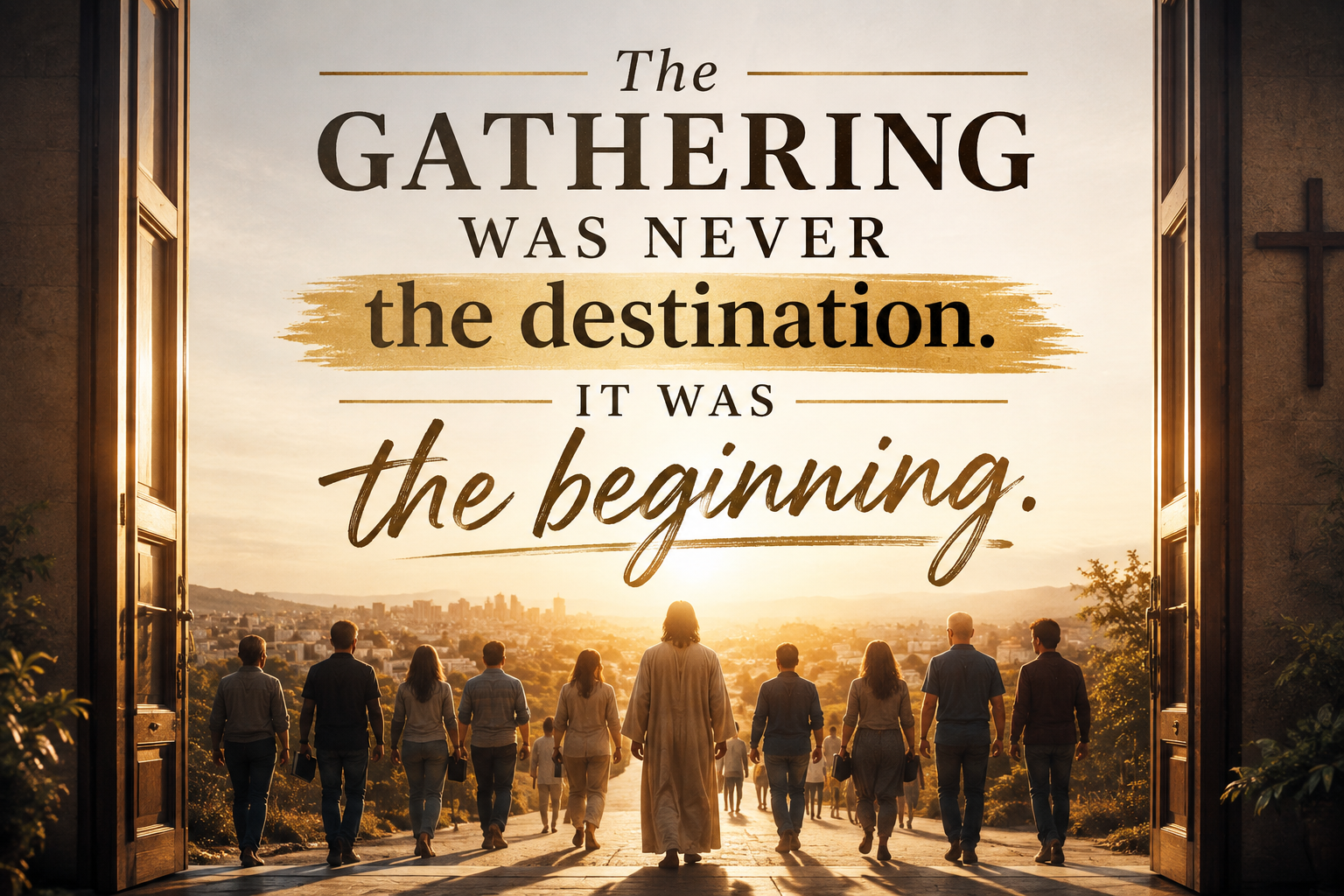
The Church was never called merely to invite people into a building. She was called to carry the presence of Christ into the world.

More Than Consumers
Perhaps nowhere is self-examination more necessary than in the way we approach gathering together. We ask: Did I enjoy the worship? Did the sermon encourage me? Did I feel fed today?
Those are not wrong questions. They are incomplete.
The New Testament invites us to ask another set of questions: Whom did I encourage? Whose burden did I help carry? Who experienced the love of Christ through me? Who did I welcome, forgive, or serve?
Church was never intended to function like a spiritual gas station where we stop once a week to refill before returning to life unchanged. If we leave our gatherings knowing more about Christ but looking no more like Him, we have misunderstood the purpose of gathering.
Worship that truly encounters God does not terminate on itself. It overflows into love, service, mercy, justice, humility, forgiveness, generosity, and sacrificial care.
Hungry Without Agenda
The same examination applies to every gift within the Church. Whether someone teaches, preaches, writes, leads worship, or serves behind the scenes, every ability entrusted by God exists to make much of Christ. Whenever a gift begins drawing attention primarily to the person using it, we have drifted from its purpose.
The platform has never been the center of worship. Christ is.
I believe believers across the world are quietly praying for communities simply hungry for Christ—without agenda, without platform-building, without chasing influence for its own sake. Communities whose greatest ambition is to know Christ and make Him known. Where people serve because they love, give because they have received grace, worship because God is worthy, and gather because they genuinely belong to one another.
Those communities may never become famous. But heaven has never measured faithfulness by fame. The Church has never needed more influence than faithfulness. She has only ever needed more of Christ.
Call Back to Christ
The prophet Micah summarized God’s desire with remarkable simplicity:
“He has told you, O man, what is good; and what does the Lord require of you but to do justice, to love mercy, and to walk humbly with your God?” (Micah 6:8)
Perhaps the Church today needs that reminder as much as any generation before us. This is not a call to abandon Christ’s Bride. It is a call to love her enough to invite her continually back to her first love.
The answer to an imperfect Church has never been abandoning her. The answer has always been allowing Christ to continue sanctifying her—including us.
May we have the humility to examine ourselves before we examine others. May we have the courage to repent wherever we have drifted. May we become people hungry for Christ without agenda—content to decrease so that He might increase.
And until the day we finally see our Savior face to face, may the watching world first catch a glimpse of Him in us.
For that has always been the Church’s greatest witness.

Graphics created in ChatGPT