Purifying our Priorities (Part 1)

Well, folks…it’s that time of year again.

  • HR Block is heating up its campaign…
  • Companies are sending out their W-2/1099’s…
  • TV’s are going on sale’
  • …and New Year resolutions are officially underway2.

After all, ’tis the season to be better, right? To start afresh and anew…and to grab change by the horns…

But perhaps you’re like me in the sense you wonder how many really know how to do this…or maybe you’re hesitant…afraid of prematurely falling off the resolution bandwagon.

Whatever the case, it’s important we get real about the type of world we live in. ‘Cause when we take a good, hard look into the deep, dark crevices of our culture, we find we’ve grown too content taking matters into our own hands…yet too passive in carrying them out…
6a00e54ee25646883301a73de1e5f9970d

…a paradoxical attribute of a society that constantly suggests having a heartfelt desire is “good enough”.

Not that “heartfelt desires” are bad; by all means, we were created to have them.

I’m just saying if we truly want to reach the next level (in any phase of life), it doesn’t make sense to be self-reliant, given the human tendency to fall short and mishandle change. Conversely, if we want to see growth become a permanent reality in our life, we not only have to accept the existence of a higher alternative, but we must be willing to depend on it as a supreme solution that exists (and only exists) in God Himself.

All that said… How do we turn our heartfelt desires, the seeds God’s plants within us, into lasting realities? How do we change from the inside out in a way that takes deep root within?

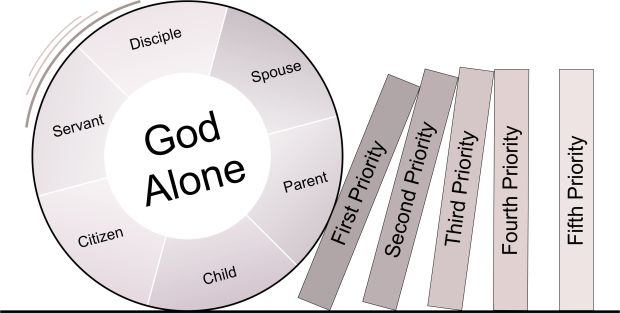
Before we can answer these questions with a customized five-point self-improvement series3, I submit we must first be willing to purify our priorities…

…which can only happen when we become intentional in spending time with God.

But first..what exactly is a “priority”?

According to the Random House Websters Dictionary...

  • A priority is “something that’s regarded as more important…a right to precede above in rank, privilege, etc. …
  • …and “to prioritize” is a process by which we arrange, particularly in order of importance, relevance, value, etc.

Thus, when we consider what a priority is…and apply it to morality…our faith, we ultimately discover the importance of recognizing God’s priorities for our life.

Take Philippians 1, for instance, where in verses 9-10, Paul prays for the Philippians’ love to abound all the more so they could better discern and approve the things that are excellent4.

Essentially, Paul is saying: if you’re feeling overcommitted, overloaded, overwhelmed…if you’re mired in apathy, confusion, striving…or simply trying to decide what is best, what’s best for your spiritual well-being…and those around you…the answer is simple: love at all costs!

when-we-start-spending-time-with-god-178
‘Cause at the end of the day, we all need Jesus in the middle of our everything…not only so we can conquer the burdens of life…but so we can love better in every circumstance (hence Paul’s use of the word “abound”).

My thought is: let’s be unified in seeking first the Kingdom (Matthew 6:33) together…in being fervent in loving one another (1 Peter 4:8; Colossians 3:14)…so we may…

  • Better identify what’s most important in our own life…
  • Better concentrate on the relationships God has called us to…
  • Be quicker in our humble obedience…
  • Be more available to God, our family, those God has called us to be around…
  • Use time more effectively, including family and ministry time (and not sacrificing one for the other)…

…all the while being Spirit-led everywhere in between.

Stay tuned next time for “part 2” of this series, where I’ll discuss a couple practical pointers on how we can better engage God in our midst and live transformationally in 2016.

Footnotes

1) In prep for the Super Bowl

2) Take a good, hard look at gym attendance…and you’ll see what I mean

3) Granted, this is a popular trend this time of year

4) I don’t know about you, but I love this association, specifically how Paul links “the greatest gift of all” (i.e. “love”) to our call to judge righteously.

Photo creds: lightwork.typepad.com, quotesgram.com, indy.shine.fm

The Bent of the Tent-Maker

By: Jan Ferguson

Bi-vocational ministry. If you’re like me, some days I wonder what that really means. Okay, so down the definition rabbit hole we go… Bi-vocational ministry (I’m calling it bi-vo for short) is an interesting term. It literally means two vocations.

What does vocation mean? According to http://www.merriam-webster.com, the main meaning is: a strong desire to spend your life doing a certain kind of work. Other meanings suggest, anything you do for a job, entry into the priesthood, or a calling.

Now, most people don’t want two job let alone, two full time jobs. So, why do we do it? What drives the bi-vo minister? By day, mild mannered administrative assistant/house painter/substitute teacher/ etc. but nights and weekends, Super Pastor! Downloading countdown videos at the speed of, well high speed internet. Able to make three hospital calls in one evening – at different hospitals. Powerfully peppering social media with quotes, scriptures, prayers and invites. Finally crashing sometime after midnight only to get up early to do it all the next day, and the next. So, I ask again, why do we do it?

I believe we do it, because we love God and we are willing to lay down our lives for Him and the sake of the gospel. We are driven by the gifts and callings God has placed in our lives. Hopefully, we are driven by obedience to Jesus and the desire to see people saved and set free. But are all bi-vo ministers alike?

As I see it, there are two kinds of bi-vo ministers and those I know fall into one of two groups:

  • Tent makers who minister
  • Ministers who make tents

Note: If you’re wondering where on earth I came up with the tent maker occupation, it’s an homage to the apostle Paul, whose trade was tent making.

A tent maker (fill in the blank with the career/job of your choice) is driven by a career vocation. Based on the definition above, it can be the thing you wanted to spend your life doing. But tentmakers may also be a youth pastor, worship leader, pastor’s wife, etc. I know a pastor’s wife that considers nursing her vocation. She teaches Bible study and helps lead the church, but she is an example of a tent maker who serves as a minister. She doesn’t actually dream of dropping the nursing gig to do ministry full time. God has strategically placed her in the marketplace as her primary service. She is passionate about the word and the church and she uses her gifts and talents in the church. But nursing… that’s the thing that floats her boat.

A minister who makes tents (fill in the blank with the job you do) has a different bent. Often, this is the person whose heart and passion are solely for the work of the ministry. They would drop the day job in a heartbeat, but God has called him/her to a church or ministry that cannot support him/her at this time. This pastor/evangelist/worship leader/church secretary/etc. works a job outside the ministry to pay the bills. But – their thoughts are consumed with ministry – sermon/Bible study prep, the people they serve, updating the church website, and the like.

With this in mind, our motivation may be similar, but the challenges we face may be very different. Next time we’ll look at the challenges and roadblocks encountered by the minister who makes tents.

Photo creds: amazon.com

5 Ways to Conquer Sermon Prep Stress

Sermon prep for the bivocational pastor can be a challenging issue. From selecting the right topic to developing ideas in the midst of unrelated work, crafting a sermon requires forward thinking and resolute diligence. Whether you’re a novice bivocational pastor or a seasoned veteran, here are some ways I’ve learned to conquer sermon prep stress.

  1. Pray at all costs

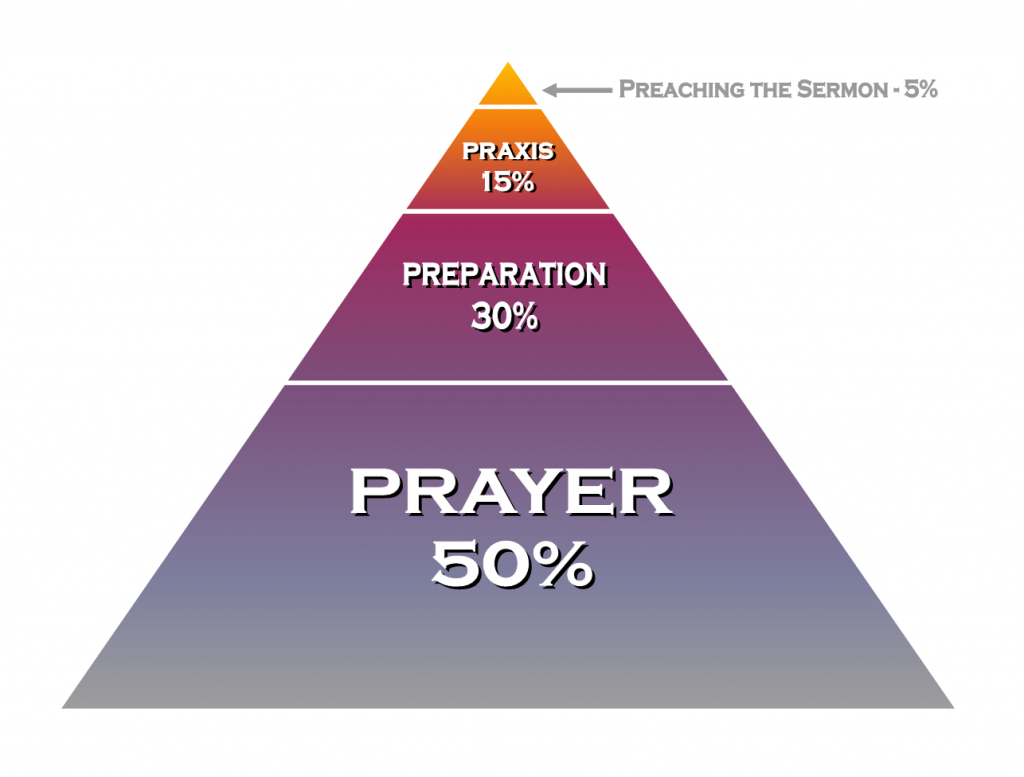
It’s been said no man is greater than his prayer life. Considering prayer, quiet time, and sermon prep are mutually inclusive, one could also deduce how no pastor is greater than his sermon prep. Of course, ideas come and go and the needs of people change; however, the one thing that must never waver is the commitment to pray (for revelation, the people of your congregation, etc.) at all costs. preachingpyramid-1024x777

To put it another way, the foundation of any teaching must always begin with prayer since it allows God to be the driver as opposed to our own finitude. So whether you’re discouraged or simply have sermon writer’s block, pray through the grind and position yourself for illumination by carving out closet time between you and God. Oh, and while you’re at is, don’t forget to bring a note/iPad so you can jot down what God tells you for future reference (which reminds me…go see “War Room” when you have the chance; such a powerful film…you won’t regret it) .

  1. Look ahead

I’m a fan of living in the now; however, with sermon prep, looking ahead isn’t just a good idea; it’s absolutely necessary. For instance, there are times when God will unveil a sermon series to you, as opposed to a stopgap message. When this happens, there are two appropriate responses: 1) rejoicing and 2) projecting (i.e. looking ahead). Not to suggest a la carte messages are inferior; I’m just saying when you’re given a sermon series, it’s critical to a) let the Word/assignment marinate in your spirit so it can be processed and b) look ahead so it can be divvied up systematically.

  1. Take advantage of breaks

At my job, there are two types of seasons: busy seasons and “less busy” seasons. During “less busy” seasons, my workload will occasionally stall to the point I’m able to reference my youth pastor worklist (or my wife 😉 and chisel it down so I can direct my focus on other things (like this blog).

Granted, productivity can still happen during busy seasons; it just means anticipation must be met with greater intentionality. Case in point: during year-end closeout season (one of the busiest for accountants), I know at the very least, I have two fifteen-minute breaks and an hour lunch. This means regardless of how busy work gets, I can take advantage of 7.5 hours of potential prep time.

Of course, we all find ourselves in different boats on different waters in different seasons; however, the point here is: if you seek the opportune moment, you will surely find it (Matthew 7:7-8; Luke 11:9; Jeremiah 29:13).

  1. Flesh out the content

Some of my greatest pastoral mentors are known to manuscript their sermons. While I certainly understand the benefit of such an approach, I also know it can be more practical for some to develop a detailed “five point-ish” outline, with a clear-cut introduction and conclusion. Whatever method you use, make sure the content is fleshed out. By this, I mean a message with a coherent outline and an organic flow sprinkled with some applicable illustrations to help the audience track with the truth1.

  1. Develop a routine

Preaching is just as much week-by-week rhythm as it is in-the-moment delivery. While congregations and experiences vary, the common denominator for rotation speakers lies in developing a steady routine tailored to what works best for them. For me, I like devoting select days to content development/study and others to revision and delivery. Of course, each week is unique with the potential to go off-script. Yet, while those weeks can be unnerving, they don’t have to be as long as I reference an establish accountability system or development checklist. Doing so will not only sharpen the content, but enhance confidence leading up to the sermon date.

Perhaps you’ve discovered some other helpful tidbits aiding you in your sermon prep. If so, feel free to share them in the comment section below.

Footnotes

  1. I believe the most memorable sermons feature applicable illustrations. For me, if a powerful truth is presented without an analogy/work picture attached (or without it amplified on a big screen for me to read à tweet), it can sometimes go in one ear, out the other; however, as a youth minister, I’ve learned the value in bolding the truth by associated it to something presentable. At any rate, the goal is not to entertain and/or convince the audience of the truth’s relevance (i.e. let God do His job) as much as it is giving them a greater chance to remember it in the first place.

Photo credits: thefrontporch.org, preachersinstitute.com

Rethinking Authority (Part 1)

No question, many of us have a bittersweet relationship with [our idea of] “authority”. We know it’s essential, we know it’s relevant…but we chafe when it comes to being under it1.

Perhaps you’ve wondered why “authority” rubs people the wrong way and creates quivers among the masses…

If that’s you, then you’re in the right place.

‘Cause whether you’re in authority and suspect the authenticity of your subordinates…or are under it and think the term is nothing more than a means for manipulation/a code word for power, addressing the issue of ‘what to do when you question authority’ is key.

With that said, here are a couple practical ways to rightfully deal with authority (as supported by Scripture):

1) Pray. As cliché as it may sound, voicing supplication is not so much a ‘good idea’, as it is a Kingdom mandate (or as I call…an “appointed opportunity“) for us to engage. Take 1 Timothy 2:1-3 for instance. In this passage, Paul is urging his younger colleague to intercede for all. Yet, as Paul commences his rundown in verse 2, note how he doesn’t start with the Isaiah 61:1 trio (i.e. poor, brokenhearted, and captives)…he starts with kings and all who are in high positions!

Why is this important, you might ask? Well, if we start with Scriptural context, the higher-ups of Paul’s time were despised political groups, mainly Roman officials and religious leaders (ex: The Jerusalem Council). So by saying, ‘all who are in high positions’, Paul wastes no time in going after the white elephant in the room…which for his audience was “loving your enemies”.

Despite the challenging command, Paul’s initiative here is not so much the call itself as it is the hope of God’s faithfulness, particularly in helping us “lead a peaceful and quiet life, godly and dignified in every way”2 (v. 2b). Thus, it should be no surprise Paul strategically writes this in an attention-grabbing way, considering the awesome reward promised through obedience. Pretty cool, eh?

So in short, Paul takes the Golden Rule and stitches it to prayer’s original design. More specifically, we pray for all men because it a) glorifies God and b) since we’d want others to do the same for us…regardless of how they feel. True, you may not want to pray for certain individuals, such as those who seem to have it all together…who disregard you…and/or who give the “peaceful and godly life” a bad name…

…but if you think about it, would not the world be a better place if what you hoped for actually happened?

Just sayin’…

2) Set the example. While prayer sets an inner tone, it’s important to set an external one as well. How do we accomplish this? By inspiring others to submit to authority! Granted, this may not sound like a thrilling concept; nevertheless, for prayer to be fervent and effective, it must ultimately be tethered to action, which in an authority context, is accomplished once we choose to be content wherever we are.

For example, you may be far down the totem pole with respect to your workplace hierarchy. You may think people look down on you because you’re young or have other priorities. Instead of grumbling, complaining, and/or risking a half-hearted effort, why not flip the frustration3 into rejoicing and be a living, breathing manifestation of Colossians 3:23:

“Whatever you do, work heartily, as for the Lord and not for men.”

‘Cause truth is, when we focus on Christ, our ultimate authority, we not only promote a heart of humility, but we also position ourselves to better serve our earthly authorities, encouraging others to do the same…all the while preserving the integrity of our influence as the healthy outflow of obedience.

So by honoring authority, by word and action, we model a tangible faith with the power to draw people near to the light we carry. Sure, we may not always agree with our earthly authorities…heck, we may not even like them…but if we’re faithful to rely on God as our vindicator…if we confess our desire to inspire the hope of Christ, then we’ll better understand how a) God always appoints with a purpose (see Romans 13:1-7)…and b) He wants us to be a part of that purpose!

I don’t know about you…but I want to accept the mission to not only honor authority…but love the way God positions people, regardless if it’s impossible in my own strength.

Stay tuned next time for a ‘second half wrap-up’ of this post, in which we’ll address our final two points on rightfully dealing with authority.

Footnotes

1) Or for some, operating within or delegating it

2) Granted we stay faithful to pray for all people

3) Or temptation to be frustrated

Cover photo creds: banner personnel.com

3 Ways to Overcome Loneliness

Have you ever felt ‘home’ locationally yet far from it relationally…

…secure in the journey, but perhaps insecure in community?

No question, it’s an awkward emotional dichotomy…to feel in love where you’re at yet estranged at the same time.

Perhaps you’ve wondered what do when you feel like you’re not connecting or what to do when you feel God isn’t honoring your obedience with the right relationships.

If that’s you, then heed my words…

…’cause truth is: I’ve been there…

…and in some ways, I’m still there.

And I’m sure for many of you reading this…you can say the same.

With that said, here are three ways to rightfully cope with the contradiction.

1)      Live and breathe God’s wholeness. 

No doubt, God is enough. The question is: do you honestly believe it?

Consider Jeremiah…a prophet whose calling meant to be alone, as evidenced by his directive not to marry, go to weddings or funerals, be in the presence of feasters and merrymakers, etc.

When we study Jeremiah’s narrative, it shouldn’t surprise us to find him often discouraged and depressed. After all, Jeremiah was entirely human…and to be without friends is one of life’s greatest challenges. But though Jeremiah carried certain “love deficits”, this didn’t keep him from finding satisfaction in God, as noted by his tendency to open prayer with “sovereign Lord” and conclude it with a reference to His steadfast love and/or power. Though Jeremiah lived without companionship, God was able to use his singleness and isolation to fulfill His purposes1 through him in ways that couldn’t have happened had he shared dependence.

1352897081As for us, there may be seasons when God temporarily detaches us to cultivate greater dependence on Him, as He did with Jeremiah. But while these seasons may be arduous, we can still find contentment in knowing God always has our best in mind and always sees the beginning from the end.

Hence, it makes perfect sense to receive God’s wholeness since it not only helps us cope with our deficiencies, but provides spiritual nourishment to keep going…all the while, renewing our trust in His providence.

2)      Pray the Word over your location. 

Let’s be honest: It’s easier to pray for people you know than those you don’t, right?

…especially considering we live in a compartmentalized culture where our concept of the world is essentially our concept of ‘our world’.

However, let’s say God repositions you in a foreign place or season. Would the change be enough to diminish your prayer life or would you stay persistent regardless?

While prayer can certainly benefit from sound company, truth is: the tempo of our prayer life should not be dictated by our social life2 or lack thereof.

Why? ‘Cause at the end of the day, it’s God who orchestrates our connectedness!

Thus, if we’re feeling dissatisfied or desolate, we should feel compelled to turn to God without hesitation and seek his direction, considering if anything is in the way, it’s likely a stronghold of man.

So next time you find yourself disappointed by the hardness of your heart and/or surroundings, pray the Word over your location…and choose to make intercession your default as opposed to withdrawal.

Again, it may not be easy, but you can, at least, bank on finding fuel even when you’re running on empty.

3)      Focus on opportunities to serve.

As mentioned before, we all want to belong…and find our place.

However, though the desire itself makes sense, the problem is often how and where it’s prioritized.

For instance, if the desire is overly prioritized, then we risk engaging community as a means to an end, where on the flip side, if the desire is not prioritized enough, we risk relationship being a nonchalant concept, dependent on chance rather than intention.

But if we truly want to bridge relationships organically, why not focus on opportunities to serve and invite God into the process?

Seriously…it’s not like we have anything to lose yielding to the Spirit’s leading.

And if you think you got to have friends before you can find your “place,” consider how God prepared the way in Scripture time and time again (i.e. God frequently prepped the territory before tending the inhabitants; see Deuteronomy 1-16, John 14:3).

In short, when it comes to seeking connection, the best approach is to let God be God by consecrating our relationships (present and future; real and hopeful), staying rooted in prayer, and seeking His desire to plant us in the best place possible…in the best way possible.

Footnotes

1) To fulfill his purpose, it was essential Jeremiah relied entirely on God, considering he may have a) integrated a fear of man into his prophecies or b) fallen away completely had he placed his own needs above God’s wants.

2) Or how we feel our social life is

Photo credits: https://blog.febc.org
https://c2.staticflickr.com/