Some quick scratch notes on our work identity as seen specifically through Genesis 3:
Scripture:
17 And to Adam he said, “Because you have listened to the voice of your wife and have eaten of the tree of which I commanded you, ‘You shall not eat of it,’ cursed is the ground because of you; in pain you shall eat of it all the days of your life; 18 thorns and thistles it shall bring forth for you; and you shall eat the plants of the field. 19 By the sweat of your face you shall eat bread, till you return to the ground, for out of it you were taken; for you are dust, and to dust you shall return.”
20 The man called his wife’s name Eve, because she was the mother of all living.21 And the Lord God made for Adam and for his wife garments of skins and clothed them. 22 Then the Lord God said, “Behold, the man has become like one of us in knowing good and evil. Now, lest he reach out his hand and take also of the tree of life and eat, and live forever—” 23 therefore the Lord God sent him out from the garden of Eden to work the ground from which he was taken. 24 He drove out the man, and at the east of the garden of Eden he placed the cherubim and a flaming sword that turned every way to guard the way to the tree of life.
Scratch Notes
We don’t work because of the fall. We work because God intended it to be a divine partnership!
A primary consequence of original sin as it relates to work are the thorns and thistles, the strife we experience within our occupational calling.
The thorns and thistles can look a number of different ways; however, they often involve the collision of our depravities, the interlocking of our sins and limitations, the lack of justice and fairness in some cases.
While our walk with God can prune us as vessels in the marketplace, we must realize our effectiveness is tied to our vertical reliance, our commitment to being like Christ on the clock.
Again, we were created to work as co-partners with Christ/ambassadors for God’s Kingdom as part of our original design (see Adam’s animal naming assignment in Genesis 2:20-22). Despite the fall, we still have a vocational calling. The problem is the overflow of grace, peace, joy, etc. in our jobs can be significantly harder.
While sin’s entrance into the world reversed the natural current in which we effort upstream, our intentionality to be faithful can become rhythmic as we depend on God. This is largely why discovering Him is so important!
God is with you always, so lean on Him when things aren’t working out. After all, He wants the marketplace to be the market space in which He speaks and moves! Why not cry out to Him when you’ve overwhelmed, when you’re burnt out, when you’re being misused or mistreated? Remember He wants to hear from you, so don’t you dare stay silent in times of trouble.
So last week, I’m revisiting the prodigal parable when it dawns on me: Before there could be a party (v. Luke 15:23) for the son, there first had to be ‘fashion statement’ (v. 22), an opportunity for him to know why he was being celebrated.
Like others, my last read through of Luke 15 wasn’t the first time in which I visualized the father decking his son with boughs of jolly. To be honest, I used to skim over this part as a side detail. ‘Nice! The dad is thrilled his son is back,’ I’d think to myself.
But having marinated in this passage further, I can’t help but wonder if this excerpt is the most profound part of the entire story.
For starters, not only does the passage highlight a daily reality of God’s father-heart of love, but it also emphasizes the progression of God’s ministry of reconciliation, a progression as follows:
God’s confirmation of our identity
God’s admittance of ‘as we are’ in light of who we are
God’s celebration of #1 + #2
Per the list above, part of the revelation for me lies in how easily we skip from #1 to #3 when reading the parable. We remember the father’s compassion (v. 20) and the party he throws (v. 23), yet we forget how the father loved on purpose in between as evidenced by his desire to adorn his son with specific garments:
The robe representing a fresh outpouring of grace…
The ring representing a symbol of sonship and authority…
The sandals representing a charge for the son to walk afresh and anew (under both coverings)…
…pretty remarkable, right?
Clearly, the father wasn’t content on just running to embrace his son.
Was he overjoyed? Of course! Was he relieved? Absolutely.
However, as much as the father wanted to welcome his son, he wanted even more so to establish him into a renewed sense of identity, place, and purpose! Accordingly, one has much to gain connecting the parable to real life.
‘Cause truth is: We’re ALL prodigals in some capacity. We’ve all stumbled into rough places and tough times at one point or another. We’ve all encountered rude awakenings involving unexpected setbacks, and in some cases, our own depravity.
Yet, when we receive the power of this parable, we ultimately discover how the story doesn’t end with God forgiving us. In fact, it’s only the beginning!
For even in the wake of our setbacks, our Papa God never stops seeking a way to reconcile us as heirs with an inheritance (Romans 8:17), as anointed children blessed with a destiny. Put another way, God always has a party invitation with your name on it secured in an envelope sealed with grace. And while you’re not forced to open it, if you decide to, you’ll not only find directions, but also information on how to prepare for it. How awesome is that?
The next time you’re tempted to mentally wallow with the pigs, remember God isn’t satisfied to slap an “I forgive you” onto your wrongdoings, your past hurts and failures, and call it a day.
Moreover, God wants to remind you…
…your identity is not lost… …your place at the table is unclaimed… …and oh, by the way, when you choose to change, heaven celebrates. Like a good neighbor, He’ll not only help you arrive at a better place, He, by His Spirit, will help you stay there, too.
My encouragement to you today is to claim the robe, the ring, and the sandals, put on the garments of praise (Isaiah 61:3), and live knowing you’ve been fully reinstated into wholeness with God. Sure, there may be days when your self-perception seems hopelessly chained to dark, dreary memories, but that doesn’t mean there’s not a way to walk in your sonship!
For me, whenever I find myself in that taxing tug-of-war, I…
Confess I’ve been forgiven and set free…
I declare my identity as a mighty man/son of God…
Recommit my ways unto the Lord.
Abiding by this pathway, I affirm God’s confirmation, admittance, and celebration of who I am and *wallah*…God’s mission of reconciliation is complete in that moment.
Well, folks, I’m out of words today. As always, if you need prayer, a word of encouragement, a dose of stimulating dialogue, Lys and I are here.
Note: A more detailed analysis of this passage will be included in the Juby Journey book I’m working on. For now, I’m converting preliminary thoughts into the SOAP Bible study below to archive insight and encourage the saints in the short term.
As one dealing with grief, who went through the ringer last year while Juby was alive, I can’t help but resonate with this passage. Like the protagonist, Lys and I can relate to an afflicted daughter and the desperation for her deliverance. Granted, Juby was not demon-possessed but stricken with chronic lung disease. Still, as we cried out for Jesus, hopefully not to the chagrin of others, we discovered a posture far greater than a spiritual bookmark but of a daily exercise with reproducible influence.
Accordingly, without further ado, I’d like to unpack the remarkable faith of the Syrophoenician woman and how her hope can be a blueprint for those seeking restoration.
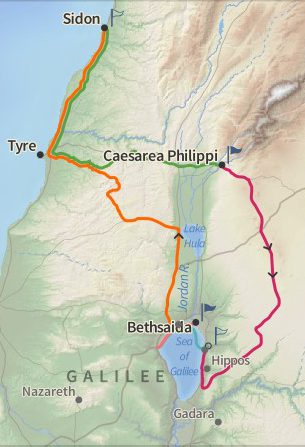
“And Jesus went away from there and withdrew to the district of Tyre and Sidon. And behold, a Canaanite woman from that region came out and was crying, ‘Have mercy on me, O Lord, Son of David; my daughter is severely oppressed by a demon.’ But he did not answer her a word. And his disciples came and begged him, saying, ‘Send her away, for she is crying out after us.’ He answered, ‘I was sent only to the lost sheep of the house of Israel.’ But she came and knelt before him, saying, ‘Lord, help me.’ And he answered, ‘It is not right to take the children’s bread and throw it to the dogs.” She said, ‘Yes, Lord, yet even the dogs eat the crumbs that fall from their masters’ table.’ Then Jesus answered her, “O woman, great is your faith! Be it done for you as you desire.’ And her daughter was healed instantly.“
Observations
1. Before we can dive into the dialogue, we must first assess the setting. While time and place may seem arbitrary, in this case, they carry notable purpose. With the end in sight, Jesus withdrew with the disciples outside Jewish territory to prepare them for the Cross to come. His days numbered, Jesus realized some final exposures and tune-ups were necessary to groom them for life in ministry without His physical presence. As such, the fact He retreated to the hostile confines of Tyre and Sidon should not be perceived as random as Jesus desired to foreshadow the Gospel going out to all peoples. How amazing it is to know Jesus, even in His last days, never stopped breaking down barriers through radical love.
2. Fast-forward to the woman’s cameo, it’s interesting to note what she requests right out of the gate. Instead of healing or intervention, she addresses Jesus as ‘Son of David’ and calls for mercy, instantly acknowledging the Master’s identity, authority, and sovereignty in one swoop (v. 22). While intellectual origins are unknown, somehow, someway, she understood who Jesus was much to the surprise of the cohort. Per the importance of this sequence, we’ll break this down as we go.
3. I also find Jesus’ response to be somewhat peculiar: “But he did not answer her a word” (v. 23). This, to me, is a critical point to examine and requires us to broaden out to consider the context. Again, this will be explored in the points below.
4. Starting with the woman’s location and situation, we find her labeled as an unclean outsider despite her Canaanite designation and erroneously judged for her non-Israelite daughter’s condition. In terms of geography and timeline, we aren’t informed of any prior wonders performed in Tyre and Sidon prior to this passage. This adds a curious wrinkle to the story as one must wonder how a woman of this stature and status could recognize Jesus as the Messiah.
5. Going back to Jesus’ response, we find multiple motives. For the disciples citing the woman as a distraction, Jesus addresses their bias prior to answering her cry (v. 24):
“I was sent only to the lost sheep of the house of Israel.”
The reason behind this is at least twofold: On one hand, Jesus wanted to remind the disciples who He was in light of what He came to do as clearly, a portion of the twelve were still pigeon-holing His kingship. On the other hand, Jesus’ intended His initial silence to be an opportunity for the woman to show patience…and resilience. From ‘have mercy’ to ‘help me’ in consecutive pleas (v. 25), the woman wasn’t just conveying poetic symmetry but reiterating Jesus’ mission. Already she had correctly identified Jesus as the Son of God (a full two chapters prior to Peter’s declaration in 16:16); now, she was begging Jesus to be consistent to her…
…what you do to Israel, please, Lord, do to me and my household as well.
6. In addition to the woman’s opening inquiry, I’m captivated by her posture. Even if she just said, ‘Son of David, please help me. My daughter is possessed’, Jesus would have recognized the woman’s understanding of His lordship through her positioning. While the woman’s kneel wasn’t evident during her first appeal, the fact Jesus gave the woman more time, in part, to let her go deeper in referencing Him was not part of instinctual circumstance. Rather, it was an intentional maneuver for her to anchor her surrender and confirm her awareness in front of a freshly humbled core of disciples.
7. The exchange between Jesus and the woman immediately following is arguably one of the most profound moments during His ministry. Up to this point, Jesus hasn’t said a word. Now ready, we again see the silence’s effect per His decision to test the depth and sincerity of her invitation. With the woman’s hopelessness on a timer, He uses the woman’s location and sense of identity as a means to assess her heart:
“It is not right to take the children’s bread and throw it to the dogs” (v. 26)
Here, Jesus elects to use ‘dog’ knowing the term was derogatory as a Gentile reference. To be a dog in Israel was to be regarded as a dirty, street scavenger; however, Jesus doesn’t associate the term to her poverty as much as her perceived sense of spiritual destitution. At the time, the rift between Jew and Gentile (between ‘clean’ and ‘unclean’) was still strong but, in a preview, we find a woman authenticating her hope while also foreshadowing the expiration of Gentile believers’ spiritual homelessness.
In the woman’s reply, “Yes, Lord; but even the pet dogs eat the crumbs that fall from their [young] masters’ table” (v. 27), we not only find confidence beyond imminent healing but in the salvation of her people. While the woman’s yieldedness was key as a demonstration of submission, Jesus knew this wasn’t simply a self-centered strategy to obtain instant results.
8. Finally, per the prior point, the significance of ‘crumb’ cannot be understated. For a “lost sheep of Israel” (v. 24) to be so hungry for Jesus that even a mere morsel would tell us the woman saw her situation as secondary to the power and presence of God. In essence, she accepts the status of a family’s dog knowing just a crumb of Jesus would be powerful enough to defeat the demon oppressing her daughter. No question, the woman had her priorities and perspectives set straight, almost as if she had anticipated the moment in advance.
Application
Despite its short duration, the passage carries immense application and universal relatability potential. Regardless of our situations, we can all identify and empathize with the Syrophoenician woman if not at least through her adamant clinging to hope in a bleak situation. Even when we’re struggling with our identity, a love deficit, and/or challenges outside our control, even when we feel stuck in a dark place, we can approach God in humility with thanksgiving acknowledging who He is and what He can do.
For some of you, you may have a loved one, a son or daughter, burdened by a disease or satanic assignment. You may feel the target on your back and paralyzed to shake it off. If this is you, don’t work to faith and prayer; start with faith and prayer. To the Lord of grace, ask for mercy and request His appointed portion of providence. If you’re lost, don’t deny the position but receive yourself as one worth saving. Like the woman, you may be deeply conscious of the misery of the soul, but this doesn’t disqualify you from bread of life crumbs.
For others, you may not have a grim circumstance on the board, but you may be thirsty to anticipate the proximity and power of God. While we don’t know exactly how the woman learned of Jesus before His arrival, we know she put herself in position to receive Him following His arrival. Like her, you don’t have to limit your bended knee to the moment. Rather you can extend it as a general posture wherever you go. Ask yourself, ‘Do I want more of Jesus? Do I want a fresh touch of Him today?’ If the answer is ‘yes’, know whatever He decides to give is more than enough even if what He offers is partly an invitation to go deeper.
Either way, dare to believe good things will happen when you seek Jesus and ask of God according to His will.
Prayer
Heavenly Father, we come before you today as we are. Heavy laden with our fears, anxieties, and insecurities, we lay them down in anticipation of what you’re going to do. Wemay feel “dogged” by life, by consequences of past decisions, by unforeseen trials and happenstances. But like Mary, we choose you ahead of any other commitment and priority in our life right now. We thank you for going before us but recognize your faithfulness before us now. For those who are hungry for you, we ask you provide something afresh to they may taste and see a new facet of your goodness. For those who don’t realize they’re hungry, guide and position them to discover the bread of life you carry. Stir in all of us an awakened passion to the wonder of you and help us to see even what we can’t control as opportunities for sharpening, pruning, and maturing. Whether or not we’re personally afflicted, we pray you prepare our hearts for inevitable testings to come and remember those who are going through tragedy, who are journeying through grief. Tend their hearts and make us sensitive to our part in nourishing them just as you are intentional in nourishing us. Whatever piece youintend to give, we receive itwith praise on our lips and gratitude in our hearts.In Jesus’ precious and holy name…
I know many prefer to stiff-arm the term, roll their eyes at its utterance, and scoff the cliches our culture has attributed.
Yet, through the proper lens, I contend resolutions defined as the process of praying into goals and taking inventory of important decisions are not just a healthy necessity but a holy expression of faith. Granted, the ability to adjust our behavior comes down to intent, or as I like to view it, the epicenter of our ‘why’ which varies from person to person.
Still, in theory, we’re unified within the construct of ‘why’ given it includes our motives/hopes and drives our emotional processing as we observe our journey to change.
The problem for many is: While their intent is perfectly good, and by proxy, valid, it’s often not pure assuming it stems from self-fulfillment and is dependent on self-effort.
Again, our hearts may be anchored to sound intent and for the right reasons from what we can tell; however, if we’re not screening them in advance or worse, belittling them due to past disappointments and present cynicisms, the leaps we’re dying to take may be compromised before they’re even attempted.
Which brings me to my point in writing this…
As you toast your growth and plans for a new year, don’t forget to commit them first.
Consider the “Proverb-ial” yellow-brick road on the subject. In three chapters, the Psalmist emphasizes resolutions as goal surrenderance in the context of allowing God to establish three things:
Like the chronology, the order is significant, one which will be unpacked in the coming months.
As for now, as you begin to assign motive to awareness dare to dream with God not only at the center…but as the originator of every determination He’s planted inside you.
Remember every strength, weakness, and desire to ‘level up’ has been foreknown since eternity – a validation to the day’s excitement and why I personally get giddy as more people start to open their aspiration doors a little bit wider.
As long as we’re on the same page in believing God by His Spirit must bridge the divide before, during, and after our resolutions, the transformation we corporately crave will begin to realize.
Hence, why maturation quests are great but are only effective to the extent we let the Alpha and Omega establish our plans/steps and open our eyes to His purposes along the way.
More on this topic in the weeks to come. For now, as always,
So lately, I’ve been building my library, adding books to shelves in a quest to answer a timeless question:
Why do we suffer?
Yet, as I absorb Daniel Carrington and Philip Yancey, I’m curious if we should reconsider the inquiry as, ‘How should we suffer?’
For if suffering is a kingdom, a divine call, and the resilience guide to discovering God, then surely the way we endure merits discussion.
Perhaps you’re like me looking to mature through past and present challenges and hoping to think outward as opposed to inward. Either way, as we near the home stretch of 2022, these are the musings of yours truly…the emotional evolution of one still processing the passing of his youngest.
Granted, much has started to calibrate since my last post. The returns to certain norms are imminent. There have even been times I’ve wondered why I’m not more depressed than I am.
But at the core of it all, Lys and I feel like Merry, Pippin, Sam, and Frodo returning to the shire from Mordor. Remember what Frodo said when he returned to Bag End in ‘Return of the King‘?
“How do you pick up the threads of an old life? How do you go on…when in your heart you begin to understand…there is no going back? There are some things that time cannot mend…some hurts that go too deep… that have taken hold.”
To me, this begs the question: What then can ‘untake’ that hold? How then should the heart resound, if not through soundless bites that in hardship can be the most beautiful expression of vulnerability?
Answers aside, the line resonates, a heart prick that has compelled me to relish the truth:
The author and perfector of my faith is the same author and perfector of my pain who from the beginning of time ordained it as a means for me to choose Him!
Like any day I’m alive, I’m taking hold of it as one made in His image. Like any hour I’m awake, I’m taking hold of it to press into His likeness. Just because my heart is healing, doesn’t mean I can’t partake in divine remedy, the sweetness of God’s Immanuel presence and the power of His strength piercing the darkness.
When I’m tempted to retreat, I remember the out I have to retreat into Jesus. And from there, I springboard into the dichotomy between the questions above…that the difference between “Why do we suffer” and “How should we suffer”, in purest form, is the asker of the latter knowing he is loved by God and is willing to trust in His purposes. That it is unfathomable love wrapped in mystery orchestrating the narrative of triumph and perspective rising from the depths.
Like Lys and I of late, you may feel like Frodo, called into adventures beyond your understanding, wishing the rings of adversity, be it disappointment or grief, hadn’t come to you. Yet, in those Moria moments, remember that’s when the Spirit finds and refreshes us as Gandalf did to Frodo:
“So do all who live to see such times. But that is not for them to decide. All we have to decide is what to do with the time that is given us.”
Sure, the year of Jubilee may be over but as her name implies, the happy ever afters are only beginning. Accordingly, we celebrate our precious daughter Hebrews 12:1 style, knowing she’s not only part of a great cloud of witnesses but also co-inspiration stirring us to lay aside the weight of anguish clinging closely…
…her voice an echo to the Master urging us to run our race with endurance.
As for you, my friends, whatever your mission is, know to be overwhelmed is only human and often the evidence of doing something right. Why not then fuse some Hebrews 12:1-2 along with some Romans 8:28 and Galatians 6:9 into the questions you’re asking? Why not faint not…knowing God works all things, including our sufferings, for good and makes things new as words trustworthy and true (Revelation 21:5)? You don’t have to bear the weight of deciphering your circumstances. Rather, you can bear each other’s burdens delighting in the fact God has you going somewhere. Even if loss is incurred along the way, remember nothing can separate you from God’s love and the victory He has in store for you.
At the very least, take it from Jubilee. Her life was a gift but even more so her legacy. What keeps her Spirit alive is the same Spirit who in whispers:
Reminds us He’s there because He’s been there and…
Ignites us to see how discovering God through perseverance as the best way to journey through suffering.
In closing, I return to Yancey: “As we rely on God and trust His Spirit to mold us in His image, true hope takes shape within us, ‘a hope that does not disappoint.’ We can literally become better persons because of suffering. Pain, however meaningless it may seem at the time, can be transformed. Where is God when it hurts? He is in us—not in the things that hurt—helping to transform bad into good. We can safely say that God can bring good out of evil; we cannot say that God brings about the evil in hopes of producing good.”