“Do you see what we’ve got? An unshakable kingdom! And do you see how thankful we must be? Not only thankful but brimming with worship, deeply reverent before God. For God is not an indifferent bystander. He’s actively cleaning house, torching all that needs to burn, and he won’t quit until it’s all cleansed. God himself is Fire!”
In light of much shaking in the world today, it’s fair to wonder how the church is to become more Kingdom-aligned.
From liturgy to doxology, theology to ecclesiology, there are many topics worth discussing, perhaps more than we like to admit. But before we dive into any ‘ologies’, it’s important we examine the church relative to God’s first command (Genesis 1:28): The family.
As Scripture attests, belonging to a family culture is not only a crucial part of our relational perspective but also our call to engage fellowship and know intimacy. A brief exegesis of Genesis 1 and John 1 confirms this: Before man could exist, there had to be a communal model for him to operate in; however, for this model to also exist, there had to be a holy community sharing everything in common (Acts 1-4) in perfect harmony. Hence, why from the very beginning, the church¹ was a sparkle in the Father’s eye.
Unfortunately, this sparkle is now contending with a culture eager to redefine identity and blur the line between love and tolerance. Stir in a coronavirus, racist divides, and fear propaganda, and there’s even more to distract us from what matters these days. Take it from a brother: If you’re a believer and have struggled lately to combat new deceptions while living your faith, my heart goes out to you. You’re certainly not alone.
Still, despite the challenges, we can’t let temporary headlines shield us from important questions worth asking. In this case…
1. While the church may be conveying truth, is she allowing it to be tasted and seen? Is the church delighting in what she’s demonstrating?
2. If not, how can we expect those outside the church to do the same?
While most would cite an answer between leadership and service, I submit part of the solution to both questions concerns how the church develops and facilities discipleship within the family dynamic.
For instance, in most structures, discipleship is perceived as in-house mentoring with evangelism serving as the primary faith vehicle into the ‘real’ world; however, if the church desires to be more Kingdom-aligned, it should further seek to prioritize these elements in the home. Yes, small groups are essential, but then again, so are Zoom calls, spontaneous texts of encouragement, one-on-one coffees, even charitable support. Like any family, tending community involves systematic and impromptu engagement. And if the church is to be the church today, we must realize this can’t happen without interactive/virtual collaboration on curriculums, events, and leadership/volunteer development.
But reeling it back to 2020: While the COVID-19 epidemic has been discouraging, the evolution of church into the home has been a significant silver lining. While not every experience has been the same, many congregations are discovering new ways to be salt and light in a crooked and twisted time. Accordingly, it’s my hope the church will continue to be Spirit-led as…
1. Her boundaries adapt 2. Her creativity sharpens 3. Her definition of evangelism expands remotely 4. Her definition of discipleship expands virtually
Assuming all four mature in rhythm, no question, believers will be more equipped to walk in authenticity, confidence, and love (1 Peter 3:15) as immediate and church family relationships strengthen.
Bottom line: If the church wants to mature in her ‘unshakability’. she must also extend her ‘open door’ policy to the home and places of influence. After all, before the church can model grace and love to a deceived generation, she must already be doing so to the next generation. Given we want our church families to be more effective in culture and at work, let’s remember to the extent we desire the unshakable Kingdom, to that extent we must pour into unbreakable family.
Selah.
Stay tuned next time when I’ll explore how faith in the marketplace can help bridge family dynamics at work and home. I must admit I’m excited about this new series as it seems largely unchartered.
‘Til then, have a great week, everyone.
Rootin’ for ya as always,
~ Cameron
Footnotes
Not to mention her approach to family discipleship and co-equal in value, diverse in function theology
Many of us have heard the phrase, ‘Do your best and let God do the rest’.
But lately, I’ve been wondering how well I truly understand this.
I mean I ‘get’ the Bible verses…
“And whatever you do, do it heartily, as to the Lord and not to men, knowing that from the Lord you will receive the reward of the inheritance; for you serve the Lord Christ.” ~ Colossians 3:23-24 (ESV)
“Do you not know that those who run in a race all run, but one receives the prize? Run in such a way that you may obtain it.” ~ 1 Corinthians 9:24 (ESV)
“I can do all things through Christ who strengthens me.” ~ Philippians 4:13 (ESV)
“Each of you must take responsibility for doing the creative best you can with your own life.” ~ Galatians 6:5 (MSG)
…yet somehow in the application, I’ve been missing something. And I think I’m starting to see what it is.
You see, we often approach work as a derivative of ‘doing’ be it a project we initiate or a means to manage. Define the goal and pursue it. Clarify the objective and go for it. In a way, this makes sense given we’re all hard-wired to perform with excellence for excellence.
However, while execution and effort have their place, it’s important, dare I say critical we ask ourselves: At what point are we allowing God into the picture? Into the frame-work of our work if you will?
At the point we’re exhausted? At the point we’re confused? At the point we’re doubting?
Or are we making way His way from the very beginning?
As one who has failed time and time again with this, trust me when I say…
1. If you want to do your best, let God get in front of it. 2. If you want God to do the rest, let Him get behind it.
Don’t wait until you’re burnt out. Don’t wait until you’re stuck. Rather before you clock in each day, consecrate your effort, receive His faithfulness, and know He will accomplish His purposes in you. Even if He’s guiding you into turbulence, into danger, know He’s calling you to see Him in the midst of it in a fresh way. Accordingly, don’t be discouraged by growing pains when in reality He’s sowing gains you can’t yet see.
In closing, I encourage you, friends…
1. Let God be in the midst of your best and rest, not the middle.
2. Examine any place you may be relegating God to an on-call substitute, any place where ‘doing the rest’ has become a request to autocorrect above anything else.
I admit: I have not been in a writing mood this month.
Baby Milo, new job prospects, freelancing gigs, totaled car, family health issues…no question, there’s been much to handle in recent weeks. But amidst the turbulence, there have been silver linings – rays of strength in voids of calm. And while there’s much I don’t know in this state of processing, what I do know is we often discover new levels of courage during life’s greatest challenges.
So for today, I want to get real, raw, and a little freestyled about what the past month has been for me and family.
‘Cause truth is: Our response to crisis and unforeseen trauma is crucial; yet, it’s our heart towards God in the midst of chaos that defines whether we see Him as a momentary provider or persistent sustainer.
Real quick, before I forget: If you’re reading this and feel outside your comfort zone, rejoice! You’re probably doing something right or better put, right where you need to be. Be at peace, receive the calming of the seas within, and don’t look back.
That said, let’s dig in…
As mentioned, October was a roller coaster month with memorable highs and freaky lows. The fun and games started back on October 7 when Lyssah was diagnosed with gestational hypertension. Coming off this appointment, we were only mildly concerned knowing we were close to Milo’s due date, not to mention we now had a valid reason to designate ministerial assignments. What we weren’t ready for was the nasty stomach virus spreading through our family starting with Everly then me, Caeden, and Lyssah respectively. While the bug left me quickly and unscathed, the same could not be said for Lyssah.
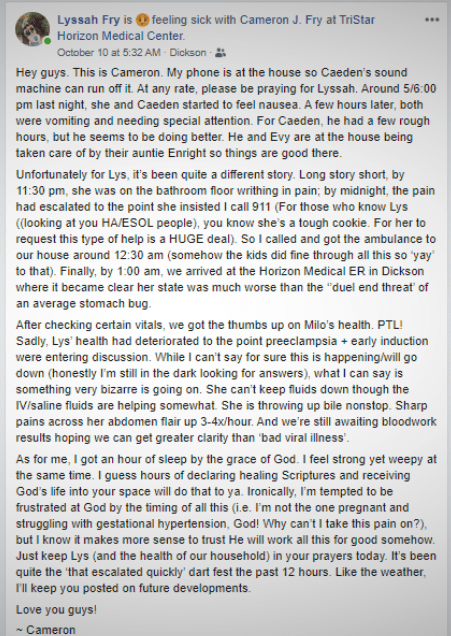
I’ll let my October 10th post do the talking…
As you can see, the episode ran a gauntlet of fear, mainly preeclampsia and early induction. Thankfully, while our collective nerves had been rattled, none of these issues verified. Despite the modest scare, the event was now mellowing to background prologue. Surely Milo’s labor and delivery would be uphill in comparison…
Long story short, strength had gained momentum heading into Milo’s birth weekend thanks, in large part, to our surprise emergency excursion; however, this impetus could not have happened without deferred fear and supernatural strength adrenaline. For instance, throughout the Dickson Tristar ordeal, I’d often catch myself wondering, “How am I doing so well amidst this turmoil? I should be freakin’ out right now. This is unchartered territory. I don’t how to handle all this!” Yet, time and time again, I’d land on a familiar tune, beating into heart as if it had been on loop for days…
Don’t just ‘not stop’ and keep going, but stop making sense of my strength…and just receive it.
Ahhh, just receive it. Sounds easier said than done, right? Like fortune-cookie wisdom disguised as solicited sarcasm or oversimplified commentary on complex theology. But as the ‘tune’ advised, when ‘try’ and ‘do’ become excluded, the right option becomes an effortless decision, and perseverance is made practical, who’s to say receiving divine strength has to be challenging?
As Lys and I discussed with our doula, sometimes abiding in Christ is simply allowing God to prop us up when falling seems like the only option. Even as waves of crap are hitting the fan, by recognizing the proximity and sovereignty of God, we can experience a higher confidence never thought possible. Granted, it may seem counter-intuitive at first; however, as embracing God’s strength in weakness becomes rhythm, it’s not long until we find rest and rise to our aim.
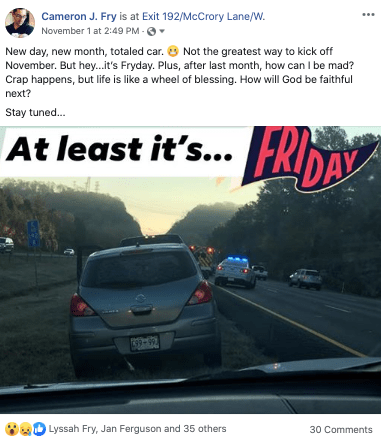
For example, when I crashed my car in a four-vehicle accident a few Friday’s ago, I could have easily catered to disappointment wondering ‘why me‘ or ‘why God‘; however, having exercised my focus to ‘help me‘ and ‘help God‘ in prior troubles, my dependence was locked into gratitude.
Of course, sitting in a totaled car on an interstate median is never fun. But again, as the Spirit reminded me, it can be when you count your blessings and declare praise knowing you and God’s best are still alive. Come to think of it, I wonder why we often say, ‘it could have been worse‘ when to use it implies a contrast of an inferior outcome to the worst possible one. Shouldn’t we go the other way and gauge reality through the ‘new’ that is to come?
Whatever the case, whether you’re walking through hell or a level of purgatory, what ultimately matters is knowing a) you’re perpetually loved by One who has your front and your back and b) even in your darkest hours, you can worship through staccato cries for help.
As for how one stays strong in the void of calm? Frankly, there are many ways, but perhaps the shortest and sweetest one is this: Draw near, surrender fear, pray on the fly, don’t wonder why…just rely. Again, this takes years to learn and is handily theorized outside moments of stress; however, by committing to these steps ahead of the heat, you’ll be primed for God’s power during it. Like conquering any temptation, the winning move doesn’t start at the point of testing, but well before it (more on this in a later post).
For now, I’ll conclude with this: Though this breakthrough may sound basic to some, for the first time in forever, I’m pressing through pain without making sense of it, content in knowing what I don’t immediately understand will eventually be understood. And while I get the value in devotionals and specialized guides on handling conflict, there’s something to be said when God shows up in a fresh way, does an expanding work in your heart, and it’s not contingent on whether or not you ask for it.
He just shows up and pours in…because that’s who He is.
Selah.
As mentioned in my last pod, Lys and I will try (key word) to air a new pod on all this before 2020. Until then, feast on these verses (ESV/AMV), receive them whether or not you’re in a storm, and know if all you got is, ‘Help me, God‘, ‘Hallelujah‘ or ‘I need you, Jesus‘, God considers it a fragrant offering.
2 Timothy 1:7 – “For God has not given us a spirit of timidity, but of power and love and discipline.”
Psalm 107:29-30 – “He caused the storm to be still so that the waves of the sea were hushed. Then they were glad because they were quiet, So He guided them to their desired haven.”
John 14:27 – “Peace I leave with you; My peace I give to you; not as the world gives do I give to you Do not let your heart be troubled, nor let it be fearful.”
Psalm 37:7-9 – “Rest in the LORD and wait patiently for Him; Do not fret because of him who prospers in his way, Because of the man who carries out wicked schemes. Cease from anger and forsake wrath; Do not fret; it leads only to evildoing. For evildoers will be cut off, But those who wait for the LORD, they will inherit the land.“
Psalm 46:10 – “Cease striving and know that I am God; I will be exalted among the nations, I will be exalted in the earth.”
Isaiah 43:2 – “When you pass through the waters, I will be with you; and through the rivers, they shall not overwhelm you; when you walk through fire you shall not be burned and the flame shall not consume you.”
Sooo…I wasn’t initially going to write anything on this, but after cutting a pod earlier this week, I’m calling an audible.
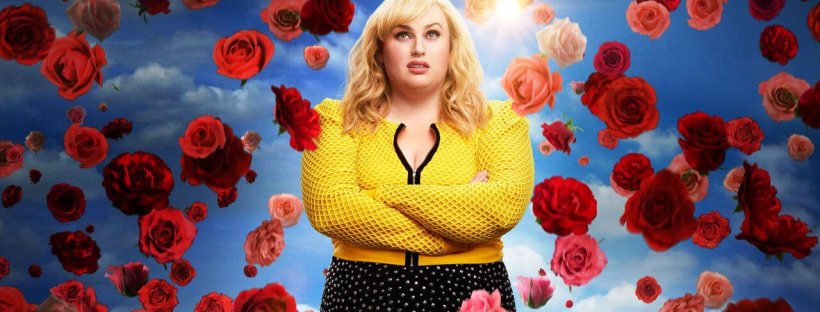
‘Cause truth is: I’m surprised how much a feel good movie in ‘Isn’t It Romantic’ has me feeling, well, not that good.
While the film, in itself, is charming full of laugh out loud moments and clever wit, to say the film lacks irony would be an understatement.
*Spoiler alert*
For instance, when contrasting real life to rom coms, our protagonist is clear she hates happy endings since they hinge on plot convenience more than anything else.
The funny thing: This is exactly what ‘Isn’t It Romantic’ does on the issue of self-love which begs the question…
Does self-love actually exist?
To be fair, the answer can’t be addressed in a vacuum since real love can’t be compartmentalized. That said, while secular voices can only go so far in their quest not to offend, one must wonder if we, as a culture, are synonymizing love and esteem as much as we are love and tolerance.
This in mind, I want to tackle the question by un-blurring the lines between self-love/love and self-esteem/esteem. As for love versus tolerance, don’t worry. I’ll come back and do a ‘part 2’ once the right movie comes along.
Before we define any contrasts, let’s define some terms.
First, what is love?
For starters, the most central answer can be found in 1 Corinthians 13:
“If I speak with the tongues of men and of angels, but have not [a]love [for others growing out of God’s love for me], then I have become only a noisy gong or a clanging cymbal [just an annoying distraction]. 2 And if I have the gift of prophecy [and speak a new message from God to the people], and understand all mysteries, and [possess] all knowledge; and if I have all [sufficient] faith so that I can remove mountains, but do not have love [reaching out to others], I am nothing. 3 If I give all my possessions to feed the poor, and if I surrender my body [b]to be burned, but do not have love, it does me no good at all.
4 Love endures with patience and serenity, love is kind and thoughtful, and is not jealous or envious; love does not brag and is not proud or arrogant. 5 It is not rude; it is not self-seeking, it is not provoked [nor overly sensitive and easily angered]; it does not take into account a wrong endured. 6 It does not rejoice at injustice, but rejoices with the truth [when right and truth prevail]. 7 Love bears all things [regardless of what comes], believes all things [looking for the best in each one], hopes all things [remaining steadfast during difficult times], endures all things [without weakening].
8 Love never fails [it never fades nor ends]. But as for prophecies, they will pass away; as for tongues, they will cease; as for the gift of special knowledge, it will pass away. 9 For we know in part, and we prophesy in part [for our knowledge is fragmentary and incomplete]. 10 But when that which is complete and perfect comes, that which is incomplete and partial will pass away. 11 When I was a child, I talked like a child, I thought like a child, I reasoned like a child; when I became a man, I did away with childish things. 12 For now [in this time of imperfection] we see in a mirror dimly [a blurred reflection, a riddle, an enigma], but then [when the time of perfection comes we will see reality] face to face. Now I know in part [just in fragments], but then I will know fully, just as I have been fully known [by God]. 13 And now there remain: faith [abiding trust in God and His promises], hope [confident expectation of eternal salvation], love [unselfish love for others growing out of God’s love for me], these three [the choicest graces]; but the greatest of these is love.”
Granted, most are familiar with this passage; however, what’s often missed is the reason why we struggle grasping it.
Hey, tell me haven’t ya heard? Love is a serious word. Hey, I think it’s time ya learned. I don’t care what you say. I don’t care care what ya heard. The word love, love is a verb.
…and while we’re at it, let’s hit the bridge as well…
Back in the day there was a man who stepped out of Heaven and he walked the land. He delivered to the people an eternal choice with a heart full of love and the truth in His voice. Gave up His life so that we may live. How much more love could the Son of God give? Here is the example that we oughta be matchin’ ‘cause love is a word that requires some action.
Yeah, yeah…I’m starting this exegesis with the most popular ‘love Scripture’ and one of the most iconic 90’s Christian rap songs ever. Nevertheless, the content is 100% certified truth; specifically, love isn’t love without action…without a transitive nature.
Speaking of which, allow me to get nerdy for just a second…
In math, the transitive property is expressed as the successive members of a sequence of at least three, where if A is larger than B, and B is larger than C, then A is larger than C. Interestingly, from a theological perspective, this confirms the existence of the Trinity (more on this in a future post).
In this case, let’s use the metaphor to compare us to ‘B’ with the people we love as ‘C’. If ‘B’ (love median) and ‘C’ (love recipient) are given, then who represents A?
In fewer words, God (i.e. love giver). But the big picture point is this: The reason love exists is because there has always been a giver and receiver for all of eternity. Thus, whenever we talk about self-love, it’s only fair to reference the concept as intransitive since the act is not only internal, but immobile.
But Cam…Matthew 22:39 says, “You shall love your neighbor as yourself”. Certainly, self-love isn’t a bad thing?
And to that, I’d have to agree…wait for it…in a vacuum. But as mentioned, we can’t address this topic in a vacuum so let’s zoom out further and ask another question…
Is the self-love culture conveys the same as what Scripture describes?
‘Cause when we reference the Word, we find love, in every use, to be a direct response to receiving love. For example, before we can confess God as love (1 John 4:8), we must first believe the preceding verse: “Let us love one another, for love comes from God. Everyone who loves has been born of God and knows God.”
Therefore, the difference between self-love (culture) and loving yourself (Scripture) is one is contained and the other can’t be. One is restricted, the other depicted. One is incomplete, the other complete. One is achieved, the other received. One looks to preserve, the other looks to subserve. I could go on.
For now, let’s discuss esteem.
As Webster defines, esteem is a regard involving an admiration, adulation, and/or appreciation of another. A derivative of gratitude, esteem molds an ‘I respect you’ statement into an ‘I value you’ declaration.
Unfortunately, most learn esteem as self-esteem, taking that ‘I value you’ and reforming it into ‘I value me’. Again, this is appropriate in moderation; however, we must be careful not to abuse the practice as how we love. Reason being: like self-love/love, for self-esteem to exist, there must first be esteem and for esteem to exist, not only must there be a giving entity, but authentic community surrounding it. Put another way, the necessity of esteem isn’t rooted in feeling valuable, but in sharing praise.
“Through Him, therefore, let us at all times offer up to God a sacrifice of praise, which is the fruit of lips that thankfully acknowledge and confess and glorify His name.” (AMP)
“All the earth will [bow down to] worship You [in submissive wonder], And will sing praises to You; they will praise Your name in song.”(AMP)
…for praise to have any purpose, it must be expressed as unrequited adoration. For if the affirmation of self is what focuses our esteem, then what we think is love is pride in disguise…or as I like to say, a vehicle for validation.
And it’s here where self-esteem goes off the rail for many people. Yes, self-esteem has a place, but can we say it has purpose when it’s narcissistically misappropriated? For example, we see in entertainment, politics, even health, the cultural message of self-esteem being a barometer to success and worth. Ironically, the same voices are also surprised when such pathways are met by insecurity, stress, and burnout. Keep going, they say. Don’t give up, they say.
Of course, Christ in us, we see how this is done the right way. In context, we tie esteem to love through the nature of God which then allows us to see anxiety as the bypassing of holy residence to feel significant. Sadly, for most, self-esteem is and will forever be detached from its Creator, leading many to strive for desirability through skillsets, passions, even status. How sad is it that many discover strengths without wondering or questioning how they got there in the first place? No wonder so many struggle with voids given they’re pursuing meaning without reason!
But getting back to the movie…
After our protagonist’s comatose catharsis, she finally comes to the pay off: While love is not a fairytale, it doesn’t mean you can’t love yourself. True, the happy ending might not exist, but it doesn’t mean you can’t be happy. As long as you’re not depending on others for acceptance, you can love yourself to determine your destiny…and at least come close to a happy ever after.
Now…*cracks knuckles*…I have much to say to this moral discount morale boost.
But being I’m already near 1300 words, I’ll be short. The problem I have with this movie (and others like it) is how it conveys love as being stronger when it’s independent.
While I agree that our sense of value should be detached from what others think, if we’re constantly generating love out of self-preservation (i.e. an egotistic approach to void filling), there’s no way we can sustain love in any capacity.
Essentially, the movie’s tagline fits the “moral” of the story.
To love yourself, complete yourself. Don’t possess your emotions, numb them! To feel esteem, don’t rely on others to affirm it, provide it for yourself. Don’t just be indifferent to what others think, but be different to what others do. That way you can love you without the sensitivity to others’ needs getting in the way. After all, love isn’t given; it’s a personal choice.
*Sighs* *Sarcasm subsides*
I guess what I’m trying to say is…
The reason we love is because it has always existed.
The reason love has always existed not only points to the existence of God, but to the reality of a Godhead.
By this, we can accept the truth that though we were made for love, we weren’t made to ignite and sustain it by ourselves¹. Accordingly, as the object of love and not the subject, let’s be careful with any cultural messaging suggesting the contrary. In the same way we create because we’ve been created and design because we’ve been designed, we love because we were and are forever loved.
Again, God didn’t generate us; rather He formed and fashioned us uniquely with delicate precision before the beginning of time (see Isaiah 44:24, Isaiah 49:15, Psalm 71:6, Jeremiah 1:5, Galatians 1:15). And while we can’t possibly fathom the eternity of such love, we can accept its presence as constant sovereignty living and breathing outside ourselves.
How sweet is it to know we can experience the Gospel as the greatest romance in history:
We love because we were first loved and we love because it was first given.
Finally, we can answer our original question, ‘Does self-love exist?’
In short, outside of God, loving anyone or anything is impossible. Sure, we can admire, cherish, and enjoy the people in our path and the companies we keep. But if ‘our way’ is more important than any other, we can’t possibly know the origin and intricate delicacies that make love what it is. This doesn’t mean a lost concept of love and/or esteem can’t be based in self; it just means if what’s good for us is the gravity, the epicenter of perception and paradigm, the idea of crazy, crave-able love is a mirage via the transitive property.
If a) God is love, but b) God isn’t a part of our love, then c) is what we think is love really love at all?
Okay…enough preaching already; time for one last thought…
Next time you’re discouraged about a situation with no happy ending in sight, remember…
You’re not alone…
You’re not your own…
Because of a + b, you don’t have to express how you feel to know your love is real.
Have you ever wondered why it’s easier to accept your flaws as opposed to your voids?
Flaws = Weaknesses, imperfections, what you can control and change
Voids = Lacking a necessary good, what you can’t control and change
If so, I want to encourage you: No matter how vast, no matter how voluminous the void, God’s sovereignty is always greater to not only fill it, but overflow it.
Granted, this truth is clearer conceptually than applicably, not to mention I’m sure there are some who struggle less with voids than flaws; however, in case you’re sittin’ there thinking I get all this, I just don’t know how to get there, consider this post a joint dive in discovering fresh purpose in places you never thought possible.
‘Cause truth is, for many of us (myself included), we prefer bridging our voids than exploring them in depth. Even when we do take the plunge, we’re often not ready for what we may find be it ego, fears, and/or our infatuation with the past. As Richard Rohr states in his book, Immortal Diamond…
“Whether humans admit to or not, we’re all in love with the status quo and the past, even when it’s killing us. [For most], it’s easier to gather energy around death, pain and problems than joy. For some sad reason, it’s joy we hold lightly and victimhood we hold on to.”
This in mind, let’s go back to the initial question and rephrase it: When it comes to the holes in our lives,have you ever wondered why we put God behind the telescope and our voids under the microscope?
Shouldn’t it be the other way around? Or are we so content in idolizing what’s not working in our life, so content in finding identity in ego¹, we fail to see our voids as God’s love reminder. To quote Jamie George, senior pastor at Journey Church in Franklin, Tennessee, “The thing that’s not working [in your life] is your opportunity for salvation to be saved from your ego and remember who you are.”
Accordingly, the reason we wrestle with our voids often ties to not knowing what God wants to reveal through them. On the surface, we admit God wants us to know the highest heights of His love in the darkest depths of our despair. Yet, deeper down, we fade God in light of false hopes telling our trust what to do. Before we know it, we’re lost in a search for meaning outside the only place we can find it desperate for breakthrough, but not necessarily for freedom.
Perhaps this is why Jesus taught love as an invitation first (Psalm 91:14, Matthew 11:28-30, John 3:16, John 15:15, Romans 5:8, Romans 8:38-39, Revelation 3:20) and as an instruction second (Deuteronomy 6:4-5, Matthew 22:37-40)…so we could see awe in the awful and life as not only richer than temporary troubles, but richer because ofthem! The inevitable hurdles we encounter, they are more than opportunities to be humbled, but lifelines we’re passionately loved and rescued through. Therefore, we must accept the fact voids are imperative in the narrative of our lives as they offer a chance to centralize Christ as our security, the redeemer of all things who takes our time traveling tendencies and morphs them into a desire to know God as perpetual presence.
Think of it this way: In this life, on this side of heaven, there are many people living apart from God. To them, fear in the face of chaos makes perfect sense. After all, they have nothing to rely on other than themselves, their hope a mere flatline on the cardiogram of circumstance. But to those who trust in God, they can fear² Him in disarray knowing the chasms created in trial also create the heart space we need to receive those aforementioned love reminders³. As I told a colleague at work today, an empty container is better than no container at all since only the former can be opened and poured into.
Bottom line: Whatever you did…whatever you’re going through…those experiences are never worth the fear we preserve keeping them close at heart. Remember your battle scars are more than checkpoints signifying where you got it right; they are altars pointing people in the direction of wonder and reference…the veins by which people can know God longs to commune with them. Ultimately, our voids help us adore God, abide in gratitude, and die to our need to make sense of it all.
Selah.
Footnotes
The sum of self-reliance/independence (i.e. prioritizing reason over faith); sentence shout-out to Jamie George and his Awakening series