Resurrected Community: A SOAP Study on John 13

Scripture: John 13:1-9

“Now before the Feast of the Passover, when Jesus knew that his hour had come to depart out of this world to the Father, having loved his own who were in the world, he loved them to the end. 2 During supper, when the devil had already put it into the heart of Judas Iscariot, Simon’s son, to betray him, 3 Jesus, knowing that the Father had given all things into his hands, and that he had come from God and was going back to God, 4 rose from supper. He laid aside his outer garments, and taking a towel, tied it around his waist. 5 Then he poured water into a basin and began to wash the disciples’ feet and to wipe them with the towel that was wrapped around him. 6 He came to Simon Peter, who said to him, “Lord, do you wash my feet?” 7 Jesus answered him, “What I am doing you do not understand now, but afterward you will understand.” 8 Peter said to him, “You shall never wash my feet.” Jesus answered him, “If I do not wash you, you have no share with me.”9 Simon Peter said to him, “Lord, not my feet only but also my hands and my head!”

Observation:

While much attention in this passage is given to the washing of feet, it’s interesting to note the towel’s contextual significance in the moment and beyond. With His hour rapidly approaching, Jesus knew now was the time to prepare His disciples for life post-resurrection; however, He also knew ‘now’ was not yet the time to commission them for evangelism. Accordingly, Jesus, through the towel, opted to preview the next ~40 days, a stretch during which He wouldn’t evangelize, but strengthen His community as a future colony of heaven (i.e. Kingdom community)12.

Having said that, before we can dive further into “towel theology” (i.e. the towel as a communal template to daily rising with Christ), we must first talk about what Christ sought to model through it.

Consider this: The resurrection of Jesus Christ is the most powerful event that this planet has ever witnessed. Yet, as for who actually ‘saw’ the resurrection? Nobody but a couple of awe-struck Roman soldiers who in a matter of hours would go from literally trembling in fear to lying about what they had seen. One would think the lives of these guards would instantaneously change Ă  la Paul’s conversion, but truth is the power of the resurrection didn’t change them at all.

Of course, none of this was a surprise to God given He knew what the soldiers denied would be what many believed as they experienced His transformational love working through human hearts3; still, the takeaway here is while Christ’s resurrection was certainly a powerful moment in history, it wasn’t the greatest demonstration of divine power. Rather, as we’ll soon see, the cross,  paved the way for the greatest force of divine power – sustainable agape love.
walter-rane

Application:

The application is simple: To be raised with Christ is to build His community as Jesus did after His resurrection.

“If then you have been buried with him in baptism, in which you were also raised with him through faith in the powerful working of God, who raised him from the dead, walk in newness of life and seek the things that are above, where Christ is, seated at the right hand of God.” ~ Colossians 2:12, Colossians 3:1, Romans 6:4 (Blended ESV)

Again, we may think the key to being on mission with God is effective evangelism, but when we consider how Paul and early church perceived being raised with Christ, we find the critical priority to be the community of Jesus serving one another in love with evangelism as the overflow. For when a genuine Christ community exists that’s all the Holy Spirit needs to impact the cultural community it exists in.

Therefore, we must be careful we don’t abuse evangelism as a promotional means to add to ‘our’ number, but rather allow the Spirit to awaken eyes to see the love we have for one another. This, I suggest, was the center of Paul’s approach to mission – we don’t build a colony of heaven through forced rhythms of effort, but instead build Christ’s community through unforced rhythms of service laden with love, kindness, and compassion. Doing this, as Paul saw it, was the way a local church could reflect heaven on earth and the way the Spirit could spread this light into new places.

As for the body of Christ, the recipe for cultural transformation is straightforward: To build communities of agape love and to let the Spirit establish them as colonies of heaven. For as we know, in this life we are plagued by worldly structures bent on dominating, manipulating, and controlling through destructive systems of independence yielding cultures of anxiety, fear, hatred, and pride. However, by living confidently in the assurance of our guaranteed future (Jeremiah 29:11, Romans 4:16, Hebrews 11:1), we can be free to accept a Kingdom, ‘crucified and raised in Christ’ structure as the framework by which we love and serve – a structure that proclaims the good news in this way: We are free because we’re helpless, free because we’re confident, free because we’re crucified in Christ, and free because we’ve been raised with Christ, the foundation to being a Jesus community4. Once we accept our helplessness, then we can better depend on the Holy Spirit, rest in our future completion, and serve in present love.

Paul describes this endgame in Galatians 5:13 and 6:2:

“For you were called to freedom, brothers. Only do not use your freedom as an opportunity for the flesh, but through love serve one another.” ~ Galatians 5:13

“If you bear one another’s burdens, if you love by serving each other, you’ll stay in the Spirit and remain in alignment with Christ and so fulfill the law of Christ.” ~ Galatians 6:2 (paraphrased)

With Christ’s resurrection in mind, the core of being a community of Christ is experiencing the law of Christ as loving one another by serving one another…

…which brings us to why Jesus took the towel in John 13. 

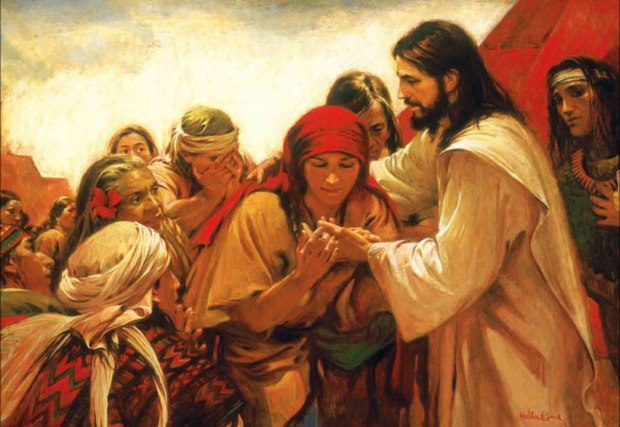
While many are quick to emphasize Jesus’ humility and modeling of submissive service, what’s often missed is how the washing of His disciples’ feet clinched the founding of His community. Backtrack to v. 3 and we find our first sign of evidence: Jesus knew the Father had given all things into His hands and that He had come from God and was going back to God. This is the real reason why Jesus took the towel5 – to not only achieve a timely metaphor, but to unveil a central commandment (i.e. ‘love one another’) that would soon become the cornerstone of Christianity.

basin-towel1

Remember up until their feet were washed, the disciples were followers, but not a following of disciple-makers. When Peter didn’t want Jesus to wash His feet, Jesus said, ‘If I do not wash you, you have no part with me‘. Why? Because love through serving was the foundation Jesus was laying. In other words, Jesus knew convicting Peter to helplessness would open him up to radical dependence. We see this instantly when Peter replies, ‘Lord, not my feet only but also my hands and my head‘. Yet, even at the utter of this imperative, little did Peter realize this act of total dependence would result in radical freedom, a newness of life where he could experience life as a new human serving and loving.

As Peter discovered, the implications of this reality, specifically how we do church, is huge. In a world screaming ‘make your life count’, it’s worth noting the early church would not have understood such dogma. To them, one didn’t try to make a difference, but rather let their love through service be the difference. As such, having embraced their identity as a resurrection community – a community who loves and serves in the moment – their operation as the new humanity would ultimately revolutionize arguably the world’s greatest superpower in history.

Bottom line: What Jesus did in John 13 went far beyond washing a few stinky feet.

Rather by exchanging outer garment for towel


  1. He revealed what resurrection community would soon look like – a ‘walk in the Spirit’, ‘serve your spouse, forgive your brother, love your enemy’ way of living far contrary to the ‘life, liberty, and the pursuit of happiness’ lifestyle we know today.
  2. He connected repentance to not only being transformed by the renewal of our minds (Romans 12:2), but also celebrating our helplessness, dependence, and freedom to be a John 13:35 community so, “by this all people will know that [we are His] disciples, [by our] love for one another.”
  3. He redefined church as a body of believers becoming the colony of heaven on earth by living in the Spirit (i.e. daily dying and rising with Christ).

Selah.

Prayer:

Footnotes

  1. As would soon emerge through the Holy Spirit
  2. Not to suggest we don’t prioritize evangelism; after all, the Holy Spirit’s coming was so we could be empowered to be Christ’s witnesses.
  3. Remember after Christ’s resurrection, Jesus not only prepared a community the Holy Spirit would eventually come upon in Acts 2, but also a unified body transformed by Christ’s love as a testament to God’s existence.
  4. Inspired by Messenger Fellowship’s ‘Being the Community of Jesus’ module.
  5. Side note: I love how this moment captures Christ’s baptism and brings it full circle (more on this in a future post).
Photo creds: Highland Park United Methodist Church
*Content inspired by Messenger Fellowship’s ordination course*




Repeat the Sounding Joy

So a few weeks ago I’m walkin’ to work basking in the joy of winter actually feeling like winter when out of the corner of my ear, I hear ‘Joy to the World’ playing from a nearby corner street music station. At first, I’m like, ‘December is over. No more Christmas music!’ But almost instantly I hear that still, small voice whispering…

…‘But Cam. Why not repeat the sounding joy?’

*Holy Spirit mic drop*

giphy

Of course, what can I say, but admit the truth…

…that notes and lyrics that seem out of place by cultural timelines should always be in place by daily surrender.

Among all the reasons Isaac Watts wrote the song, perhaps this in light of the cross’ power is the greatest key to his interpretation of Genesis 3:17-18, Psalm 96:11-12, and Psalm 98Âč.

Of course, I could dive into a deeper analysis of the carol’s Scriptural inspirations (I may come back to this Christmas 2019). For now, understand there’s a reason why certain Christmas songs like, ‘Deck the Halls’ and ‘Joy to the World’ are the only ones that can cure my little Everly’s sadness. Seriously, Caeden (who just turned three) will start singing his ‘Fa, la, la, la’s’
and even if it’s a few minutes, all is calm, all is bright in the world.

*Note: You don’t need kids to extrapolate this example into your own life*

Bottom line: As you walk with God, receive the practical, prudent reminders of His goodness, peace, and joy even they momentarily disagree with the senses.

Footnotes

  1. Speaking of the latter, it’s interesting to note how he incorporated the passage into his song. As history shows, after Watt’s father challenged Isaac to write contrarian to his contemporaries, Watts started to pursue lyrics that not only exalted Christ, but also reminded Christians of their hope in his saving work on the cross. Clearly, this desire is evident in the way he wrote “Joy to the World” with Psalm 98:4 driving the song’s legacy home:


“Make a joyful noise to the LORD, all the earth; break forth into joyous song and sing praises!” And this is exactly what Watts set out to do. Little did he know that this song would spark a joyful noise that would ring through the ages.”


3 More Things I’m [Really] Sorry For

If you’re like me, you like to reflect.

So much to say, so much to do
how can either happen when there’s so much to think.

Yet, as we journey another January, the heart behind this series, as made known last year, is still the same:

If we want to think right, then we must get right, if we want to get right, then we must get real…and if we want to get real, we must value cleanse before change.

Not to suggest such internal inventory is easy. Certainly putting all things on the table for examination requires courage, humility, vulnerability
among other things; however, since my goal with these posts is to help us embrace God’s ‘next’, it only makes sense to pray into the substitutionsÂč God has for us.

That said, here are three things I’m owning as we turn the page to 2019


1) Making sense of my surroundings

It’s remarkable the ways we justify our surroundings. I know for me, whenever I find myself in what I can’t explain, living in the moment can almost seem secondary to knowing why it has to exist. ‘If only I can solve the mystery, perhaps then I can find the satisfaction and peace I crave,’ I sometimes think.

But as we know, the journey of life is far from cut and dry. As much as we want to reconcile all our relationships and circumstances, we’ll never be able to given sin and free will’s response to it among other things.

Granted, God’s sovereignty isn’t confined by man’s weakness. But it’s also not restricted by our ability to ‘sherlock’ the past. And it’s this temptation I believe trips many of us up. We long to feel affirmed when we’re down. We yearn to feel validated when we smell injustice. We burn to make sense of our surroundings when they don’t make sense. Yet, in our quest to solve our voids, little do we realize the size of our ego and the numbing effect it has on our attitudes and heart postures.

It’s not always fun to accept, but the way I see it: Often the reason we are where we are is because God wants to help us find our kneel
to show us where our independencies have become idolatries
and to learn reliance within the unforced rhythms of grace. Perhaps you’ve struggled to grasp this feeling in seasons of idleness or stress
in settings where you felt more like a fish in an aquatic Pandora’s box.

If so, take a bite of my 2018 testimony. Our free will exists so we can choose Jesus to find freedom. No 12-step program full of striving. Just a simple decision to resist the fear of man and the impulse to make sense of our surroundings.

Accordingly, if you sense the temptation but not the exit, yield to surrender, voice the heartcry, and receive the serenity of stilled waters. God has not abandoned you, so don’t you abandon ship.

giphy

2) The Nazareth complex

I suppose this could be a subset of point #1, but the nature of this conviction alone is worth emphasizing.

As alluded to in my 2018 Year in Review post, when last year started, going back to The Gate was far from an option. Having phased out of LEGACYouth weeks prior, my hope had clung to a sunset narrative where my last days of youth ministry would coincide with where it took place. While there were many reasons I emotionally did not want to return, the core of my withdrawalÂČ centered on what I call the Nazareth complex.

The Nazareth complex is based out of Luke 4:14-30 when Jesus is driven out of his hometown (i.e. Nazareth) after revealing his true identity at the synagogue. While obviously I’m no Jesus, the personal correlation was this: Among whom whose eyes I had been under for years, there was no way for me to be known as God knew me. As such, what Nazareth was to Jesus, The Gate/local church was to me. To move on with my life, I had to leave the church to find anyone who not only would listen, but see me sans past and last name.

Of course, it’s safe to say Jesus never employed such a self-absorbed attitude. Still, it’s not hard to see why my deception took months to dissipate with resentment rooted in deception and victimization fixed in misapplied Scripture. To justify my isolated ego, I had to constantly cite the past, church gossip, unsurrendered soul/spirit hurts
even assumed vain assumptions (sounds confusing, but that’s unholy fear for you).

Yet, as the story goes, I eventually woke up, realizing if I truly wanted to move on and take hold of the new, I couldn’t keep holding on the way I had been. Six months later, the exchange is still ongoing…however, the door to freedom is much wider, in large part, to having repented of this complex.

tumblr_nikl8pxddz1tq4of6o1_5003) Financial fitness

For many couples, one spouse is the buyer, the other is the saver. In my relationship with Lyssah, the contrast is evident. While I’m a buyer who lives well within his means, Lys is much better at budgeting and sticking to it.

Ironically, you would never know by where our financial anxieties lie. As co-bread winners, to make ends meet, we both must work…whatever the cost with whatever time we can give. Unfortunately, the drive for excellence doesn’t always extinguish the entitlements and justifiers we use to buy (or even save for) momentary contentment/peace.

I know for me, I can only afford to invest so much as I near the end of paying off student loans. The white lie, then, is if I can’t currently invest as much as I want for my family, I should be frugal in my giving and employ generosity through alternative means. Yet, as I’ve been convicted, often my lack of giving ties to a lack of trust manifest as leverage against God for not opening certain doors. And I think for some of us, we forget withdrawing doesn’t just apply to our presence and/or banking transactions. It’s applies to trusting God with our finances
our energy
our time
not just what to sow, but where to sow and how much.

All that said, if you feel financial weak starting 2019, you’re not alone. Yeah, I’m an ex-Ramsey spouse. I have content, lessons, and principles I can pass down to future generations. But I also know


  • If I’m not maturing my stewardship, those values can only go so far.

  • If’ I’m not maturing my stewardship, my intentionality in inviting God into my budget will be compromised.

As for 2019, no longer will I reduce God to an on-call financial counselor and over-rely on my wife’s strengths to make up the difference. Rather, I’m going to pursue financial fitness, embrace frugality under the context of stewardship, and flex into shape accordingly.

Think of it this way: Even though money isn’t the end-all, be-all of extending God’s providence, in no way should we want God’s faithfulness to be restricted by what we’re not trusting Him in.

Besides if you’re reading this, chances are you have enough and know God as more than enough. Not do you have what it takes
but you can do this. Why not do it together?

giphy-1.gif

Selah.

Footnotes

  1. Where I’m letting go of a stronghold, sin, negative thought pattern, etc. to replace it with something better
  2. Albeit an indefinite sabbatical was necessary
Photo creds: https://buzzerg.com

Intentional to Be Intentional

Intentional.

We like to throw the word around, don’t we?

Granted, not intentionallyÂč, but enough we risk growing desensitized, even numb, to its mention.

Perhaps you’re like me wondering how to take not only your goal-setting, but your intentionality to the next level in 2019. If so, consider the following question:

‘How do we  become more intentional in our intentionality?’

For while most understand intentionality implies an upgrade in dedication…as being more mindful more often…not nearly as many see the term as anything more than the sum of its google definitions…
…which leads me to my first point.

Point 1: To embrace intentionality we must first see its core as covenantal commitment. For all you resolution setters out there, this is imperative to keep in mind. To achieve any goal with purpose, you must not only count the cost, but weigh it against an appointed strategy (more on this in a moment).

“For which of you, desiring to build a tower, does not first sit down and count the cost, whether he has enough to complete it?” ~ Luke 14:28 (ESV)

Furthermore, it’s worth noting whenever we appropriate a particular cost, we’re also considering the promises and blessings of God (see how God institutes his covenants with the patriachs in Genesis). As such, to be intentional is to examine the faithfulness of God in all three time dimensions (i.e. past, present, future).

tenor
Point 2: To embrace intentionality, we must view it as a relational/communal experience as opposed to individual effort. Like point 1, this concept is necessary both for pursuing the dreams/visions God plants as well as the sustaining of them.

Note how the Psalmist discerns God as one who delegates and journeys with us through the obedience…

“Behold, the eye of the Lord is upon those who fear Him [and worship Him with awe-inspired reverence and obedience], On those who hope [confidently] in His compassion and lovingkindness.” ~ Psalm 33:18 (AMP)

“Why are you in despair, O my soul? And why have you become restless and disturbed within me? Hope in God and wait expectantly for Him, for I shall again praise Him For the help of His presence? Why are you in despair, O my soul? Why have you become restless and disquieted within me? Hope in God and wait expectantly for Him, for I shall yet praise Him, The help of my countenance and my God.”” ~ Psalm 42:5,11 (AMP)

Put another way, whether God delegates an assignment or gives direction, He always offers the hope of experiencing Him in greater measure. Props to Webster, but unfortunately this something he missed in his dictionary.

Point 3: To embrace intentionality, we must understand our response to what God appoints and appropriates. For when God appoints, He is often granting fresh instruction and direction; however, when God appropriates, He is setting aside something for our possession that we already have.

Having said that, if you’re ever unsure what God is saying, always yield in surrender knowing God has anointed you to what He’s appointed you.

Ephesians 5:15-17 captures this beautifully in three simple words:  know His will.

“Look carefully then how you walk, not as unwise but as wise, making the best use of the time, because the days are evil.  Therefore do not be foolish, but understand what the will of the Lord is.” ~ Ephesians 5:15-17 (ESV)

A couple key nuggets from this passage…

1) Note how the context leading up to this passage centers on living on children of light and knowing what’s worth participating in. This is important to grasp as knowing our true identity (i.e. children of light) enables us to perceive our function/calling as an overflow/extension of that identity.

2) In verse 16, the Greek wording for ‘making the best’ means “buy up at the marketplace”, to see the opportunity as a commodity used by believers. This may sound strange at first; however, in the context of God’s evangelical economy, recognizing opportunity is crucial to valuing/seizing the time He’s given us.

With that in mind, we can better comprehend Paul’s charge at Ephesus, particularly the  transactional effects of Matthew 6:33 (which I submit is an underrated definition of intentionality)…

“But first and most importantly seek (aim at, strive after) His kingdom and His righteousness [His way of doing and being right—the attitude and character of God], and all these things will be given to you also.”

right-on-gif-7

Final Thoughts

  • While many of us like operating under the cover of ‘intentional’…in feeling secure in what we’re going after as opposed to being confident we’ll actually get there…true intentionality is never content on defining goals until it has established tactical strategies.
  • Intentionality is often received as a reactionary buzz word. If this truth resonates, we must re-evaluate our understanding of the term.
  • Often there’s a disconnect between what is good for us and what we want to be good for us. Accordingly, it should be no surprise if shallow convictions are met with shallow efforts. If we’re skeptical/indifferent concerning the sacrifice intentionality requires, we’ll be derailed by the facets of life that don’t cooperate amidst our pursuits.
  • Referencing the Lord with our intentions helps us know if God is in them. When we seek the Lord, not only must we seek with expectancy knowing He will answer, but also inquire how to integrate that answer into the priorities and commitments He’s already established/will continue to establish (see 2 Samuel 5 when David repeatedly references God in his tactical analysis). Remember in the realm of grace, there’s a natural rhythm embedded in the natural order of these priorities and commitments. Thus, by keeping God first, foremost, and center, we can know a higher level of intentionality with what He’s given us.

Selah.

Footnotes

  1. See what I did there? 😉
Cover photo creds: billiemakesahome.info


Year in Review: A Look Back at 2018

I’ll be honest


it’s hard to know how to process this year.

I mean…it’s not like things went according to plan
as if all my resolutions came to fruition; granted a lack of bucket list checks is nothing new in the history of late Decembers.

Still, as I look back on 2018, I can’t help but bask in awe. For while each year is its own journey, there are some more seismic, more catalytic in nature. To capture their magnitude? Nearly impossible. But to consecrate them into altars of gratitude? Now we’re talkin’.

Perhaps you’re wondering how you survived the year, hoping to find hidden truths between the lines months, or stressing about what next year will bring. If so, consider this simple year-in-review
a year that started in obscurity yet finished with a renewed embrace of it.

But where to begin. That is the question…

I suppose the best place to start is last Christmas when Everly Hope made her debut weeks after our last days in LEGACYouth and Ramsey Solutions.

While ushering in our new bundle of joy was certainly a lifetime highlight, it didn’t negate the fact going into 2018 was the meteorological equivalent of a clear, sunny day turned cold, freezing fog. So much of what we were used to was now lost in what we couldn’t see.

No more Wednesday morning devotions at work, no more co-workers and paycheck security (at least for Lys) no more sermon prepping, no more ministry on the go.

I remember a stretch in January I’d drive to work feeling all I had was daily bread and the world’s best family. I know, I know
this is [way] more than enough for the majority of the world’s population. I get that. I’m one blessed man; let the record stand.

However, as an exposed man realizing how much identity he had put in what he put out (i.e. how much personal worth he had assigned to ministry), no longer could I reconcile the sum of what I had versus what I didn’t have.

Lost in ego, it became quite clear the sabbatical God called Lys and I to when 2018 started was going to go much deeper than the average church break. I needed to find myself seek Jesus, embrace the words I’d been preaching for years, and let the tables turn.

And so it began, this foreign survey into various liturgies and doxologies, each Sunday a chance to learn something new about my local church. One step back, two steps forward. One step back, two steps forward. Never before has being a complete stranger, especially in church community, been so exciting yet awkward at the same time. Timely words pitted against uncertainty, a functioning compass that felt broken more often than not
this was my reality heading into late June.

Halftime Musings: https://hisgirlfryday.com/2018/06/28/halftime-a-musing-on-life-in-2018/

But to God’s credit, with assists from Jamie George and several Messenger colleagues, the heart, though bruised, kept rhythm. Yes, I missed LEGACYouth. Yes, I missed having a ministerial outlet where I could justify my day job by what I did outside it. But somehow, I was able to catch the bigger picture. God was not only after my heart, but my independence.

By time July arrived, the stage was set. All I had to do was keep my ears open.

Of course, you may know what happens next. If not, I’ll let this post do the talking:

Begin Again: https://hisgirlfryday.com/2018/09/06/begin-again/

In hindsight, it’s interesting to see the progression between late June and early September. As my harshest critic, accept my word when I say what God did during this time was nothing less than a minor miracle.

And yeah, I get a return to your home church isn’t exactly a $1,000 check in the mail or an ailment being instantly healed. At the same time, I think anytime a certain amount of pain, regardless its form, is supernaturally conquered, it must find anchor in testimony.

In my case, I went back to places of untended hurt, having previously hoped the end of LEGACYouth would be the end of them. After surrendering the ‘sail into sunset’ narrative for a ‘look what I will do in Act 2’ declaration, I finally did what I should have done years ago: I traded the vain imaginations, the depressive thoughts, the hopeless medications in for a buy-in into God’s plan of restoration. Whatever happened in ‘Act 1’ had to be released. Thanks to divine grace and that ever pestering still small voice, I was able to let go like never before.

And wouldn’t you know it
as all this was happening
ten years of on and off stomach ulcer-like symptoms vanished. It’s almost like God was giving me a head start into the fall (i.e. ‘You commit to this, I’ll heal you of your depression!’ And boom! It happened. Unexplainable, indescribable…yet unsurprising. A recipe for knowing where God is.

At any rate, while much happened this year behind closed doors, at times underground, no question there were many seeds planted that have taken root and will sprout in years to come.

As for what happened elsewhere, I’ll let the video and Q&A segment below take it from here.


When you think back on 2018, what immediately comes to mind?

CF: “Begin Again. The official battle-cry proclamation of 2018. Victory, repaved foundations, fresh trust in the Lord…quite a bit actually.

LF: “Change and transition. I felt the whole year was shifting sands. New baby, new career, new challenges. Concerning the latter, while we overcame and succeeded most of them, perhaps none was bigger than replacing my income as a stay-at-home virtual assistant with Everly in the fold. Despite all we’ve been tackling, we’ve been tackling them as a team. We’re ending the year on a totally different level.”

29543203_10100994902524502_228109258005018861_n.jpg

What were some of the highlights/defining moments?

CF: “Conquering anxiety. The physical effects of my depression being healed. Our story in going back to The Gate. That late summer stretch was memorable on multiple fronts. Interesting to note in past Q&A’s, the answers to this question often featured events and travels, but this was a year that required a sabbatical and less mobility as part of its narrative.  As such, while our yieldedness felt more grounded at times, I think it ultimately helped establish the undercurrents that would go on to define the year. On a more secondary note, building the bridge between His Girl Fryday and Fry Freelance has been an exciting, though at times humbling, experience.”

45275148_957180197800180_4895243543175495680_n.jpg

LF: “Landing my clients. Seeing God come through in this way was truly amazing. Knocking out the postpartum much quicker this go-around. Embracing the overall momentum that came with accepting the children’s pastoral role at The Gate. Learning a new rhythm without feeling I’m just surviving was defining in itself.”

How would you compare this year of marriage to the past years?

CF: “We have a more well-rounded idea of what intimacy is. In recent years, we’ve seen our communication tighten, but this year, I feel our desire to be on the same page is greater than ever. We’re not just picking and choosing how we want to be close. I suppose the type of troubleshooting and hurdle-clearing we’ve had to do this year is a major reason why.”

38492189_10101079794709882_4687997494104162304_o.jpg

LF: “This year has been more real. To end it on a high note, after so much transition…that says a lot. We’ve had some of our most intense discussions this year, but they brought us closer while pushing us towards growth and deeper connection. We’re getting better at being intentional. This was a ‘make or break’ year and while it wasn’t always pretty, we’re coming out stronger.” 

What lesson from 2018 are you eager to apply in 2019?

CF: “The relationship between dependence and satisfaction in the Lord. While we know we have every reason to trust God, He never stops pursuing our reliance and purifying our sense of worth. Furthermore, I better understand the connection between abiding in peace and not needing to make sense of my surroundings. I’m considerably more content in obeying without the entitlement of knowing why. In a way, I feel I have built-in relief for 2019 based on what God has taught me this year. One more lesson…sometimes, the dreams we think are dead are just dormant instead.”

32819541_10101028878860652_3738945386820141056_n.jpg

LF: “I’ve learned so much about grace, the kind that propels you to keep going. This year we’ve oscillated being being intentional and reactionary. Going into 2019, my heart and focus is on being more intentional as a function of overflow. That’s the word buzzing in my heart right now. I yearn to overflow as I surrender security and self-preservation and engage worship in all aspects of life. Given my belief in 2019 being more addition by multiplication, how we overflow is going to go a long way in how we mature as givers.”

What do you hope you’ll be saying at this time next year?

CF: “We’ve broadened our voice. We‘re working from home. We’re better stewards of what we’ve been given. We took the next steps of intentionality across the board…and are closer to God and each other because of it.”

LF: “#Livingourbestlife. We invested in what matters. We traveled more and were able to expose the kids to more outside of themselves. I reached my goal weight having hit the halfway point the year before.”

696A0366.jpg

Peace to the journey that is 2019…

~ Cameron & Lyssah Fry