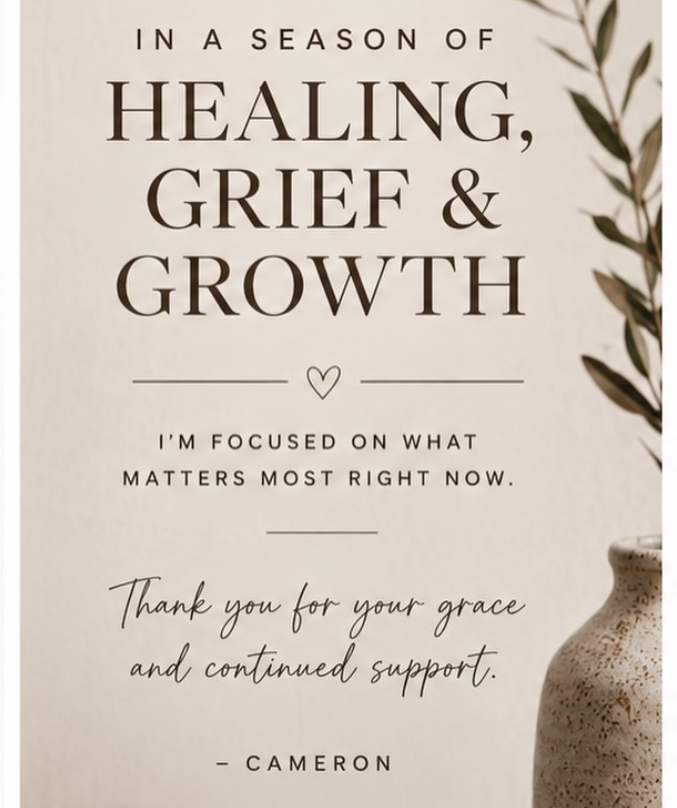
There are seasons when words flow freely—and seasons when they don’t.
This is one of those seasons for me.
If you’ve noticed fewer blog posts or podcast episodes, I want to offer a simple and honest update about why. Not as an exhaustive explanation of everything happening in my life, but as a way of being transparent with this community I deeply value.
Since December, I’ve been engaged in counseling and therapy at The Refuge Center. This has been an important part of my ongoing healing journey as I continue to process past trauma and pursue greater wholeness. It is steady, intentional work that requires time, honesty, and emotional presence.
In February, I entered the editing phase of Jubilee’s book while also starting her nonprofit (more details to come). These are sacred responsibilities to me, and they deserve thoughtful attention as these efforts begin to lift off the ground.
In March, I stepped into a new Accounting Manager role with Rural Health Redesign Center. It has been a meaningful professional transition, but also one that requires focus and adjustment as I learn new rhythms and responsibilities. Around the same time, I began a two-month mental health evaluation as part of Vanderbilt’s VUMC Studyfinder program, which confirmed my ASD diagnosis earlier this month.
Alongside these transitions, my roles at The Gate Church and Messenger Fellowship have also shifted. Instead of focusing on admin and tech support, I’m beginning to move more into my wheelhouse—spiritual formation and education. This work has been deeply life-giving, though more inward-facing.
Most importantly, I’m doing my best to be fully present for my kids and support them as they finish their school semesters strong. That responsibility remains one of my highest priorities.
All of these pieces together have created a season in which I simply do not have the same capacity for consistent blogging and podcasting as before.
This is not a step away from this space, but rather a recognition of the season I am currently in.
I still believe in the value of storytelling, reflection, and honest conversation. I still care deeply about this community. And when the time and capacity return, I look forward to engaging more regularly again.
For now, I’m grateful for your patience, your understanding, and your continued presence here.
When the world is at war—especially during a conflict you disagree with—it can leave you feeling conflicted about how to even approach God. Do you pray for peace? For justice? For protection?
What if you are no longer entirely sure what the “right” outcome is supposed to look like?
And perhaps even more unsettling: What happens when you are no longer fully confident your own perspective is entirely right either?
If that is where you find yourself, you are not alone.
One of the comforting realities of Scripture is that the Bible makes room for this kind of tension. It gives language to grief, uncertainty, confusion, and even disagreement while still drawing us toward prayer instead of away from it.
So, what does it look like to process war faithfully?
First, it starts with honesty, raw as it may be.
One of the greatest misconceptions about prayer is that we are supposed to sound composed and certain before approaching God. Yet throughout Scripture, we see the opposite. The Psalms are filled with unresolved prayers from people who were hurting, confused, and desperate for understanding:
“How long, Lord? Will you forget me forever?” (Psalm 13:1)
There is nothing polished about that prayer. It is emotional. Unfiltered. Human. And maybe that is the point.
When violence unfolds across the world and everything feels heavy or deeply wrong, we do not have to sanitize those emotions before bringing them to God. We can pray honestly:
“God, this does not make sense.”
“I do not understand why this is happening.”
“This feels heartbreaking.”
Lament is not the absence of faith; it is faith refusing to disengage. At the same time, Scripture continually redirects our attention away from political positions and back toward people—an increasingly difficult thing in an age where outrage spreads faster than empathy.
In 1 Timothy 2:1, Paul urges believers to pray “for all people.” Not merely the people we agree with. All people.
That includes civilians caught in the middle of conflict, families grieving unimaginable loss, children living in fear, and even soldiers on opposing sides of war.
It is possible to care deeply about human suffering without endorsing every action tied to it. Prayer allows us to hold that tension without surrendering compassion. And perhaps that matters more than we realize because prolonged conflict has a way of hardening people if they are not careful.
Jesus said, “Blessed are the peacemakers, for they will be called children of God” (Matthew 5:9). Peace in Scripture is not passive sentimentality. It is something God values deeply.
Praying for peace may feel unrealistic in the middle of war, but it is not naive. If anything, it is resistance against the belief that destruction and violence are inevitable.
Sometimes our prayers are simple:
“God, interrupt cycles of violence.”
“Bring de-escalation where tensions are rising.”
“Raise up leaders who value wisdom over power.”
Even when we cannot envision peace ourselves, prayer aligns our hearts with the heart of God.
But Scripture also makes clear that justice matters deeply to Him.
Micah 6:8 reminds us to “act justly, love mercy, and walk humbly with your God.” I think it is significant that mercy and humility remain attached to justice in that verse because, especially during war, the desire for justice can slowly transform into bitterness, vengeance, or hatred if we are not careful.
Prayer has a way of exposing that shift before it consumes us.
We can ask God to defend the vulnerable, bring truth into the light, and hold powerful people accountable while simultaneously asking Him to protect our hearts from becoming hardened in the process.
Because if we are not careful, we can become so consumed with winning arguments that we forget the humanity of the people suffering underneath them.
Which brings me to arguably one of the hardest parts of all: praying for leaders.
Scripture instructs believers to pray “for kings and all those in authority” (1 Timothy 2:2), even when we strongly disagree with them.
That does not mean endorsing every decision they make. It means recognizing that no earthly authority exists outside God’s awareness and asking Him to intervene where human wisdom falls short.
Sometimes those prayers sound like:
“Give them wisdom they do not currently have.”
“Surround them with truth instead of ego.”
“Restrain decisions that would bring unnecessary harm.”
Other times, all we can bring before God is confusion.
Romans 8:26 says, “We do not know what we ought to pray for, but the Spirit himself intercedes for us.” I love that verse because it reminds us that prayer does not require perfect clarity.
Sometimes faithfulness simply sounds like:
“God, I feel torn.”
“I do not know what the right outcome is.”
“Help me not grow numb to suffering.”
God is not waiting for us to say everything perfectly before He listens. He meets us honestly in uncertainty.
And maybe that is one of the hidden invitations within prayer itself: not merely to ask God to change the world around us, but to let Him change what is happening within us too.
Because over time, prayer has a way of softening us instead of hardening us. It makes us more compassionate instead of more reactive, more humble instead of more certain.
As James 3:17 describes wisdom from heaven is “peace-loving, considerate, full of mercy.”
You do not have to solve the world’s problems to pray faithfully in the middle of them. You simply have to show up honestly and trust that God meets you there.
As more companies return to hybrid or fully onsite work, I keep coming back to a simple question: If we’re asking people to be physically present again…what are we actually using that presence for?
We can’t rewind to pre-pandemic. Work changed. People changed. Expectations around flexibility, productivity, and trust changed. And for many employees, performance didn’t drop when they left the office—it actually improved.
So, when organizations decide that onsite time should increase, the “why” matters more than ever. It can’t just be about proximity for proximity’s sake or leaders feeling secure within their control.
If people are commuting in, that time should feel different—not just a change of scenery from remote work. It should be where in-person presence adds something you can’t get through a screen:
Faster collaboration and real-time problem solving
Deeper mentorship and coaching moments
Relationship-building that strengthens trust
Decisions that benefit from shared context and energy
Otherwise, employees start asking a fair question: What’s the point of being here?
And honestly, that’s where a lot of friction shows up—not in the requirement itself, but in the lack of clarity and communication. around it.
Most people aren’t anti-office. They’re anti-wasted-office-time.
They don’t mind coming in when it’s useful, engaging, or meaningful. What frustrates them is showing up to sit on video calls all day, doing the exact same work they could have done remotely—just with a commute added on top. That’s not collaboration. That’s relocation.
Thus, if we’re going to bring people back in more consistently, maybe the better conversation isn’t how often, but how intentionally.
Because proximity, when used well, is powerful. It accelerates ideas. It strengthens relationships. It builds momentum. But when used poorly, it just feels like distance with extra steps.
There is a quiet but intense pain that comes not from judgment, but from neglect. You confess, open up, step into the light…and for reasons unknown, the other side withdraws.
What does Scripture say about this scenario?
First, the Bible consistently honors confession. “Confess your sins [offenses, insecurities] to one another and pray for one another, that you may be healed” (James 5:16). Confession is not weakness; it is courageous obedience, an expression of virtue rooted in trust both in God and in the community of believers.
But what happens when that trust is not reciprocated?
While the Bible calls believers to bear one another’s burdens (Galatians 6:2), it also prepares us for a sobering reality – not everyone will respond with grace or remain engaged in it. Even within communities of faith, people can fail to reflect Christ’s compassion. Some withdraw out of discomfort. Others stay distant, bypassing love in the name of self-preservation, passive-aggressive retaliation, or simply making a point.
Yet, Scripture gently redirects our expectations: “It is better to take refuge in the Lord than to trust in man” (Psalm 118:8). This is not a call to isolation – but recalibration. While human relationships are imperfect vessels, God alone is absolute and constant.
Consider this: Your confession was never ultimately for them but before God. As hurtful as silence can be, a widening of detachment does not invalidate your obedience, minimize your need for wisdom and encouragement, or erase your healing.
In fact, Jesus Himself experienced relational abandonment in moments of deepest vulnerability. In Gethsemane, His closest friends slept. At the cross, many fled. Some even mocked. Yet, He remained anchored in the Father’s will, not human consistency.
So, what do you do with the ache?
You grieve it honestly. You resist the urge to harden your heart. And you keep pursuing authentic community – because while some may fail you, others will reflect the grace you hoped for.
Put another way…
Being neglected after confession does not mean you chose the wrong path; it just means you chose the narrow one.
My charge to you, my friends, is simple: Keep going, pray for the ghosting orbiters who have strayed, and stay true to God’s path knowing you’re never alone from where it matters most.
I’m cruising at 31,000 feet, overlooking the spine of the Appalachians. Heaven knows I’m still stunned by this career page turn – relieved and excited as I may be.
Am I anxious? Sure. After all, this is only my second week at a new job, with many faces to meet and much to learn. At the same time, I’m reminded of why I’m in this situation – and, in four words, why any of us are here at all:
The joy set before.
For some of us, we read these words and instantly think of Hebrews 12:2: “Looking to Jesus, the founder and perfecter of our faith, who for the joy that was set before him endured the cross, despising the shame, and is seated at the right hand of the throne of God.”
Fair enough as apart from foreshadowing samples in Psalm 16 and Psalm 110, this is the only direct mention of the phrase in Scripture.
Still, we must be careful with context. For instance, as a younger Christian, I often misinterpreted this passage, thinking the cross – the fruit of Christ’s mission – was the joy set before Him; however, as I now understand, the joy set before Christ was exaltation with the Father in the presence of a redeemed people.
You see, the ultimate sacrifice – the necessity of reconciliation – is only half the story. The other half is the eternal invitation we have with God, in the presence of Jesus, who endured the cross as a prerequisite.
Accordingly, the joy set before us should not be limited to our sins being atoned for but should extend to thy Kingdom come on earth as it is in heaven. Understandably, there is a temptation to base Easter joy primarily on the freedom we have in Christ because of His death and resurrection. Yet, if we are to grow into the likeness of Christ – if we desire to deepen our gratitude for that freedom – we must celebrate where it ultimately leads: the throne room where Jesus resides today and will forever.
What about the part where we “despise the shame” of the cross?
Again, referencing Hebrews 12, we find the answer. Christ did not detest Calvary but rather anything that threatened the joy of redemption – the public humiliation, disgrace, and intense suffering of crucifixion. In full submission to His mission, Jesus never faltered in obedience to the Father or in the intimacy that obedience required. In all He accomplished – in heart and in word – Jesus not only kept joy at the center of His hope but expressed love as the currency of every cost He counted.
Even as a child, Jesus knew where He was going. Unlike most journeys with a fixed endpoint, Christ’s destination was less static and more perpetual, saving those He loved and sanctifying them from His Father’s right hand. In essence, the joy set before Christ was His Father’s house: a dwelling from which He could save from an exalted place, draw near to the brokenhearted, and prepare a place for them.
Yes, Jesus anticipated completion (i.e., “It is finished”), but what He truly desired was to give people the opportunity to experience what He knew – to invite them into a place where pain and strife fade into glory.
My question to you, my friends, is simple: Is joy set before you? If not, what is? What is driving you, calling you, fueling your purpose?
Whatever your answers, let the cross be a prompt to recalibrate your perspective – your heart, and all the aims and burdens you carry. Do not let them drift. Instead, let them compel you to look to Jesus, not just as the founder of your faith, but as the restorer of your faith, who purifies your sin and shame, from where joy was, and still is, set before you.